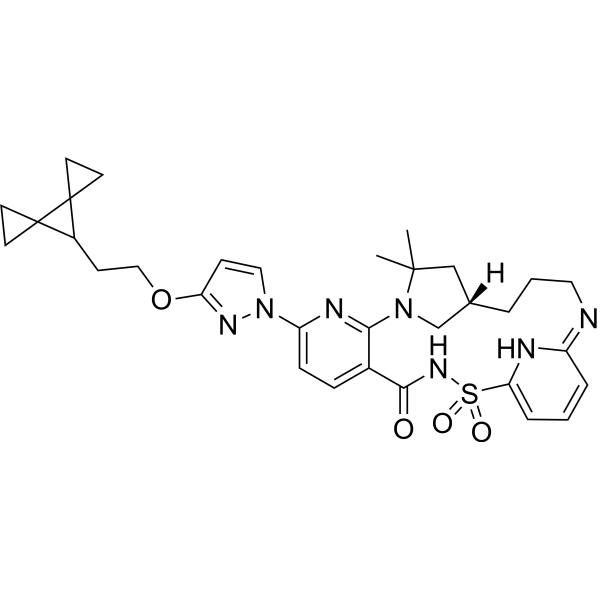
Physicochemical Properties
| Molecular Formula | C32H39N7O4S |
| Molecular Weight | 617.76 |
| Exact Mass | 617.278 |
| Elemental Analysis | C, 62.74; H, 6.54; N, 15.52; O, 10.13; S, 5.07 |
| CAS # | 2374124-49-7 |
| Related CAS # | 2374124-48-6 |
| PubChem CID | 139399801 |
| Appearance | Off-white to light yellow solid powder |
| LogP | 5.7 |
| Hydrogen Bond Donor Count | 2 |
| Hydrogen Bond Acceptor Count | 9 |
| Rotatable Bond Count | 5 |
| Heavy Atom Count | 44 |
| Complexity | 1200 |
| Defined Atom Stereocenter Count | 1 |
| SMILES | S1(=O)(=O)C2N3N1C(=O)C1=CC=C(N4C=CC(OCCC5C6(CC6)C65CC6)=N4)N=C1N1C[C@@]([H])(CCCNC3C=CC=2)CC1(C)C |
| InChi Key | VCSUIBJKYCVWNF-NRFANRHFSA-N |
| InChi Code | InChI=1S/C32H39N7O4S/c1-30(2)19-21-5-4-16-33-24-6-3-7-27(34-24)44(41,42)37-29(40)22-8-9-25(35-28(22)38(30)20-21)39-17-10-26(36-39)43-18-11-23-31(12-13-31)32(23)14-15-32/h3,6-10,17,21,23H,4-5,11-16,18-20H2,1-2H3,(H,33,34)(H,37,40)/t21-/m0/s1 |
| Chemical Name | (14S)-8-[3-(2-dispiro[2.0.24.13]heptan-7-ylethoxy)pyrazol-1-yl]-12,12-dimethyl-2,2-dioxo-2λ6-thia-3,9,11,18,23-pentazatetracyclo[17.3.1.111,14.05,10]tetracosa-1(22),5(10),6,8,19(23),20-hexaen-4-one |
| Synonyms | Vanzacaftor; 2374124-49-7; Vanzacaftor [INN]; COM1POP492; VX-121; |
| HS Tariff Code | 2934.99.9001 |
| Storage |
Powder-20°C 3 years 4°C 2 years In solvent -80°C 6 months -20°C 1 month |
| Shipping Condition | Room temperature (This product is stable at ambient temperature for a few days during ordinary shipping and time spent in Customs) |
Biological Activity
| Targets | CFTR/cystic fibrosis transmembrane conductance regulator |
| ln Vitro | The transport of charged ions across cell membranes is normally achieved through the actions of the cystic fibrosis transmembrane regulator (CFTR) protein. This protein acts as a channel and allows for the passage of chloride and sodium. This process affects the movement of water in and out of the tissues and impacts the production of mucus that lubricates and protects certain organs and body tissues, including the lungs. In the _F508del_ mutation of the CFTR gene, one amino acid is deleted at the position 508, therefore, the CFTR channel function is compromised, resulting in thickened mucus secretions. Vanzacaftor is a CFTR corrector that aims to repair mutant CFTR cellular misprocessing. This is done by modulating the position of the mutant CFTR protein on the cell surface to the correct position, allowing for adequate ion channel formation and increased in water and salt movement through the cell membrane. Vanzacaftor binds to a different site on the CFTR protein than [tezacaftor], with which it is co-administered, resulting in an additive effect in facilitating the cellular processing and trafficking of mutant CFTR compared to either agent alone. |
| ln Vivo | Vanzacaftor exerts its therapeutic effects by facilitating the expression CFTR on the cell surface. In patients with mutations responsive to Alyftrek (vanzacaftor, tezacaftor, and deutivacaftor), the mean absolute change in sweat chloride through 24 weeks of treatment was -2.4 to -8.6 mmol/L. |
| ADME/Pharmacokinetics |
Absorption At steady-state, typically achieved within 20 days, the Cmax and AUC0-24h of vanzacaftor are 0.812 mcg/mL and 18.6 mcg.h/mL, respectively. The Tmax of vanzcaftor occurs approximately 7.8 hours following administration. Administration with a low- or high-fat meal results in an AUCinf increase of 4- to 6-fold, respectively. Route of Elimination Approximately 91.6% of an administered radiolabeled dose of vanzacaftor is excreted in feces, primarily as metabolites. Approximately 0.5% is excreted in the urine. Volume of Distribution The apparent volume of distribution of vanzacaftor is 121 L. Clearance The apparent clearance of vanzacaftor is 1.34 L/h. Protein Binding Vanzacaftor is >99% protein-bound in plasma, primarily to albumin and alpha 1-acid glycoprotein. Metabolism / Metabolites Vanzacaftor is primarily metabolized by CYP3A4 and CYP3A5. It does not produce any active metabolites. Biological Half-Life The effective half-life of vanzacaftor is 92.8 hours. |
| Toxicity/Toxicokinetics |
In study VX18-561-101, participants treated with deutivacaftor 150 mg once daily (n=23) or deutivacaftor 250 mg once daily (n=24) had mean absolute changes in ppFEV1 of 3·1 percentage points (95% CI -0·8 to 7·0) and 2·7 percentage points (-1·0 to 6·5) from baseline at week 12, respectively, versus -0·8 percentage points (-6·2 to 4·7) with ivacaftor 150 mg every 12 h (n=11); the deutivacaftor safety profile was consistent with the established safety profile of ivacaftor 150 mg every 12 h. In study VX18-121-101, participants with F/MF genotypes treated with vanzacaftor (5 mg)-tezacaftor-deutivacaftor (n=9), vanzacaftor (10 mg)-tezacaftor-deutivacaftor (n=19), vanzacaftor (20 mg)-tezacaftor-deutivacaftor (n=20), and placebo (n=10) had mean changes relative to baseline at day 29 in ppFEV1 of 4·6 percentage points (-1·3 to 10·6), 14·2 percentage points (10·0 to 18·4), 9·8 percentage points (5·7 to 13·8), and 1·9 percentage points (-4·1 to 8·0), respectively, in sweat chloride concentration of -42·8 mmol/L (-51·7 to -34·0), -45·8 mmol/L (95% CI -51·9 to -39·7), -49·5 mmol/L (-55·9 to -43·1), and 2·3 mmol/L (-7·0 to 11·6), respectively, and in CFQ-R respiratory domain score of 17·6 points (3·5 to 31·6), 21·2 points (11·9 to 30·6), 29·8 points (21·0 to 38·7), and 3·3 points (-10·1 to 16·6), respectively. Participants with the F/F genotype treated with vanzacaftor (20 mg)-tezacaftor-deutivacaftor (n=18) and tezacaftor-ivacaftor (n=10) had mean changes relative to baseline (taking tezacaftor-ivacaftor) at day 29 in ppFEV1 of 15·9 percentage points (11·3 to 20·6) and -0·1 percentage points (-6·4 to 6·1), respectively, in sweat chloride concentration of -45·5 mmol/L (-49·7 to -41·3) and -2·6 mmol/L (-8·2 to 3·1), respectively, and in CFQ-R respiratory domain score of 19·4 points (95% CI 10·5 to 28·3) and -5·0 points (-16·9 to 7·0), respectively. The most common adverse events overall were cough, increased sputum, and headache. One participant in the vanzacaftor-tezacaftor-deutivacaftor group had a serious adverse event of infective pulmonary exacerbation and another participant had a serious rash event that led to treatment discontinuation. For most participants, adverse events were mild or moderate in severity. [1]
Cystic fibrosis results from mutations in the cystic fibrosis transmembrane conductance regulator (CFTR) anion channel, ultimately leading to diminished transepithelial anion secretion and mucociliary clearance. CFTR correctors are therapeutics that restore the folding/trafficking of mutated CFTR to the plasma membrane. The large-conductance calcium-activated potassium channel (BKCa, KCa1.1) is also critical for maintaining lung airway surface liquid (ASL) volume. Here, we show that the class 2 (C2) CFTR corrector VX-445 (elexacaftor) induces K+ secretion across WT and F508del CFTR primary human bronchial epithelial cells (HBEs), which was entirely inhibited by the BKCa antagonist paxilline. Similar results were observed with VX-121, a corrector under clinical evaluation. Whole-cell patch-clamp recordings verified that CFTR correctors potentiated BKCa activity from both primary HBEs and HEK cells stably expressing the α subunit (HEK-BK cells). Furthermore, excised patch-clamp recordings from HEK-BK cells verified direct action on the channel and demonstrated a significant increase in open probability. In mouse mesenteric artery, VX-445 induced a paxilline-sensitive vasorelaxation of preconstricted arteries. VX-445 also reduced firing frequency in primary rat hippocampal and cortical neurons. We raise the possibilities that C2 CFTR correctors gain additional clinical benefit by activation of BKCa in the lung yet may lead to adverse events through BKCa activation elsewhere.[2] |
| References |
[1]. Safety and efficacy of vanzacaftor-tezacaftor-deutivacaftor in adults with cystic fibrosis: randomised, double-blind, controlled, phase 2 trials. Lancet Respir Med. 2023 Jun;11(6):550-562. [2]. Potentiation of BKCa channels by cystic fibrosis transmembrane conductance regulator (CFTR) correctors VX-445 and VX-121. J Clin Invest. 2024 Jul 2:e176328. |
| Additional Infomation |
Vanzacaftor is a small molecule cystic fibrosis transmembrane conductance regulator (CFTR) corrector. It is used alongside other CFTR correctors and CFTR potentiators to increase the quantity and function of CFTR at the cell surface in patients with cystic fibrosis. Vanzacaftor was first approved by the US FDA in December 2024 in combination with another CFTR corrector - [tezacaftor], which binds to a different site than vanzacaftor - and [deutivacaftor], a CFTR potentiator, for the treatment of patients with responsive CFTR mutations.
DrugBank
VANZACAFTOR is a small molecule drug with a maximum clinical trial phase of IV (across all indications) that was first approved in 2024 and has 2 investigational indications.
This approval is based on the most comprehensive Phase 3 pivotal program ever conducted in CF, including more than 1,000 patients across more than 20 countries and more than 200 sites. These data were previously released at the conclusion of the studies and presented at the North American Cystic Fibrosis Conference in September of this year. The Phase 3 studies in people with CF ages 12 years and older met their primary endpoint (non-inferiority on absolute change from baseline in ppFEV1 compared to TRIKAFTA) and all key secondary endpoints (including absolute change from baseline in sweat chloride [SwCl] compared to TRIKAFTA). In the Phase 3 study of children with CF ages 6-11 years, ALYFTREK demonstrated safety, the primary endpoint. Secondary endpoints, such as absolute change from baseline in ppFEV1 and absolute change from baseline in SwCl, were presented, supporting the benefit of ALYFTREK in this age group. ALYFTREK was generally well tolerated across all studies. “In Phase 3 clinical trials, across a broad range of genotypes, once-daily ALYFTREK demonstrated non-inferiority to TRIKAFTA in ppFEV1 response and statistically significant improvement in SwCl, a welcomed advancement for the treatment of CF,” said Claire L. Keating, M.D., Co-Director of the Gunnar Esiason Adult Cystic Fibrosis and Lung Program at Columbia University and investigator in the ALYFTREK clinical trial program. “ALYFTREK has the potential to improve the care of patients with CF.” ALYFTREK is the first, once-daily CFTR modulator. In a recent survey, approximately 75% of physicians reported that more convenient dosing is a very high unmet need for people with CF. Specifically, people with CF will have the added benefit from a once-daily dosing regimen, given the need to take CFTR modulators with fat-containing food. ALYFTREK also offers a potentially transformative option for approximately 150 people with CF in the U.S. with one of 31 mutations who are now eligible for a CFTR modulator for the first time. ALYFTREK was also submitted to global health authorities and is under regulatory review in the European Union, the United Kingdom, Canada, Switzerland, Australia and New Zealand. |
Solubility Data
| Solubility (In Vitro) | May dissolve in DMSO (in most cases), if not, try other solvents such as H2O, Ethanol, or DMF with a minute amount of products to avoid loss of samples |
| Solubility (In Vivo) |
Note: Listed below are some common formulations that may be used to formulate products with low water solubility (e.g. < 1 mg/mL), you may test these formulations using a minute amount of products to avoid loss of samples. Injection Formulations (e.g. IP/IV/IM/SC) Injection Formulation 1: DMSO : Tween 80: Saline = 10 : 5 : 85 (i.e. 100 μL DMSO stock solution → 50 μL Tween 80 → 850 μL Saline) *Preparation of saline: Dissolve 0.9 g of sodium chloride in 100 mL ddH ₂ O to obtain a clear solution. Injection Formulation 2: DMSO : PEG300 :Tween 80 : Saline = 10 : 40 : 5 : 45 (i.e. 100 μL DMSO → 400 μLPEG300 → 50 μL Tween 80 → 450 μL Saline) Injection Formulation 3: DMSO : Corn oil = 10 : 90 (i.e. 100 μL DMSO → 900 μL Corn oil) Example: Take the Injection Formulation 3 (DMSO : Corn oil = 10 : 90) as an example, if 1 mL of 2.5 mg/mL working solution is to be prepared, you can take 100 μL 25 mg/mL DMSO stock solution and add to 900 μL corn oil, mix well to obtain a clear or suspension solution (2.5 mg/mL, ready for use in animals). Injection Formulation 4: DMSO : 20% SBE-β-CD in saline = 10 : 90 [i.e. 100 μL DMSO → 900 μL (20% SBE-β-CD in saline)] *Preparation of 20% SBE-β-CD in Saline (4°C,1 week): Dissolve 2 g SBE-β-CD in 10 mL saline to obtain a clear solution. Injection Formulation 5: 2-Hydroxypropyl-β-cyclodextrin : Saline = 50 : 50 (i.e. 500 μL 2-Hydroxypropyl-β-cyclodextrin → 500 μL Saline) Injection Formulation 6: DMSO : PEG300 : castor oil : Saline = 5 : 10 : 20 : 65 (i.e. 50 μL DMSO → 100 μLPEG300 → 200 μL castor oil → 650 μL Saline) Injection Formulation 7: Ethanol : Cremophor : Saline = 10: 10 : 80 (i.e. 100 μL Ethanol → 100 μL Cremophor → 800 μL Saline) Injection Formulation 8: Dissolve in Cremophor/Ethanol (50 : 50), then diluted by Saline Injection Formulation 9: EtOH : Corn oil = 10 : 90 (i.e. 100 μL EtOH → 900 μL Corn oil) Injection Formulation 10: EtOH : PEG300:Tween 80 : Saline = 10 : 40 : 5 : 45 (i.e. 100 μL EtOH → 400 μLPEG300 → 50 μL Tween 80 → 450 μL Saline) Oral Formulations Oral Formulation 1: Suspend in 0.5% CMC Na (carboxymethylcellulose sodium) Oral Formulation 2: Suspend in 0.5% Carboxymethyl cellulose Example: Take the Oral Formulation 1 (Suspend in 0.5% CMC Na) as an example, if 100 mL of 2.5 mg/mL working solution is to be prepared, you can first prepare 0.5% CMC Na solution by measuring 0.5 g CMC Na and dissolve it in 100 mL ddH2O to obtain a clear solution; then add 250 mg of the product to 100 mL 0.5% CMC Na solution, to make the suspension solution (2.5 mg/mL, ready for use in animals). Oral Formulation 3: Dissolved in PEG400 Oral Formulation 4: Suspend in 0.2% Carboxymethyl cellulose Oral Formulation 5: Dissolve in 0.25% Tween 80 and 0.5% Carboxymethyl cellulose Oral Formulation 6: Mixing with food powders Note: Please be aware that the above formulations are for reference only. InvivoChem strongly recommends customers to read literature methods/protocols carefully before determining which formulation you should use for in vivo studies, as different compounds have different solubility properties and have to be formulated differently. (Please use freshly prepared in vivo formulations for optimal results.) |
| Preparing Stock Solutions | 1 mg | 5 mg | 10 mg | |
| 1 mM | 1.6188 mL | 8.0938 mL | 16.1875 mL | |
| 5 mM | 0.3238 mL | 1.6188 mL | 3.2375 mL | |
| 10 mM | 0.1619 mL | 0.8094 mL | 1.6188 mL |