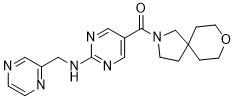
Vanin-1-IN-1 is a novel and potent inhibitor of vanin-1 enzyme, a cell surface associated, giycosyiphosphatidyS inositol (GPi) anchored protein which plays an important role in metabolism and inflammation.
Physicochemical Properties
| Molecular Formula | C18H22N6O2 |
| Molecular Weight | 354.406282901764 |
| Exact Mass | 354.18 |
| Elemental Analysis | C, 61.00 H, 6.26 N, 23.71 O, 9.03 |
| CAS # | 2173134-00-2 |
| PubChem CID | 134177597 |
| Appearance | White to off-white solid powder |
| LogP | 0 |
| Hydrogen Bond Donor Count | 1 |
| Hydrogen Bond Acceptor Count | 7 |
| Rotatable Bond Count | 4 |
| Heavy Atom Count | 26 |
| Complexity | 476 |
| Defined Atom Stereocenter Count | 0 |
| InChi Key | VGRLXWFIXGZRMS-UHFFFAOYSA-N |
| InChi Code | InChI=1S/C18H22N6O2/c25-16(24-6-1-18(13-24)2-7-26-8-3-18)14-9-21-17(22-10-14)23-12-15-11-19-4-5-20-15/h4-5,9-11H,1-3,6-8,12-13H2,(H,21,22,23) |
| Chemical Name | (2-((pyrazin-2-ylmethyl)amino)pyrimidin-5-yl)(8-oxa-2-azaspiro[4.5]decan-2-yl)methanone |
| Synonyms | Vanin-1-IN-1 Vanin-1IN-1 Vanin-1 IN-1 |
| HS Tariff Code | 2934.99.9001 |
| Storage |
Powder-20°C 3 years 4°C 2 years In solvent -80°C 6 months -20°C 1 month |
| Shipping Condition | Room temperature (This product is stable at ambient temperature for a few days during ordinary shipping and time spent in Customs) |
Biological Activity
| Targets |
Vanin-1-IN-1 targets Vanin-1 enzyme with an IC50 of 2.3 nM (recombinant human Vanin-1) [1] |
| ln Vitro |
Vanin-1-IN-1 (0.1 nM–50 nM) dose-dependently inhibited recombinant human Vanin-1 enzyme activity: 1 nM achieved 48% inhibition, 10 nM achieved 92% inhibition, and 50 nM maintained >95% inhibition [1] In human hepatocyte-like cells (HepG2) expressing Vanin-1, Vanin-1-IN-1 (1 nM–20 nM) dose-dependently reduced pantetheinase activity (Vanin-1 catalytic activity): 10 nM reduced pantetheinase activity by 76% compared to the control group [1] Vanin-1-IN-1 showed high selectivity for Vanin-1 over related enzymes (Vanin-2, Vanin-3): IC50 > 1000 nM for both Vanin-2 and Vanin-3 [1] At concentrations up to 100 nM, Vanin-1-IN-1 did not affect HepG2 cell viability (viability > 90%) as assessed by MTT assay [1] |
| Enzyme Assay |
Vanin-1 enzyme activity assay: Recombinant human Vanin-1 enzyme was incubated with Vanin-1-IN-1 (0.01 nM–1000 nM) in assay buffer containing pantetheine (substrate) and a colorimetric detection reagent. The reaction was carried out at 37°C for 60 minutes, and the absorbance of the reaction product (cysteamine-derived chromophore) was measured at 405 nm. Inhibition rates were calculated relative to the control group, and IC50 was obtained by fitting dose-response curves [1] Selectivity assay: The same enzyme activity assay protocol was used for recombinant human Vanin-2 and Vanin-3 enzymes, with Vanin-1-IN-1 concentrations up to 1000 nM to evaluate off-target inhibition [1] |
| Cell Assay |
Cellular Vanin-1 pantetheinase activity assay: HepG2 cells were seeded in 96-well plates (1 × 10⁴ cells/well) and cultured for 24 hours. Cells were treated with Vanin-1-IN-1 (1 nM–20 nM) for 4 hours, then incubated with pantetheine substrate and detection reagent at 37°C for 30 minutes. Absorbance at 405 nm was measured to quantify pantetheinase activity, and inhibition rates were calculated [1] Cell viability assay: HepG2 cells were seeded in 96-well plates (5 × 10³ cells/well) and treated with Vanin-1-IN-1 (0.1 nM–100 nM) for 72 hours. MTT reagent was added, and the plates were incubated for another 4 hours. Absorbance at 570 nm was measured to assess cell viability [1] |
| Animal Protocol |
Acute inflammation mouse model: 6–8 week-old C57BL/6 mice were intraperitoneally injected with lipopolysaccharide (LPS) to induce acute inflammation. One hour prior to LPS injection, mice were randomized into vehicle and Vanin-1-IN-1 treatment groups (5 mg/kg, 10 mg/kg, p.o., n=8/group). Vanin-1-IN-1 was dissolved in 0.5% hydroxypropyl methylcellulose (HPMC) solution. Mice were sacrificed 6 hours post-LPS injection, and liver tissues were collected to measure Vanin-1 enzyme activity and pro-inflammatory cytokine (TNFα, IL-6) levels [1] |
| ADME/Pharmacokinetics |
In Sprague-Dawley rats, oral administration of Vanin-1-IN-1 (20 mg/kg) showed a bioavailability (F) of 51%, blood drug peak concentration (Cmax) of 980 ng/mL, time to peak (Tmax) of 1.3 hours, and elimination half-life (t1/2) of 7.2 hours [1] In C57BL/6 mice, oral administration of Vanin-1-IN-1 (10 mg/kg) exhibited a Cmax of 650 ng/mL, Tmax of 1.0 hour, and volume of distribution (Vd) of 285 mL/kg [1] Vanin-1-IN-1 showed good stability in human liver microsomes (t1/2 = 8.7 hours) and mouse liver microsomes (t1/2 = 7.9 hours) [1] |
| Toxicity/Toxicokinetics |
Acute toxicity study in ICR mice: Oral administration of Vanin-1-IN-1 at doses up to 300 mg/kg did not cause mortality or obvious toxic symptoms (weight loss, diarrhea, behavioral abnormalities) within 14 days [1] Subchronic toxicity study in Sprague-Dawley rats (oral administration of 10 mg/kg, 30 mg/kg, 100 mg/kg daily for 28 days): No significant changes in body weight, hematological parameters (WBC, RBC, platelets), or biochemical parameters (ALT, AST, BUN, creatinine) were observed. Histopathological examination of liver, kidney, heart, and lung showed no drug-related lesions [1] |
| References |
[1]. Novel pyrimidine carboxamides as inhibitors of vanin-1 enzyme. WO2018011681A1. |
| Additional Infomation |
Vanin-1-IN-1 is a novel small-molecule inhibitor of Vanin-1 enzyme, belonging to the pyrimidine carboxamide class [1] Its mechanism of action involves selective inhibition of Vanin-1 pantetheinase activity, reducing the production of cysteamine (a pro-inflammatory mediator) and subsequent pro-inflammatory cytokine release [1] The compound is being developed for the potential treatment of Vanin-1-mediated inflammatory diseases, including acute inflammation, liver inflammation, and autoimmune disorders [1] Vanin-1-IN-1 exhibits favorable oral bioavailability, good metabolic stability, and low toxicity, supporting its potential clinical application [1] |
Solubility Data
| Solubility (In Vitro) | DMSO : ~125 mg/mL (~352.70 mM) |
| Solubility (In Vivo) |
Solubility in Formulation 1: ≥ 2.08 mg/mL (5.87 mM) (saturation unknown) in 10% DMSO + 40% PEG300 + 5% Tween80 + 45% Saline (add these co-solvents sequentially from left to right, and one by one), clear solution. For example, if 1 mL of working solution is to be prepared, you can add 100 μL of 20.8 mg/mL clear DMSO stock solution to 400 μL PEG300 and mix evenly; then add 50 μL Tween-80 to the above solution and mix evenly; then add 450 μL normal saline to adjust the volume to 1 mL. Preparation of saline: Dissolve 0.9 g of sodium chloride in 100 mL ddH₂ O to obtain a clear solution. Solubility in Formulation 2: ≥ 2.08 mg/mL (5.87 mM) (saturation unknown) in 10% DMSO + 90% (20% SBE-β-CD in Saline) (add these co-solvents sequentially from left to right, and one by one), clear solution. For example, if 1 mL of working solution is to be prepared, you can add 100 μL of 20.8 mg/mL clear DMSO stock solution to 900 μL of 20% SBE-β-CD physiological saline solution and mix evenly. Preparation of 20% SBE-β-CD in Saline (4°C,1 week): Dissolve 2 g SBE-β-CD in 10 mL saline to obtain a clear solution. Solubility in Formulation 3: ≥ 2.08 mg/mL (5.87 mM) (saturation unknown) in 10% DMSO + 90% Corn Oil (add these co-solvents sequentially from left to right, and one by one), clear solution. For example, if 1 mL of working solution is to be prepared, you can add 100 μL of 20.8 mg/mL clear DMSO stock solution to 900 μL of corn oil and mix evenly. (Please use freshly prepared in vivo formulations for optimal results.) |
| Preparing Stock Solutions | 1 mg | 5 mg | 10 mg | |
| 1 mM | 2.8216 mL | 14.1080 mL | 28.2159 mL | |
| 5 mM | 0.5643 mL | 2.8216 mL | 5.6432 mL | |
| 10 mM | 0.2822 mL | 1.4108 mL | 2.8216 mL |