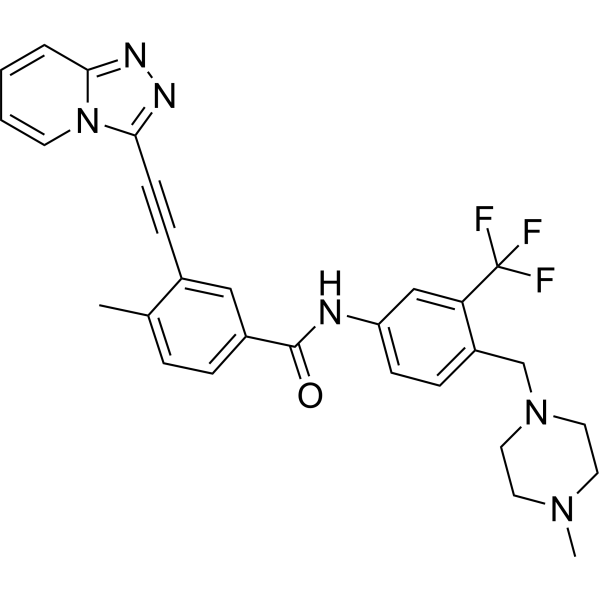
Physicochemical Properties
| Molecular Formula | C29H27F3N6O |
| Molecular Weight | 532.559496164322 |
| Exact Mass | 532.219 |
| CAS # | 1416241-23-0 |
| Related CAS # | 2141996-20-3 (mesylate);1416241-23-0; |
| PubChem CID | 71475839 |
| Appearance | Off-white to light yellow solid powder |
| LogP | 5 |
| Hydrogen Bond Donor Count | 1 |
| Hydrogen Bond Acceptor Count | 8 |
| Rotatable Bond Count | 6 |
| Heavy Atom Count | 39 |
| Complexity | 910 |
| Defined Atom Stereocenter Count | 0 |
| SMILES | C(NC1=CC=C(CN2CCN(C)CC2)C(C(F)(F)F)=C1)(=O)C1=CC=C(C)C(C#CC2N3C(=NN=2)C=CC=C3)=C1 |
| InChi Key | SLIVDYMORZGPLW-UHFFFAOYSA-N |
| InChi Code | InChI=1S/C29H27F3N6O/c1-20-6-7-22(17-21(20)9-11-27-35-34-26-5-3-4-12-38(26)27)28(39)33-24-10-8-23(25(18-24)29(30,31)32)19-37-15-13-36(2)14-16-37/h3-8,10,12,17-18H,13-16,19H2,1-2H3,(H,33,39) |
| Chemical Name | 4-methyl-N-[4-[(4-methylpiperazin-1-yl)methyl]-3-(trifluoromethyl)phenyl]-3-[2-([1,2,4]triazolo[4,3-a]pyridin-3-yl)ethynyl]benzamide |
| HS Tariff Code | 2934.99.9001 |
| Storage |
Powder-20°C 3 years 4°C 2 years In solvent -80°C 6 months -20°C 1 month Note: Please store this product in a sealed and protected environment (e.g. under nitrogen), avoid exposure to moisture and light. |
| Shipping Condition | Room temperature (This product is stable at ambient temperature for a few days during ordinary shipping and time spent in Customs) |
Biological Activity
| ln Vitro | At IC50 values of 0.49, 0.78, and 1.0 µM for ABL, ABL(T315l), and ABL(H396P), respectively, vamotinib (0-1 µM) inhibits ABL kinase and its mutations [1]. In a dose-dependent way, vamotinib (0-1000 nM) suppresses BCR/ABL and BCR/ABL-T315I autophosphorylation [1]. When Ba/F3 cells expressing natural BCR/ABL are exposed to vamotinib (0-2000 nM), it shows antiproliferative action [1]. Ba/F3 cells that express BCR/ABL and BCR/ABL-T315I undergo apoptosis when exposed to vamotinib (0-100 nM) [1]. Ph+ patient-derived cell lines grown in k562, kcl-22, SupB15, Tom-1, and BV-173 cells are inhibited by vamotinib (0-1000 nM) [1]. Ph+ PD-LTC with non-mutational resistance and the T315I mutation is inhibited in growth by vamotinib (0-1000 nM) [1]. |
| ln Vivo | Vamotinib (25, 40 mg/kg; ir; once daily for 14 days) demonstrates anticancer efficacy [1]. Vamotinib (50 mg/kg; oral; once daily for 20 days) prolong survival in mice with BCR/ABL and BCR/ABL-T315I driven CML-like illness [1]. |
| Cell Assay |
Western Blot Analysis[1] Cell Types: Ba/F3 Cell Tested Concentrations: 0, 10, 25, 50, 100, 500, 1000 nM Incubation Duration: Experimental Results: A single dose inhibits the autophosphorylation of BCR/ABL and BCR/ABL-T315I dependent manner and inhibited substrate phosphorylation, as shown by BCR/ABL and BCR/ABL-T315I diminished Crk1 phosphorylation and downstream Stat5 activation. Cell proliferation assay[1] Cell Types: Ba/F3 Cell Tested Concentrations: 0, 50, 500, 2000 nM Incubation Duration: Experimental Results: Effectively inhibited the proliferation of Ba/F3 cells expressing native BCR/ABL in a dose-dependent manner and did not The effect on Ba/F3 cells transduced with empty vector in the presence of IL-3 (10 ng/ml) is shown. Apoptosis analysis [1] Cell Types: Ba/F3 Cell Tested Concentrations: 0-100 nM Incubation Duration: Experimental Results: Apoptosis was induced in Ba/F3 cells expressing BCR/ABL and BCR/ABL-T315I in a dose-dependent manner. |
| Animal Protocol |
Animal/Disease Models: Female BALB/cAnNRj-Foxn1nu (nude) mice (K562 nude mouse xenograft model) [1] Doses: 25, 40 mg/kg Route of Administration: po (oral gavage); one time/day for 14 days Experimental Results: Average tumor within 4 weeks Volume diminished by 100%. Animal/Disease Models: 8-12 weeks, C57BL/6N mice (mouse model of CML-like disease) [1] Doses: 50 mg/kg Route of Administration: Po; one time/day for 20 days Experimental Results: Median survival from 28 days was Dramatically extended to 39 days. |
| References |
[1]. PF-114, a potent and selective inhibitor of native and mutated BCR/ABL is active against Philadelphia chromosome-positive (Ph+) leukemias harboring the T315I mutation. Leukemia. 2015 May;29(5):1104-14. [2]. PF-114, a potent and selective inhibitor of native and mutated BCR/ABL is active against Philadelphia chromosome-positive (Ph+) leukemias harboring the T315I mutation. Leukemia. 2015 May;29(5):1104-14. [3]. PF‑114, a novel selective inhibitor of BCR‑ABL tyrosine kinase, is a potent inducer of apoptosis in chronic myelogenous leukemia cells. Int J Oncol. 2019 Jul;55(1):289-297. |
| Additional Infomation |
Vamotinib (PF-114) is under investigation in clinical trial NCT02885766 (Study to Evaluate Tolerability, Safety, Pharmacokinetics and Preliminary Efficacy of PF-114 for Oral Administration in Adults With Ph+ Chronic Myeloid Leukemia, Which is Resistant to the 2-nd Generation Bcr-Abl Inhibitors or Has T315I Mutation in the BCR-ABL Gene). Vamotinib is an orally bioavailable, Bcr-Abl tyrosine kinase inhibitor, with potential antineoplastic activity. Designed to overcome resistance of tumor cells to second generation Bcr-Abl inhibitors, vamotinib targets and binds to the Bcr-Abl fusion oncoprotein, including those fusion proteins with the 'gatekeeper' resistance mutation T315I, an amino acid substitution at position 315 in Bcr-Abl from a threonine (T) to an isoleucine (I). This inhibits Bcr-Abl-mediated proliferation of, and enhances apoptosis in, Philadelphia chromosome-positive (Ph+) hematologic malignancies. The Bcr-Abl fusion protein is an aberrantly activated tyrosine kinase produced by leukemia cells that contain the Philadelphia chromosome. |
Solubility Data
| Solubility (In Vitro) | DMSO : ~50 mg/mL (~93.89 mM) |
| Solubility (In Vivo) |
Solubility in Formulation 1: 2.5 mg/mL (4.69 mM) in 10% DMSO + 40% PEG300 + 5% Tween80 + 45% Saline (add these co-solvents sequentially from left to right, and one by one), suspension solution; with sonication. For example, if 1 mL of working solution is to be prepared, you can add 100 μL of 25.0 mg/mL clear DMSO stock solution to 400 μL PEG300 and mix evenly; then add 50 μL Tween-80 to the above solution and mix evenly; then add 450 μL normal saline to adjust the volume to 1 mL. Preparation of saline: Dissolve 0.9 g of sodium chloride in 100 mL ddH₂ O to obtain a clear solution. Solubility in Formulation 2: ≥ 2.5 mg/mL (4.69 mM) (saturation unknown) in 10% DMSO + 90% (20% SBE-β-CD in Saline) (add these co-solvents sequentially from left to right, and one by one), clear solution. For example, if 1 mL of working solution is to be prepared, you can add 100 μL of 25.0 mg/mL clear DMSO stock solution to 900 μL of 20% SBE-β-CD physiological saline solution and mix evenly. Preparation of 20% SBE-β-CD in Saline (4°C,1 week): Dissolve 2 g SBE-β-CD in 10 mL saline to obtain a clear solution. (Please use freshly prepared in vivo formulations for optimal results.) |
| Preparing Stock Solutions | 1 mg | 5 mg | 10 mg | |
| 1 mM | 1.8777 mL | 9.3886 mL | 18.7772 mL | |
| 5 mM | 0.3755 mL | 1.8777 mL | 3.7554 mL | |
| 10 mM | 0.1878 mL | 0.9389 mL | 1.8777 mL |