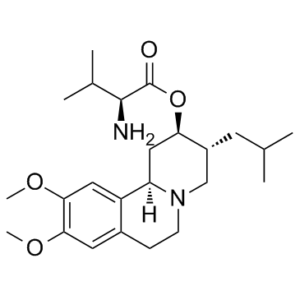
Valbenazine (formerly NBI98854; MT5199; NBI-98854; MT-5199; trade name: Ingrezza) is a potent and selective inhibitor of VMAT2 (vesicular monoamine transporter 2) with potential usefulness in the treatment of TD/tardive dyskinesia (uncontrollable movement of the face, tongue, or other body parts). As of 2017, it has been approved by FDA as the first medication to treat adults with TD/tardive dyskinesia. Valbenazine is a prodrug of the (+)-α isomer of tetrabenazine for tardive syndrome therapy. It is effective in regulating the levels of dopamine release during nerve communication, while at the same time having minimal impact on the other monoamines. Valbenazine is used to treat tardive dyskinesia in adults. Tardive dyskinesia is a neurological disorder characterized by involuntary movements. The clinical trials that led to FDA approval of valbenzazine were 6 weeks in duration. An industry-sponsored study has studied the use of valbenzazine for up to 48 weeks, in which it was found to be safe and effective for maintaining short-term (6 week) improvements in tardive dyskinesia.
Physicochemical Properties
| Molecular Formula | C24H38N2O4 |
| Molecular Weight | 418.57 |
| Exact Mass | 418.283 |
| CAS # | 1025504-45-3 |
| Related CAS # | Valbenazine tosylate;1639208-54-0 |
| PubChem CID | 24795069 |
| Appearance | Light yellow to yellow solid powder |
| Density | 1.1±0.1 g/cm3 |
| Boiling Point | 507.2±50.0 °C at 760 mmHg |
| Flash Point | 260.6±30.1 °C |
| Vapour Pressure | 0.0±1.3 mmHg at 25°C |
| Index of Refraction | 1.548 |
| LogP | 4.31 |
| Hydrogen Bond Donor Count | 1 |
| Hydrogen Bond Acceptor Count | 6 |
| Rotatable Bond Count | 8 |
| Heavy Atom Count | 30 |
| Complexity | 569 |
| Defined Atom Stereocenter Count | 4 |
| SMILES | CC(C)C[C@@H]1CN2CCC3=CC(=C(C=C3[C@H]2C[C@H]1OC(=O)[C@H](C(C)C)N)OC)OC |
| InChi Key | GEJDGVNQKABXKG-CFKGEZKQSA-N |
| InChi Code | InChI=1S/C24H38N2O4/c1-14(2)9-17-13-26-8-7-16-10-21(28-5)22(29-6)11-18(16)19(26)12-20(17)30-24(27)23(25)15(3)4/h10-11,14-15,17,19-20,23H,7-9,12-13,25H2,1-6H3/t17-,19-,20-,23+/m1/s1 |
| Chemical Name | [(2R,3R,11bR)-9,10-dimethoxy-3-(2-methylpropyl)-2,3,4,6,7,11b-hexahydro-1H-benzo[a]quinolizin-2-yl] (2S)-2-amino-3-methylbutanoate |
| Synonyms | Valbenazine; NBI-98854; MT-5199; NBI 98854; MT5199; NBI98854; MT 5199; trade name: Ingrezza |
| HS Tariff Code | 2934.99.9001 |
| Storage |
Powder-20°C 3 years 4°C 2 years In solvent -80°C 6 months -20°C 1 month |
| Shipping Condition | Room temperature (This product is stable at ambient temperature for a few days during ordinary shipping and time spent in Customs) |
Biological Activity
| Targets |
Valbenazine (NBI-98854) targets vesicular monoamine transporter 2 (VMAT2) (Kᵢ = 110-190 nM in rat striatal/rat forebrain/human platelet homogenates); its metabolite (+)-α-dihydrotetrabenazine (R,R,R-HTBZ) also targets VMAT2 (Kᵢ = 1.0-2.8 nM in rat striatal homogenates, Kᵢ = 4.2 nM in rat forebrain homogenates, Kᵢ = 2.6-3.3 nM in human platelet homogenates); another metabolite NBI-136110 targets VMAT2 (Kᵢ = 160-220 nM in rat striatal/rat forebrain/human platelet homogenates) [1] |
| ln Vitro |
In rat striatum and human platelets, valbenazine demonstrates VMAT2 binding affinities with Kis values of 110 and 150 nM, respectively [1]. 1. Radioligand-binding studies showed that Valbenazine (NBI-98854) inhibited [³H]-HTBZ binding to VMAT2 in rat striatal, rat forebrain, and human platelet homogenates with a Kᵢ value of 110-190 nM, exhibiting inhibitory activity but lower potency than its metabolite R,R,R-HTBZ [1] 2. The metabolite R,R,R-HTBZ of Valbenazine (NBI-98854) potently inhibited [³H]-HTBZ binding to VMAT2 in rat striatal homogenates (Kᵢ = 1.0-2.8 nM), rat forebrain homogenates (Kᵢ = 4.2 nM), and human platelet homogenates (Kᵢ = 2.6-3.3 nM), showing high potency for VMAT2 [1] 3. The metabolite NBI-136110 of Valbenazine (NBI-98854) inhibited [³H]-HTBZ binding to VMAT2 in rat striatal, rat forebrain, and human platelet homogenates with a Kᵢ value of 160-220 nM, with lower potency than R,R,R-HTBZ [1] 4. A broad panel screen involving >80 receptor, transporter, and ion channel sites demonstrated that Valbenazine (NBI-98854), R,R,R-HTBZ, and NBI-136110 had no significant off-target interactions at serotonin (5-HT₁A, 5-HT₂A, 5-HT₂B) or dopamine (D₁ or D₂) receptor sites [1] |
| ln Vivo |
Oral valbenazine (10 mg/kg) causes ptosis in rats, which is mainly an adrenergic response, and raises plasma prolactin, which is primarily a dopaminergic response [1]. 1. In vivo studies in rats measuring ptosis and prolactin secretion confirmed that R,R,R-HTBZ (metabolite of Valbenazine (NBI-98854)) interacted with VMAT2 in a specific and dose-dependent manner; tetrabenazine also showed similar dose-dependent interactions with VMAT2 in these assays [1] |
| Enzyme Assay |
1. Radioligand-binding assays were performed to evaluate the inhibitory effects of Valbenazine (NBI-98854), tetrabenazine, and their metabolites on VMAT2; homogenates of rat striatum, rat forebrain, and human platelets were prepared, and [³H]-HTBZ was used as the radioligand to assess the binding inhibition ability of the test compounds; the Kᵢ values were calculated to reflect the potency of each compound for VMAT2 [1] 2. A broad panel screen was conducted to detect potential off-target interactions of Valbenazine (NBI-98854), R,R,R-HTBZ, and NBI-136110; the screen covered more than 80 receptor, transporter, and ion channel sites, including serotonin (5-HT₁A, 5-HT₂A, 5-HT₂B) and dopamine (D₁, D₂) receptors, to determine whether the compounds had non-specific binding or inhibitory effects on these targets [1] |
| Animal Protocol |
1. In vivo experiments were carried out on rats to evaluate the interaction of Valbenazine (NBI-98854) metabolite R,R,R-HTBZ and tetrabenazine with VMAT2; ptosis and prolactin secretion levels in rats were measured after administration of different doses of the compounds, and the dose-dependent relationship of the compounds' effects on VMAT2 was analyzed; specific details such as drug dissolution formula, administration frequency, [1] |
| ADME/Pharmacokinetics |
Absorption, Distribution and Excretion Valbenazine and its active metabolite ([+]-α-HTBZ) demonstrate approximate proportional increases for the area under the plasma concentration versus time curve (AUC) and maximum plasma concentration (Cmax) after single oral doses from 40 mg to 300 mg (i.e., 50% to 375% of the recommended treatment dose). Following oral administration, the time to reach maximum valbenazine plasma concentration (Tmax) ranges from 0.5 to 1.0 hours. Valbenazine reaches steady-state plasma concentrations within 1 week. The absolute oral bioavailability of valbenazine is approximately 49%. [+]-α-HTBZ gradually forms and reaches Cmax 4 to 8 hours after administration of valbenazine. Ingestion of a high-fat meal decreases valbenazine Cmax by approximately 47% and AUC by approximately 13%. [+]-α-HTBZ Cmax and AUC are unaffected. Following the administration of a single 50-mg oral dose of radiolabeled C-valbenazine (i.e., ~63% of the recommended treatment dose), approximately 60% and 30% of the administered radioactivity was recovered in the urine and feces, respectively. Less than 2% was excreted as unchanged valbenazine or [+]-α-HTBZ in either urine or feces. The mean steady-state volume of distribution of valbenazine is 92 L. Valbenazine has a mean total plasma systemic clearance value of 7.2 L/hr. Metabolism / Metabolites Valbenazine is extensively metabolized after oral administration by hydrolysis of the valine ester to form the active metabolite ([+]-α-HTBZ) and by oxidative metabolism, primarily by CYP3A4/5, to form mono-oxidized valbenazine and other minor metabolites. [+]-α-HTBZ appears to be further metabolized in part by CYP2D6. Biological Half-Life Both Valbenazine and [+]-α-HTBZ have half-lives of 15 to 22 hours. 1. Valbenazine (NBI-98854) is converted to two significant circulating metabolites in vivo: (+)-α-dihydrotetrabenazine (R,R,R-HTBZ) and a mono-oxy metabolite NBI-136110; no other detailed ADME/pharmacokinetic parameters (absorption, distribution, metabolism, excretion, half-life, oral bioavailability) [1] |
| Toxicity/Toxicokinetics |
Effects During Pregnancy and Lactation ◉ Summary of Use during Lactation No information is available on the use of valbenazine during breastfeeding in humans. Based on animal studies, the manufacturer recommends that breastfeeding be avoided during valbenazine therapy and for 5 days after the final dose. ◉ Effects in Breastfed Infants Relevant published information was not found as of the revision date. ◉ Effects on Lactation and Breastmilk Relevant published information was not found as of the revision date. Protein Binding The plasma protein binding of valbenazine and [+]-α-HTBZ is greater than 99% and approximately 64%, respectively. |
| References |
[1]. Pharmacologic Characterization of Valbenazine (NBI-98854) and Its Metabolites. J Pharmacol Exp Ther. 2017 Jun;361(3):454-461. |
| Additional Infomation |
Valbenazine is a modified metabolite of [tetrabenazine], and it is currently being approved for the treatment of various movement disorders, particularly tardive dyskinesia and chorea associated with Huntington's disease. Tardive dyskinesia has long been regarded as a consequence of anti-dopamine receptor therapy, and until 2008 with the advent of [tetrabenazine], most treatments were ineffective. However, challenges in using [tetrabenazine] as a treatment of tardive dyskinesia included frequent dosing and safety and tolerability concerns. On April 2017, valbenazine was approved by the FDA under the brand name INGREZZA as the first and only approved treatment for adults with Tardive Dyskinesia (TD). On August 2023, valbenazine was again approved by the FDA for the treatment of chorea associated with Huntington's disease respectively. This approval was supported by positive results in multiple trials, including the KINECT-HD Phase 3 study and the ongoing KINECT-HD2 open-label extension trial. The reduction in chorea severity was observed as early as 2 weeks after starting treatment with an initial dose of 40 mg. Valbenazine is a Vesicular Monoamine Transporter 2 Inhibitor. The mechanism of action of valbenazine is as a Vesicular Monoamine Transporter 2 Inhibitor. See also: Valbenazine tosylate (active moiety of). Drug Indication Valbenazine is indicated for the treatment of adults with tardive dyskinesia and chorea associated with Huntington’s disease. FDA Label Mechanism of Action Although the exact mechanism of action of valbenzine is still unknown, it is thought be mediated through the reversible inhibition of vesicular monoamine transporter 2 (VMAT2), a transporter that regulates monoamine uptake from the cytoplasm to the synaptic vesicle for storage and release. Pharmacodynamics Valbenazine inhibits human VMAT2 (Ki ~ 150 nM) with no appreciable binding affinity for VMAT1 (Ki > 10 µM). Valbenazine is converted to the active metabolite [+]-α-dihydrotetrabenazine ([+]-α-HTBZ). [+]-α-HTBZ also binds with relatively high affinity to human VMAT2 (Ki ~ 3 nM). Valbenazine and [+]-αHTBZ have no appreciable binding affinity (Ki > 5000 nM) for dopaminergic (including D2), serotonergic (including 5HT2B), adrenergic, histaminergic or muscarinic receptors, thus limiting off-target receptors binding for a more favorable safety profile. Valbenazine may cause an increase in the corrected QT interval in patients who are CYP2D6-poor metabolizers or who are taking a strong CYP2D6 or CYP3A4 inhibitor. An exposure-response analysis of clinical data from two healthy volunteer studies revealed increased QTc interval with higher plasma concentrations of the active metabolite. Based on this model, patients taking an valbenazine 60 mg or 80 mg dose with increased exposure to the metabolite (e.g., being a CYP2D6 poor metabolizer) may have a mean (upper bound of double-sided 90% CI) QT prolongation of 9.6 (12.0) msec or 11.7 (14.7) msec, respectively as compared to otherwise healthy volunteers given valbenazine, who had a respective mean (upper bound of double-sided 90% CI) QT prolongation of 5.3 (6.7) msec or 6.7 (8.4) msec. 1. Vesicular monoamine transporter 2 (VMAT2) is an integral presynaptic protein that regulates the packaging and subsequent release of dopamine and other monoamines from neuronal vesicles into the synapse [1] 2. Valbenazine (NBI-98854) is a novel compound that selectively inhibits VMAT2 and is approved for the treatment of tardive dyskinesia [1] 3. The pharmacologic characteristics of Valbenazine (NBI-98854) (selective and potent inhibition of VMAT2 with no significant off-target interactions) are consistent with the favorable efficacy and tolerability findings of recent clinical studies [KINECT 2 (NCT01733121), KINECT 3 (NCT02274558)] [1] 4. The potency and selectivity of tetrabenazine and its pharmacologically active metabolites were also evaluated in the study, for comparison with Valbenazine (NBI-98854) and its metabolites [1] |
Solubility Data
| Solubility (In Vitro) |
|
|||
| Solubility (In Vivo) |
Solubility in Formulation 1: ≥ 2.5 mg/mL (5.97 mM) (saturation unknown) in 10% DMSO + 40% PEG300 + 5% Tween80 + 45% Saline (add these co-solvents sequentially from left to right, and one by one), clear solution. For example, if 1 mL of working solution is to be prepared, you can add 100 μL of 25.0 mg/mL clear DMSO stock solution to 400 μL PEG300 and mix evenly; then add 50 μL Tween-80 to the above solution and mix evenly; then add 450 μL normal saline to adjust the volume to 1 mL. Preparation of saline: Dissolve 0.9 g of sodium chloride in 100 mL ddH₂ O to obtain a clear solution. Solubility in Formulation 2: ≥ 2.5 mg/mL (5.97 mM) (saturation unknown) in 10% DMSO + 90% Corn Oil (add these co-solvents sequentially from left to right, and one by one), clear solution. For example, if 1 mL of working solution is to be prepared, you can add 100 μL of 25.0 mg/mL clear DMSO stock solution to 900 μL of corn oil and mix evenly. (Please use freshly prepared in vivo formulations for optimal results.) |
| Preparing Stock Solutions | 1 mg | 5 mg | 10 mg | |
| 1 mM | 2.3891 mL | 11.9454 mL | 23.8909 mL | |
| 5 mM | 0.4778 mL | 2.3891 mL | 4.7782 mL | |
| 10 mM | 0.2389 mL | 1.1945 mL | 2.3891 mL |