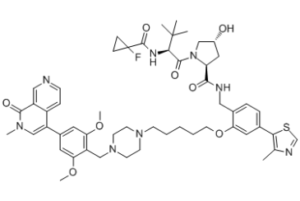
VZ185 is a potent, fast, and selective degrader of BRD9 and of its close homolog BRD7. Developing PROTACs to redirect the ubiquitination activity of E3 ligases and potently degrade a target protein within cells can be a lengthy and unpredictable process, and it remains unclear whether any combination of E3 and target might be productive for degradation. VHL-based degraders could be optimized from suboptimal compounds in two rounds by systematically varying conjugation patterns and linkers and monitoring cellular degradation activities, kinetic profiles, and ubiquitination, as well as ternary complex formation thermodynamics.
Physicochemical Properties
| Molecular Formula | C53H67FN8O8S |
| Molecular Weight | 995.211295366287 |
| Exact Mass | 994.478 |
| CAS # | 2306193-61-1 |
| PubChem CID | 138454768 |
| Appearance | White to off-white solid powder |
| LogP | 5.1 |
| Hydrogen Bond Donor Count | 3 |
| Hydrogen Bond Acceptor Count | 14 |
| Rotatable Bond Count | 20 |
| Heavy Atom Count | 71 |
| Complexity | 1850 |
| Defined Atom Stereocenter Count | 3 |
| SMILES | S1C=NC(C)=C1C1=CC=C(C(=C1)OCCCCCN1CCN(CC2C(=CC(C3=CN(C)C(C4C=NC=CC3=4)=O)=CC=2OC)OC)CC1)CNC([C@@H]1C[C@H](CN1C([C@H](C(C)(C)C)NC(C1(CC1)F)=O)=O)O)=O |
| InChi Key | ZAGCLFXBHOXXEN-JPTLTNPLSA-N |
| InChi Code | InChI=1S/C53H67FN8O8S/c1-33-46(71-32-57-33)34-11-12-35(27-56-48(64)42-26-37(63)29-62(42)50(66)47(52(2,3)4)58-51(67)53(54)14-15-53)43(23-34)70-22-10-8-9-17-60-18-20-61(21-19-60)31-41-44(68-6)24-36(25-45(41)69-7)40-30-59(5)49(65)39-28-55-16-13-38(39)40/h11-13,16,23-25,28,30,32,37,42,47,63H,8-10,14-15,17-22,26-27,29,31H2,1-7H3,(H,56,64)(H,58,67)/t37-,42+,47-/m1/s1 |
| Chemical Name | (2S,4R)-N-[[2-[5-[4-[[2,6-dimethoxy-4-(2-methyl-1-oxo-2,7-naphthyridin-4-yl)phenyl]methyl]piperazin-1-yl]pentoxy]-4-(4-methyl-1,3-thiazol-5-yl)phenyl]methyl]-1-[(2S)-2-[(1-fluorocyclopropanecarbonyl)amino]-3,3-dimethylbutanoyl]-4-hydroxypyrrolidine-2-carboxamide |
| Synonyms | VZ-185; VZ185; VZ 185 |
| HS Tariff Code | 2934.99.9001 |
| Storage |
Powder-20°C 3 years 4°C 2 years In solvent -80°C 6 months -20°C 1 month |
| Shipping Condition | Room temperature (This product is stable at ambient temperature for a few days during ordinary shipping and time spent in Customs) |
Biological Activity
| ln Vitro | VZ185's efficacy was validated by degradation study in a collection of other human tumor lines (EOL-1, A-204) (DC50 topic for BRD9 between 2 and 8 nM). The remarkable hydrodynamic solubility (up to about 100 μM) and stability of VZ185 in these solutions and microsomes are further supported by external PK data [1]. |
| References |
[1]. Iterative Design and Optimization of Initially Inactive Proteolysis Targeting Chimeras (PROTACs) Identify VZ185 as a Potent, Fast, and Selective von Hippel-Lindau (VHL) Based Dual Degrader Probe of BRD9 and BRD7. J Med Chem. 2019 Jan 24;62(2):699-726. |
Solubility Data
| Solubility (In Vitro) | DMSO : ~200 mg/mL (~200.96 mM) |
| Solubility (In Vivo) |
Solubility in Formulation 1: ≥ 5 mg/mL (5.02 mM) (saturation unknown) in 10% DMSO + 90% Corn Oil (add these co-solvents sequentially from left to right, and one by one), clear solution. For example, if 1 mL of working solution is to be prepared, you can add 100 μL of 50.0 mg/mL clear DMSO stock solution to 900 μL of corn oil and mix evenly. (Please use freshly prepared in vivo formulations for optimal results.) |
| Preparing Stock Solutions | 1 mg | 5 mg | 10 mg | |
| 1 mM | 1.0048 mL | 5.0241 mL | 10.0481 mL | |
| 5 mM | 0.2010 mL | 1.0048 mL | 2.0096 mL | |
| 10 mM | 0.1005 mL | 0.5024 mL | 1.0048 mL |