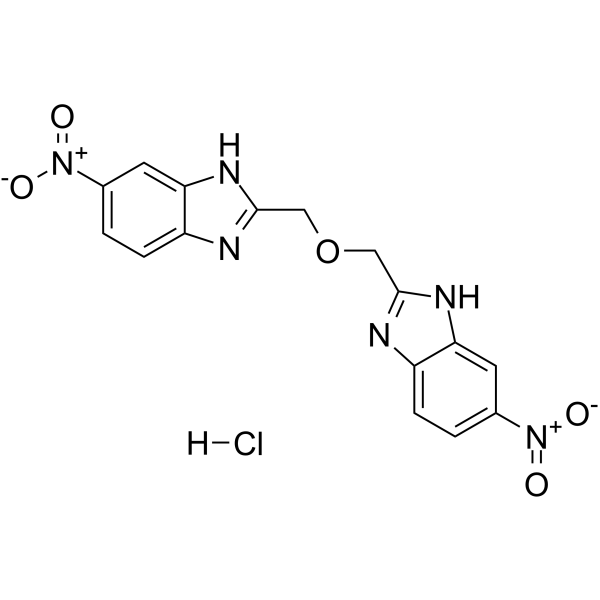
Physicochemical Properties
| Molecular Formula | C16H13CLN6O5 |
| Molecular Weight | 404.764621496201 |
| Exact Mass | 404.063 |
| CAS # | 1315380-70-1 |
| Related CAS # | VU591;1222810-74-3 |
| PubChem CID | 90488918 |
| Appearance | Typically exists as solid at room temperature |
| Hydrogen Bond Donor Count | 3 |
| Hydrogen Bond Acceptor Count | 7 |
| Rotatable Bond Count | 4 |
| Heavy Atom Count | 28 |
| Complexity | 521 |
| Defined Atom Stereocenter Count | 0 |
| SMILES | Cl.O(CC1=NC2C=CC(=CC=2N1)[N+](=O)[O-])CC1=NC2C=CC(=CC=2N1)[N+](=O)[O-] |
| InChi Key | PXLOUHLPDHEXCC-UHFFFAOYSA-N |
| InChi Code | InChI=1S/C16H12N6O5.ClH/c23-21(24)9-1-3-11-13(5-9)19-15(17-11)7-27-8-16-18-12-4-2-10(22(25)26)6-14(12)20-16;/h1-6H,7-8H2,(H,17,19)(H,18,20);1H |
| Chemical Name | 6-nitro-2-[(6-nitro-1H-benzimidazol-2-yl)methoxymethyl]-1H-benzimidazole;hydrochloride |
| HS Tariff Code | 2934.99.9001 |
| Storage |
Powder-20°C 3 years 4°C 2 years In solvent -80°C 6 months -20°C 1 month Note: Please store this product in a sealed and protected environment, avoid exposure to moisture. |
| Shipping Condition | Room temperature (This product is stable at ambient temperature for a few days during ordinary shipping and time spent in Customs) |
Biological Activity
| Targets |
VU591 is a selective inhibitor of the Renal Outer Medullary Potassium channel ROMK (Kir1.1). The half-maximal inhibitory concentration (IC₅₀) for rat ROMK was 300 nM, as determined by patch-clamp electrophysiology. The IC₅₀ in a thallium flux assay was 240 nM. VU591 showed no significant inhibition (< 10%) at 10 µM against Kir7.1, Kir2.1, Kir2.3, Kir4.1, Kv1.3, or Slol/β1 (BK) channels. VU591 inhibited Kir6.2/SUR1 currents by 17 ± 4% at 10 µM and 28 ± 3% at 50 µM. VU591 inhibited hERG tail currents by approximately 25% at 10 µM in Xenopus laevis oocytes. In a broad panel of 68 off-target assays, VU591 (10 µM) showed significant activity (>50% radioligand displacement) only at the GABAA receptor (IC₅₀ = 6.2 µM), dopamine D4 receptor, dopamine transporter, and norepinephrine transporter. [1] VU591 is described as a selective blocker of the renal outer medullary potassium channel (ROMK, Kir1.1), as cited from a previous study (Bhave et al., 2011). [2] |
| ln Vitro |
VU591 hydrochloride is a selective ROMK inhibitor and ROMK channel pore blocker. VU591 can bind to serum proteins and has great metabolic stability [1]. In whole-cell patch-clamp experiments on HEK-293 cells expressing rat ROMK1, VU591 (10 µM) inhibited ROMK current at -120 mV by approximately 90%. Inhibition was dose-dependent, with an IC₅₀ of 300 nM. Block reached a maximum of about 90% at 10 µM, and increasing the concentration to 30 µM did not significantly increase inhibition. The inhibition of ROMK by VU591 exhibited weak voltage dependence, with block decreasing at strong hyperpolarizing potentials, especially under high extracellular K⁺ conditions, suggesting it acts as a pore blocker. In isolated perfused rat cortical collecting ducts, luminal perfusion with 10 µM VU591 significantly reduced net K⁺ secretion (JK) from -7.0 ± 1.3 pmol·min⁻¹·mm⁻¹ to -3.6 ± 0.6 pmol·min⁻¹·mm⁻¹. It had no significant effect on net Na⁺ transport (JNa) in the same tubules. [1] |
| ln Vivo |
The immobility duration in TST is greatly reduced by VU591 hydrochloride (icv; 1.842 μg) [2]. To confirm the involvement of the ROMK channel in depression-like behavior, the effect of VU591 was examined in the mouse tail suspension test (TST). Intracerebroventricular (i.c.v.) administration of VU591 (5 μL of a 20 mM solution dissolved in dimethyl sulfoxide) significantly decreased the immobility time compared to the control group, demonstrating an antidepressive effect. [2] |
| Cell Assay |
Thallium (Tl⁺) Flux Assay: Cells (a monoclonal HEK-293 cell line stably expressing ROMK1-S44D) were cultured overnight in a 384-well plate with serum-free media and tetracycline. Cells were loaded with a Tl⁺-sensitive fluorescent dye. After a 20-minute incubation with test compounds, Tl⁺ was added, and the fluorescence increase, reflecting Tl⁺ influx through open ROMK channels, was measured. The normalized rate of flux between 7 and 12 seconds after Tl⁺ addition was used to calculate inhibition. [1] Automated Patch-Clamp Electrophysiology (Patchliner): A fully automated patch-clamp system was used. Cells (the same stable ROMK-expressing line) were dissociated and seeded into microfluidic recording chambers. After establishing the whole-cell configuration, cells were voltage-clamped from a -75 mV holding potential and stepped to -120 mV every 10 seconds. Test compounds at increasing concentrations were added to the external compartment. Currents were recorded, and cells with unstable baselines or less than 90% barium-inhibitable current were excluded from analysis. This method was used to generate concentration-response data. [1] Conventional Whole-Cell Patch-Clamp Electrophysiology: HEK-293 cells transiently or stably expressing various ion channels (ROMK, Kir7.1, Kir2.1, Kir2.3, Kir4.1, Kir6.2/SUR1, Kv1.3, Slol/β1) were used. Standard intracellular and extracellular solutions were applied. After achieving stable whole-cell currents, VU591 was applied, and currents were recorded using specific voltage protocols (e.g., voltage ramps or steps). Block was quantified by comparing current amplitudes before and after drug application. Known channel blockers (e.g., barium for Kir channels) were applied at the end as positive controls. [1] Two-Electrode Voltage-Clamp (TEVC) on Xenopus laevis Oocytes: Oocytes were injected with cRNA encoding hERG and incubated for 24-48 hours. Whole-cell currents were recorded using the TEVC technique. From a holding potential of -80 mV, the membrane was stepped to -20 mV for 2 seconds and then back to -80 mV to elicit inward tail currents. The protocol was repeated every 20-30 seconds. VU591 was applied at 10 µM, and its effect on tail current amplitude was measured. Currents were pharmacologically isolated by subtracting the time-independent residual current after maximal block with dofetilide. [1] |
| Animal Protocol |
Animal/Disease Models: Male ICR mouse [2] Doses: 1.842 μg Route of Administration: icv; 1.842 μg Experimental Results:demonstrated antidepressant effect in tail suspension test (TST). Tail Suspension Test (TST) in Mice: Male ICR mice were used. VU591 was dissolved in dimethyl sulfoxide (DMSO) to prepare a 20 mM stock solution. A volume of 5 μL of this solution was administered via intracerebroventricular (i.c.v.) injection into the right cerebral ventricle. The injection coordinates were 0 mm caudal to bregma, 1.0 mm lateral to the midline, and 3.5 mm below the skull. The injection was performed over 30 seconds under isoflurane anesthesia, and the needle was kept in place for 1 minute post-injection. The behavioral test (TST) was conducted after drug administration, though the exact time interval is not specified for VU591 in this experiment (the standard interval for other peptides in the study was 30 minutes). [2] |
| ADME/Pharmacokinetics |
Plasma Protein Binding: The binding of VU591 to human and rat serum proteins was measured using a rapid equilibrium dialysis system. Human or rat plasma spiked with 10 µM VU591 was dialyzed against phosphate-buffered saline for 4 hours at 37°C. The percentage of compound bound was calculated based on the distribution between the plasma and buffer chambers. VU591 was 98.39% bound in human plasma and 97.14% bound in rat plasma. [1] Metabolic Stability (in vitro): The metabolic stability of VU591 was assessed in rat and human liver microsomes. VU591 was incubated with microsomes, NADPH cofactor, and buffer at 37°C for 15 minutes. The reaction was stopped, and the amount of parent compound remaining was quantified. After 15 minutes, approximately 60-80% of VU591 remained intact in both rat and human liver microsomes, indicating moderate metabolic stability. [1] |
| References |
[1]. Development of a selective small-molecule inhibitor of Kir1.1, the renal outer medullary potassium channel. Mol Pharmacol. 2011 Jan;79(1):42-50. [2]. Antidepressive effect of an inward rectifier K+ channel blocker peptide, tertiapin-RQ. PLoS One. 2020 Nov 13;15(11):e0233815. |
| Additional Infomation |
VU591 (2,2'-oxybis(methylene)bis(5-nitro-1H-benzo[d]imidazole)) is a small-molecule inhibitor developed from a lead compound BNBI through medicinal chemistry optimization, specifically by introducing an ether oxygen into the linker to increase potency. It is proposed to act as a pore blocker of the ROMK channel, likely binding within the intracellular ion permeation pathway, as its block can be relieved ("knocked off") by inwardly directed K⁺ ions, especially at hyperpolarized membrane potentials. The development of VU591 aims to provide a selective pharmacological tool to probe ROMK function in vitro and in vivo, and to test the hypothesis that ROMK inhibition could serve as a novel diuretic mechanism without causing hypokalemia. [1] The chemical synthesis of VU591 involved heating a mixture of 4-nitrobenzene-1,2-diamine and diglycolic acid in 5 N HCl at 120°C for 12 hours, followed by work-up and recrystallization from ethanol. [1] In this study, VU591 is referenced as a known selective small-molecule inhibitor of the ROMK (Kir1.1) channel, based on a prior publication (Bhave et al., 2011). Its i.c.v. administration was used as a pharmacological tool to support the hypothesis that ROMK channel blockade contributes to antidepressive-like effects in mice, alongside the primary investigational peptide tertiapin-RQ. [2] |
Solubility Data
| Solubility (In Vitro) |
DMSO : ~16.67 mg/mL (~41.18 mM) H2O : < 0.1 mg/mL |
| Solubility (In Vivo) |
Solubility in Formulation 1: ≥ 1.25 mg/mL (3.09 mM) (saturation unknown) in 10% DMSO + 90% (20% SBE-β-CD in Saline) (add these co-solvents sequentially from left to right, and one by one), clear solution. For example, if 1 mL of working solution is to be prepared, you can add 100 μL of 12.5 mg/mL clear DMSO stock solution to 900 μL of 20% SBE-β-CD physiological saline solution and mix evenly. Preparation of 20% SBE-β-CD in Saline (4°C,1 week): Dissolve 2 g SBE-β-CD in 10 mL saline to obtain a clear solution. (Please use freshly prepared in vivo formulations for optimal results.) |
| Preparing Stock Solutions | 1 mg | 5 mg | 10 mg | |
| 1 mM | 2.4706 mL | 12.3530 mL | 24.7060 mL | |
| 5 mM | 0.4941 mL | 2.4706 mL | 4.9412 mL | |
| 10 mM | 0.2471 mL | 1.2353 mL | 2.4706 mL |