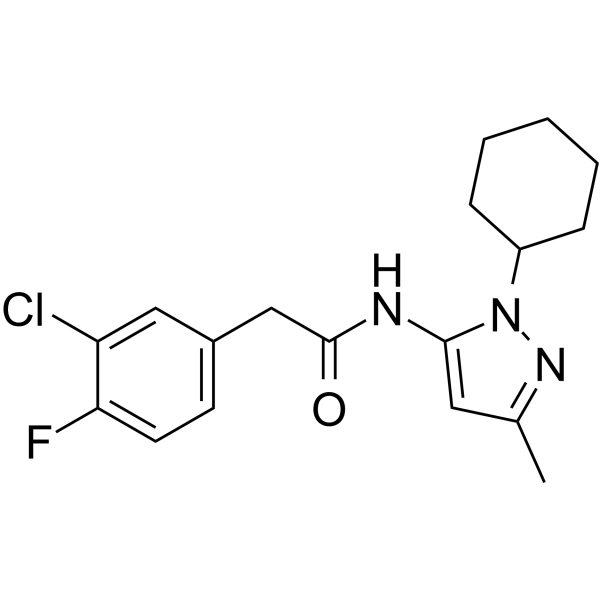
Physicochemical Properties
| Molecular Formula | C18H21CLFN3O |
| Molecular Weight | 349.830246686935 |
| Exact Mass | 349.135 |
| CAS # | 2126040-21-7 |
| PubChem CID | 146014436 |
| Appearance | White to off-white solid powder |
| LogP | 4.2 |
| Hydrogen Bond Donor Count | 1 |
| Hydrogen Bond Acceptor Count | 3 |
| Rotatable Bond Count | 4 |
| Heavy Atom Count | 24 |
| Complexity | 433 |
| Defined Atom Stereocenter Count | 0 |
| SMILES | ClC1=C(C=CC(=C1)CC(NC1=CC(C)=NN1C1CCCCC1)=O)F |
| InChi Key | HNJJARDABGKWSO-UHFFFAOYSA-N |
| InChi Code | InChI=1S/C18H21ClFN3O/c1-12-9-17(23(22-12)14-5-3-2-4-6-14)21-18(24)11-13-7-8-16(20)15(19)10-13/h7-10,14H,2-6,11H2,1H3,(H,21,24) |
| Chemical Name | 2-(3-chloro-4-fluorophenyl)-N-(2-cyclohexyl-5-methylpyrazol-3-yl)acetamide |
| Synonyms | VU 0810464; VU-0810464 |
| HS Tariff Code | 2934.99.9001 |
| Storage |
Powder-20°C 3 years 4°C 2 years In solvent -80°C 6 months -20°C 1 month |
| Shipping Condition | Room temperature (This product is stable at ambient temperature for a few days during ordinary shipping and time spent in Customs) |
Biological Activity
| ln Vitro | In SAN and HPC cells, VU0810464 (0, 0.1, 0.3, 1, 3, 10, 30 μM) generated concentration-dependent current response curves. Furthermore, compared to the control SAN unit, VU0810464 had nine times the potency to activate Kir3 channels in neurons[2]. |
| ln Vivo | Male C57BL/6J mice treated with VU0810464 (ip; 30 mg/kg, 10 mg/kg, 30 mg/kg; 30 min pretreatment) showed a dose-dependent decrease in the SIH response. VU0810464 (10 mg/kg) decreased the SIH response in wild-type mice but showed no impact in Kcnj3−/− animals, suggesting that it may work through Kir3 channel activation [2]. Compared to ML297 (Kp,uu = 0.32) VU0810464 (ip; 30 mg/kg; 15, 30, 45, or 60 minutes postinjection) demonstrated good brain distribution (Kp,uu = 0.83). According to PK tests, VU0810464 is rapidly eliminated, having a 20-minute half-life in the brain and plasma [2]. |
| Animal Protocol |
Animal/Disease Models: Male C57BL/6J mice, Kcnj3−/− female and male C57BL/6J mice Doses: 10mg/kg; 30mg/kg Route of Administration: intraperitoneal (ip) injection Experimental Results: Reduce stress-induced hyperthermia (SIH), This is a physiological test of anxiolytic efficacy in wild-type mice but has no effect on Kcnj3 (Girk1) −/− mice. |
| References |
[1]. VU0810464, a non-urea G protein-gated inwardly rectifying K+ (Kir 3/GIRK) channel activator, exhibits enhanced selectivity for neuronal Kir 3 channels and reduces stress-induced hyperthermia in mice.Br J Pharmacol. 2019 Jul;176(13):2238-2249. [2]. Discovery and Characterization of 1H-Pyrazol-5-yl-2-phenylacetamides as Novel, Non-Urea-Containing GIRK1/2 Potassium Channel Activators.ACS Chem Neurosci. 2017 Sep 20;8(9):1873-1879. |
Solubility Data
| Solubility (In Vitro) | DMSO : ≥ 250 mg/mL (~714.63 mM) |
| Solubility (In Vivo) |
Solubility in Formulation 1: ≥ 2.08 mg/mL (5.95 mM) (saturation unknown) in 10% DMSO + 40% PEG300 +5% Tween-80 + 45% Saline (add these co-solvents sequentially from left to right, and one by one), clear solution. For example, if 1 mL of working solution is to be prepared, you can add 100 μL of 20.8 mg/mL clear DMSO stock solution to 400 μL PEG300 and mix evenly; then add 50 μL Tween-80 + to the above solution and mix evenly; then add 450 μL normal saline to adjust the volume to 1 mL. Preparation of saline: Dissolve 0.9 g of sodium chloride in 100 mL ddH₂ O to obtain a clear solution. (Please use freshly prepared in vivo formulations for optimal results.) |
| Preparing Stock Solutions | 1 mg | 5 mg | 10 mg | |
| 1 mM | 2.8585 mL | 14.2927 mL | 28.5853 mL | |
| 5 mM | 0.5717 mL | 2.8585 mL | 5.7171 mL | |
| 10 mM | 0.2859 mL | 1.4293 mL | 2.8585 mL |