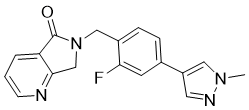
Physicochemical Properties
| Molecular Formula | C18H15FN4O |
| Molecular Weight | 322.336306810379 |
| Exact Mass | 322.12 |
| Elemental Analysis | C, 67.07; H, 4.69; F, 5.89; N, 17.38; O, 4.96 |
| CAS # | 1432436-13-9 |
| PubChem CID | 71555066 |
| Appearance | Off-white to light yellow solid powder |
| Hydrogen Bond Donor Count | 0 |
| Hydrogen Bond Acceptor Count | 4 |
| Rotatable Bond Count | 3 |
| Heavy Atom Count | 24 |
| Complexity | 476 |
| Defined Atom Stereocenter Count | 0 |
| InChi Key | LIZQOZALTSDKFU-UHFFFAOYSA-N |
| InChi Code | InChI=1S/C18H15FN4O/c1-22-9-14(8-21-22)12-4-5-13(16(19)7-12)10-23-11-17-15(18(23)24)3-2-6-20-17/h2-9H,10-11H2,1H3 |
| Chemical Name | 6-[[2-fluoro-4-(1-methylpyrazol-4-yl)phenyl]methyl]-7H-pyrrolo[3,4-b]pyridin-5-one |
| Synonyms | VU-0453595; VU0453595; VU 0453595 |
| HS Tariff Code | 2934.99.9001 |
| Storage |
Powder-20°C 3 years 4°C 2 years In solvent -80°C 6 months -20°C 1 month |
| Shipping Condition | Room temperature (This product is stable at ambient temperature for a few days during ordinary shipping and time spent in Customs) |
Biological Activity
| ln Vitro | Applying M1 PAM VU0453595 (3 μM) causes medium spiny neurons (MSNs) to become temporarily more excitable[3]. |
| ln Vivo |
VU0453595 increases the intensity of M1-mediated muscarinic long-term depression (mLTD)[1]. VU0453595 (1-10 mg/kg; i.p.) restores behavioral deficiencies brought on by phencyclidine (PCP) administration repeated[1]. |
| Animal Protocol |
Male C57BL6/J mice (8-9 weeks old) 1, 3, or 10 mg/kg Intraperitoneal (i.p.); 10 mL/kg; administered 30 min before the social interaction test |
| References |
[1]. Potentiation of M1 Muscarinic Receptor Reverses Plasticity Deficits and Negative and Cognitive Symptoms in a Schizophrenia Mouse Model. Neuropsychopharmacology. 2016 Jan;41(2):598-610. [2]. M1-positive allosteric modulators lacking agonist activity provide the optimal profile for enhancing cognition. Neuropsychopharmacology. 2018 Jul;43(8):1763-1771. [3]. M1 muscarinic activation induces long-lasting increase in intrinsic excitability of striatal projection neurons. Neuropharmacology. 2017 May 15;118:209-222. |
Solubility Data
| Solubility (In Vitro) | DMSO: ~100 mg/mL (~310.2 mM) |
| Solubility (In Vivo) |
Solubility in Formulation 1: ≥ 2.5 mg/mL (7.76 mM) (saturation unknown) in 10% DMSO + 40% PEG300 + 5% Tween80 + 45% Saline (add these co-solvents sequentially from left to right, and one by one), clear solution. For example, if 1 mL of working solution is to be prepared, you can add 100 μL of 25.0 mg/mL clear DMSO stock solution to 400 μL PEG300 and mix evenly; then add 50 μL Tween-80 to the above solution and mix evenly; then add 450 μL normal saline to adjust the volume to 1 mL. Preparation of saline: Dissolve 0.9 g of sodium chloride in 100 mL ddH₂ O to obtain a clear solution. Solubility in Formulation 2: ≥ 2.5 mg/mL (7.76 mM) (saturation unknown) in 10% DMSO + 90% (20% SBE-β-CD in Saline) (add these co-solvents sequentially from left to right, and one by one), clear solution. For example, if 1 mL of working solution is to be prepared, you can add 100 μL of 25.0 mg/mL clear DMSO stock solution to 900 μL of 20% SBE-β-CD physiological saline solution and mix evenly. Preparation of 20% SBE-β-CD in Saline (4°C,1 week): Dissolve 2 g SBE-β-CD in 10 mL saline to obtain a clear solution. (Please use freshly prepared in vivo formulations for optimal results.) |
| Preparing Stock Solutions | 1 mg | 5 mg | 10 mg | |
| 1 mM | 3.1023 mL | 15.5116 mL | 31.0231 mL | |
| 5 mM | 0.6205 mL | 3.1023 mL | 6.2046 mL | |
| 10 mM | 0.3102 mL | 1.5512 mL | 3.1023 mL |