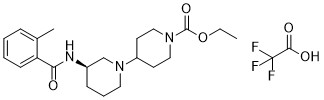
Physicochemical Properties
| Molecular Formula | C23H32F3N3O5 |
| Molecular Weight | 487.52 |
| Exact Mass | 487.229 |
| Elemental Analysis | C, 56.66; H, 6.62; F, 11.69; N, 8.62; O, 16.41 |
| CAS # | 1240514-89-9 |
| Related CAS # | 1240514-87-7;1240514-89-9 (TFA); |
| PubChem CID | 91885398 |
| Appearance | White to off-white solid powder |
| Hydrogen Bond Donor Count | 2 |
| Hydrogen Bond Acceptor Count | 9 |
| Rotatable Bond Count | 5 |
| Heavy Atom Count | 34 |
| Complexity | 588 |
| Defined Atom Stereocenter Count | 1 |
| SMILES | CCOC(=O)N1CCC(CC1)N2CCC[C@H](C2)NC(=O)C3=CC=CC=C3C.C(=O)(C(F)(F)F)O |
| InChi Key | QEFQJTFXOBPBLZ-UNTBIKODSA-N |
| InChi Code | InChI=1S/C21H31N3O3.C2HF3O2/c1-3-27-21(26)23-13-10-18(11-14-23)24-12-6-8-17(15-24)22-20(25)19-9-5-4-7-16(19)2;3-2(4,5)1(6)7/h4-5,7,9,17-18H,3,6,8,10-15H2,1-2H3,(H,22,25);(H,6,7)/t17-;/m1./s1 |
| Chemical Name | ethyl (R)-3-(2-methylbenzamido)-[1,4'-bipiperidine]-1'-carboxylate 2,2,2-trifluoroacetate |
| Synonyms | VU0364572 TFA salt; 1240514-89-9; VU0364572 (trifluoroacetate salt); AKOS037643457 |
| HS Tariff Code | 2934.99.9001 |
| Storage |
Powder-20°C 3 years 4°C 2 years In solvent -80°C 6 months -20°C 1 month |
| Shipping Condition | Room temperature (This product is stable at ambient temperature for a few days during ordinary shipping and time spent in Customs) |
Biological Activity
| ln Vitro | In striatal/NAc slices, VU0364572 (30 μM; 25 min) TFA stimulates the phosphorylation of KCNQ2, NR1, and MARCKS [2]. |
| ln Vivo | VU0364572 TFA (10 mg/kg/day; oral; 4 months) TFA demonstrates neuroprotective effects in the onset of Alzheimer's disease in 5XFAD accounts. The half-life of VU0364572 is 45 minutes [1]. |
| Cell Assay |
Western Blot Analysis[2] Cell Types: Striatal/NAc slices Tested Concentrations: 30 μM Incubation Duration: 25 min Experimental Results: Dramatically increased phosphorylation of KCNQ2 at T217, NR1 at S890 and MARCKS at S152/156. |
| Animal Protocol |
Animal/Disease Models: 5XFAD transgenic Alzheimer's disease mice [1] Doses: 10 mg/kg/day Route of Administration: Drinking water, 2 months to 6 months Experimental Results: Preserved hippocampal memory. Levels of soluble and insoluble Aβ40,42 were Dramatically diminished in the cortex and hippocampus of these animals. Levels of oligomers (oAβ) were Dramatically diminished in the cortex. |
| References |
[1]. Disease-Modifying Effects of M1 Muscarinic Acetylcholine Receptor Activation in an Alzheimer's Disease Mouse Model. ACS Chem Neurosci. 2017 Jun 21;8(6):1177-1187. [2]. Muscarinic signaling regulates voltage-gated potassium channel KCNQ2 phosphorylation in the nucleus accumbens via protein kinase C for aversive learning. J Neurochem. 2022 Feb;160(3):325-341. [3]. Development of a highly selective, orally bioavailable and CNS penetrant M1 agonist derived from the MLPCN probe ML071. Bioorg Med Chem Lett. 2011 Nov 1;21(21):6451-5. |
Solubility Data
| Solubility (In Vitro) | May dissolve in DMSO (in most cases), if not, try other solvents such as H2O, Ethanol, or DMF with a minute amount of products to avoid loss of samples |
| Solubility (In Vivo) |
Note: Listed below are some common formulations that may be used to formulate products with low water solubility (e.g. < 1 mg/mL), you may test these formulations using a minute amount of products to avoid loss of samples. Injection Formulations (e.g. IP/IV/IM/SC) Injection Formulation 1: DMSO : Tween 80: Saline = 10 : 5 : 85 (i.e. 100 μL DMSO stock solution → 50 μL Tween 80 → 850 μL Saline) *Preparation of saline: Dissolve 0.9 g of sodium chloride in 100 mL ddH ₂ O to obtain a clear solution. Injection Formulation 2: DMSO : PEG300 :Tween 80 : Saline = 10 : 40 : 5 : 45 (i.e. 100 μL DMSO → 400 μLPEG300 → 50 μL Tween 80 → 450 μL Saline) Injection Formulation 3: DMSO : Corn oil = 10 : 90 (i.e. 100 μL DMSO → 900 μL Corn oil) Example: Take the Injection Formulation 3 (DMSO : Corn oil = 10 : 90) as an example, if 1 mL of 2.5 mg/mL working solution is to be prepared, you can take 100 μL 25 mg/mL DMSO stock solution and add to 900 μL corn oil, mix well to obtain a clear or suspension solution (2.5 mg/mL, ready for use in animals). Injection Formulation 4: DMSO : 20% SBE-β-CD in saline = 10 : 90 [i.e. 100 μL DMSO → 900 μL (20% SBE-β-CD in saline)] *Preparation of 20% SBE-β-CD in Saline (4°C,1 week): Dissolve 2 g SBE-β-CD in 10 mL saline to obtain a clear solution. Injection Formulation 5: 2-Hydroxypropyl-β-cyclodextrin : Saline = 50 : 50 (i.e. 500 μL 2-Hydroxypropyl-β-cyclodextrin → 500 μL Saline) Injection Formulation 6: DMSO : PEG300 : castor oil : Saline = 5 : 10 : 20 : 65 (i.e. 50 μL DMSO → 100 μLPEG300 → 200 μL castor oil → 650 μL Saline) Injection Formulation 7: Ethanol : Cremophor : Saline = 10: 10 : 80 (i.e. 100 μL Ethanol → 100 μL Cremophor → 800 μL Saline) Injection Formulation 8: Dissolve in Cremophor/Ethanol (50 : 50), then diluted by Saline Injection Formulation 9: EtOH : Corn oil = 10 : 90 (i.e. 100 μL EtOH → 900 μL Corn oil) Injection Formulation 10: EtOH : PEG300:Tween 80 : Saline = 10 : 40 : 5 : 45 (i.e. 100 μL EtOH → 400 μLPEG300 → 50 μL Tween 80 → 450 μL Saline) Oral Formulations Oral Formulation 1: Suspend in 0.5% CMC Na (carboxymethylcellulose sodium) Oral Formulation 2: Suspend in 0.5% Carboxymethyl cellulose Example: Take the Oral Formulation 1 (Suspend in 0.5% CMC Na) as an example, if 100 mL of 2.5 mg/mL working solution is to be prepared, you can first prepare 0.5% CMC Na solution by measuring 0.5 g CMC Na and dissolve it in 100 mL ddH2O to obtain a clear solution; then add 250 mg of the product to 100 mL 0.5% CMC Na solution, to make the suspension solution (2.5 mg/mL, ready for use in animals). Oral Formulation 3: Dissolved in PEG400 Oral Formulation 4: Suspend in 0.2% Carboxymethyl cellulose Oral Formulation 5: Dissolve in 0.25% Tween 80 and 0.5% Carboxymethyl cellulose Oral Formulation 6: Mixing with food powders Note: Please be aware that the above formulations are for reference only. InvivoChem strongly recommends customers to read literature methods/protocols carefully before determining which formulation you should use for in vivo studies, as different compounds have different solubility properties and have to be formulated differently. (Please use freshly prepared in vivo formulations for optimal results.) |
| Preparing Stock Solutions | 1 mg | 5 mg | 10 mg | |
| 1 mM | 2.0512 mL | 10.2560 mL | 20.5120 mL | |
| 5 mM | 0.4102 mL | 2.0512 mL | 4.1024 mL | |
| 10 mM | 0.2051 mL | 1.0256 mL | 2.0512 mL |