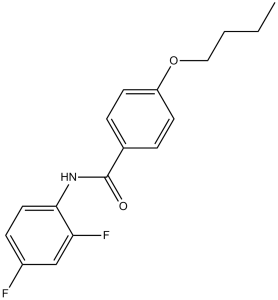
VU0357121 (VU-0357121, VU 0357121) is a positive allosteric modulator (PAM) of mGlu5 (metabotropic glutamate receptor 4) with antiparkinsonian-like effects. In inhibits mGlu5 with an EC50 of 33 nM, and exhibits little activity against other mGlu receptor subtypes.
Physicochemical Properties
| Molecular Formula | C17H17F2NO2 | |
| Molecular Weight | 305.32 | |
| Exact Mass | 305.122 | |
| CAS # | 433967-28-3 | |
| Related CAS # |
|
|
| PubChem CID | 2296132 | |
| Appearance | White to off-white solid powder | |
| Density | 1.2±0.1 g/cm3 | |
| Boiling Point | 338.7±42.0 °C at 760 mmHg | |
| Flash Point | 158.7±27.9 °C | |
| Vapour Pressure | 0.0±0.7 mmHg at 25°C | |
| Index of Refraction | 1.564 | |
| LogP | 4.78 | |
| Hydrogen Bond Donor Count | 1 | |
| Hydrogen Bond Acceptor Count | 4 | |
| Rotatable Bond Count | 6 | |
| Heavy Atom Count | 22 | |
| Complexity | 346 | |
| Defined Atom Stereocenter Count | 0 | |
| InChi Key | AHCYOTLTLQTPSU-UHFFFAOYSA-N | |
| InChi Code | InChI=1S/C17H17F2NO2/c1-2-3-10-22-14-7-4-12(5-8-14)17(21)20-16-9-6-13(18)11-15(16)19/h4-9,11H,2-3,10H2,1H3,(H,20,21) | |
| Chemical Name | 4-butoxy-N-(2,4-difluorophenyl)benzamide | |
| Synonyms |
|
|
| HS Tariff Code | 2934.99.9001 | |
| Storage |
Powder-20°C 3 years 4°C 2 years In solvent -80°C 6 months -20°C 1 month |
|
| Shipping Condition | Room temperature (This product is stable at ambient temperature for a few days during ordinary shipping and time spent in Customs) |
Biological Activity
| Targets |
Metabotropic glutamate receptor 5 (mGlu5) (Ki = 14.5 nM; EC50 = 36 nM for potentiation of glutamate-induced calcium mobilization) [1] |
||
| ln Vitro |
The fact that VU 0357121 can increase mGlu5's glutamate sensitivity is probably because of an interaction at a receptor site that is different from the MPEP binding site. VU 0357121 lacks mGlu5 NAM activity because it does not bind at the MPEP allosteric site of mGlu5. While the F585I/rmGlu5 mutation does not change the response to VU 0357121, the A809V/rmGlu5 mutation hindered VU 0357121's ability to shift the glutamate concentration response curve. In the Ca2+ mobilization assay, VU 0357121 exhibits less cooperation in the low-expressing HEK293A-mGlu5 cell line[1]. VU 0357121 acts as a positive allosteric modulator (PAM) of mGlu5 with high selectivity. In Chinese hamster ovary (CHO) cells expressing human mGlu5, it potentiated glutamate-induced calcium mobilization in a concentration-dependent manner, with an EC50 of 36 nM and a maximal potentiation fold of ~3.5 [1] It showed no significant activity against other mGlu receptor subtypes (mGlu1-4, 6-8) at concentrations up to 10 μM, and no binding affinity for ionotropic glutamate receptors (NMDA, AMPA, kainate) or other central nervous system targets (e.g., GABA receptors, dopamine receptors) [1] In rat hippocampal slices, VU 0357121 (1-10 μM) enhanced mGlu5-mediated long-term potentiation (LTP) at Schaffer collateral-CA1 synapses, with maximal enhancement observed at 5 μM; this effect was blocked by the selective mGlu5 antagonist MPEP [1] In cultured rat cortical neurons, VU 0357121 (10-100 nM) dose-dependently increased glutamate-induced extracellular signal-regulated kinase (ERK) 1/2 and cAMP response element-binding protein (CREB) phosphorylation, key downstream signaling events of mGlu5 activation [1] |
||
| ln Vivo |
|
||
| Enzyme Assay |
Radioligand binding assay for mGlu5: Prepare membrane homogenates from CHO cells expressing human mGlu5. Incubate homogenates with a fixed concentration of [3H]-MPEP (a selective mGlu5 antagonist) and various concentrations of VU 0357121 at 25°C for 60 minutes. Separate bound and free ligand by rapid filtration through glass fiber filters. Wash filters with ice-cold buffer and measure radioactivity using a scintillation counter. Calculate Ki value based on competition binding curves [1] Glutamate-induced calcium mobilization assay: Seed CHO-hmGlu5 cells in 96-well plates and culture until confluent. Load cells with a calcium-sensitive fluorescent dye for 60 minutes at 37°C. Preincubate cells with VU 0357121 (0.1-1000 nM) for 30 minutes, then stimulate with a submaximal concentration of glutamate (0.5 μM). Record fluorescent intensity changes in real time using a microplate reader. Calculate EC50 as the concentration that potentiates 50% of the maximal glutamate-induced calcium response [1] |
||
| Cell Assay |
Hippocampal slice LTP assay: Prepare 300-μm-thick rat hippocampal slices and incubate in artificial cerebrospinal fluid (ACSF) at 32°C for 1 hour. Add VU 0357121 (1-10 μM) to the ACSF for 30 minutes before inducing LTP via high-frequency stimulation (100 Hz for 1 second). Record field excitatory postsynaptic potentials (fEPSPs) for 60 minutes after LTP induction to assess synaptic potentiation enhancement [1] Cortical neuron ERK/CREB phosphorylation assay: Isolate cortical neurons from embryonic rat brains, seed in poly-D-lysine-coated plates, and culture in neurobasal medium for 7-10 days. Treat neurons with VU 0357121 (10-100 nM) plus glutamate (0.5 μM) for 10 minutes. Lyse cells, separate proteins by SDS-PAGE, and transfer to nitrocellulose membranes. Probe with antibodies against phosphorylated ERK (p-ERK), phosphorylated CREB (p-CREB), total ERK, and total CREB. Detect immunoreactive bands via chemiluminescence and quantify intensity using densitometry [1] |
||
| Animal Protocol |
|
||
| ADME/Pharmacokinetics |
Oral absorption: VU 0357121 has moderate oral bioavailability of ~42% in rats [1] Distribution: It distributes into peripheral tissues and the central nervous system, with a brain/plasma concentration ratio of ~0.7 in rats 2 hours after oral dosing [1] Metabolism: It is metabolized in the liver primarily via cytochrome P450 3A4, producing two major hydroxylated metabolites with reduced PAM activity [1] Excretion: The elimination half-life (t1/2) is ~3.8 hours in rats. Approximately 52% of the dose is excreted in feces and 38% in urine, with <10% excreted as unchanged drug [1] Plasma protein binding: VU 0357121 has a plasma protein binding rate of ~88% in rats [1] |
||
| Toxicity/Toxicokinetics |
Acute toxicity study in rats showed no mortality or overt toxicity at oral doses up to 150 mg/kg [1] In vitro cytotoxicity assay in CHO cells and rat cortical neurons showed no significant cell viability reduction at concentrations up to 10 μM (10-fold higher than the maximal effective concentration in functional assays) [1] |
||
| References |
[1]. Discovery of a Novel Chemical Class of mGlu5 Allosteric Ligands with Distinct Modes of Pharmacology. ACS Chemical Neuroscience (2010), 1(10), 702-716. |
||
| Additional Infomation |
VU 0357121 belongs to a novel chemical class of mGlu5 positive allosteric modulators (PAMs) with a distinct pharmacophore compared to earlier mGlu5 PAMs [1] Its mechanism of action involves binding to a unique allosteric site on mGlu5, enhancing the receptor’s sensitivity to endogenous glutamate without direct receptor activation [1] It exhibits high subtype selectivity for mGlu5, which minimizes off-target effects and improves safety profile [1] The potentiation of mGlu5-mediated synaptic plasticity (LTP) and downstream ERK/CREB signaling suggests potential procognitive effects, supporting its utility as a tool compound for studying mGlu5 function in learning and memory processes [1] |
Solubility Data
| Solubility (In Vitro) |
|
|||
| Solubility (In Vivo) |
Solubility in Formulation 1: 2.5 mg/mL (8.19 mM) in 10% DMSO + 40% PEG300 + 5% Tween80 + 45% Saline (add these co-solvents sequentially from left to right, and one by one), suspension solution; with sonication. For example, if 1 mL of working solution is to be prepared, you can add 100 μL of 25.0 mg/mL clear DMSO stock solution to 400 μL PEG300 and mix evenly; then add 50 μL Tween-80 to the above solution and mix evenly; then add 450 μL normal saline to adjust the volume to 1 mL. Preparation of saline: Dissolve 0.9 g of sodium chloride in 100 mL ddH₂ O to obtain a clear solution. Solubility in Formulation 2: ≥ 2.5 mg/mL (8.19 mM) (saturation unknown) in 10% DMSO + 90% Corn Oil (add these co-solvents sequentially from left to right, and one by one), clear solution. For example, if 1 mL of working solution is to be prepared, you can add 100 μL of 25.0 mg/mL clear DMSO stock solution to 900 μL of corn oil and mix evenly. (Please use freshly prepared in vivo formulations for optimal results.) |
| Preparing Stock Solutions | 1 mg | 5 mg | 10 mg | |
| 1 mM | 3.2753 mL | 16.3763 mL | 32.7525 mL | |
| 5 mM | 0.6551 mL | 3.2753 mL | 6.5505 mL | |
| 10 mM | 0.3275 mL | 1.6376 mL | 3.2753 mL |