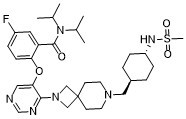
VTP50469 (VTP-50469) is a novel, oral and potent inhibitor of Menin-MLL protein protein interaction (Ki = 104 pM) with potential anticancer activity. Inhibition of the menin(MEN) and MLL1(KMT2A) interaction reverses leukemic gene expression driven by MLL-fusion proteins and is a potential targeted therapeutic strategy in MLL-rearranged AML.
Physicochemical Properties
| Molecular Formula | C32H47FN6O4S |
| Molecular Weight | 630.8168 |
| Exact Mass | 630.336 |
| CAS # | 2169916-18-9 |
| Related CAS # | VTP50469 fumarate;2169919-29-1 |
| PubChem CID | 132212900 |
| Appearance | White to light yellow solid powder |
| LogP | 4.4 |
| Hydrogen Bond Donor Count | 1 |
| Hydrogen Bond Acceptor Count | 10 |
| Rotatable Bond Count | 10 |
| Heavy Atom Count | 44 |
| Complexity | 1040 |
| Defined Atom Stereocenter Count | 0 |
| SMILES | S(C([H])([H])[H])(N([H])C1([H])C([H])([H])C([H])([H])C([H])(C([H])([H])C1([H])[H])C([H])([H])N1C([H])([H])C([H])([H])C2(C([H])([H])C1([H])[H])C([H])([H])N(C1C(=C([H])N=C([H])N=1)OC1C([H])=C([H])C(=C([H])C=1C(N(C([H])(C([H])([H])[H])C([H])([H])[H])C([H])(C([H])([H])[H])C([H])([H])[H])=O)F)C2([H])[H])(=O)=O |
| InChi Key | ADHHOUXZPBYYSU-UHFFFAOYSA-N |
| InChi Code | InChI=1S/C32H47FN6O4S/c1-22(2)39(23(3)4)31(40)27-16-25(33)8-11-28(27)43-29-17-34-21-35-30(29)38-19-32(20-38)12-14-37(15-13-32)18-24-6-9-26(10-7-24)36-44(5,41)42/h8,11,16-17,21-24,26,36H,6-7,9-10,12-15,18-20H2,1-5H3 |
| Chemical Name | 5-fluoro-2-[4-[7-[[4-(methanesulfonamido)cyclohexyl]methyl]-2,7-diazaspiro[3.5]nonan-2-yl]pyrimidin-5-yl]oxy-N,N-di(propan-2-yl)benzamide |
| Synonyms | VTP50469 VTP-50469 |
| HS Tariff Code | 2934.99.9001 |
| Storage |
Powder-20°C 3 years 4°C 2 years In solvent -80°C 6 months -20°C 1 month |
| Shipping Condition | Room temperature (This product is stable at ambient temperature for a few days during ordinary shipping and time spent in Customs) |
Biological Activity
| ln Vitro | Commercially available VTP50469 (MOLM13 (IC50: 13 nM), THP1 (IC50: 37 nM), NOMO1 (IC50: 30 nM), ML2 (IC50: 16 nM), EOL1 (IC50: 20 nM), and mouse MLL-AF9 cells (IC50 of 15 nM) and ALL (KOPN8 (IC50 of 15 nM), HB11;19 (IC50 of 36 nM), MV4;11 (IC50 of 17 nM), SEMK2 (IC50 of 27 nM), and RS4;11 (IC 50: 25 nM)) [1]. MLL-r B cells react dose-dependently to VTP50469 at early time points. VTP50469 is submitted by MLL-r AML cell lines 4-6 days following VTP50469. removed from the protein complex and stops MLL from labeling genes' chromatin. Changes in gene expression, yeast, and cell dormancy are caused by MLL-bound staining [1]. |
| ln Vivo | Treatment with VTP50469 (15-60 mg/kg; interventional; twice daily; 28 days; NSG mice) was highly successful at all dosages, with significant survival in all treatment groups. Advantages are 30 and 60 mg/kg |
| Animal Protocol |
Animal/Disease Models: Unconditional Immunodeficient (NSG) mice with MV4;11 cells [1] Doses: 15 mg/kg, 30 mg/kg and 60 mg/kg Route of Administration: Orally drug; twice (two times) daily; for 28 days Experimental Results: Highly effective at all dose levels, and all treatment groups had a significant survival advantage over the control group. |
| References |
[1]. A Menin-MLL Inhibitor Induces Specific Chromatin Changes and Eradicates Disease in Models of MLL-Rearranged Leukemia. Cancer Cell. 2019 Dec 9;36(6):660-673.e11. [2]. Abstract 4958: VTP50469 is a novel, orally available menin-MLL1 inhibitor effective against MLL-rearranged and NPM1-mutant leukemia. Cancer Resceach. July 2018.Volume 78, Issue 13 Supplement. |
Solubility Data
| Solubility (In Vitro) | DMSO : ~125 mg/mL (~198.15 mM) |
| Solubility (In Vivo) |
Solubility in Formulation 1: ≥ 2.5 mg/mL (3.96 mM) (saturation unknown) in 5% DMSO + 40% PEG300 + 5% Tween80 + 50% Saline (add these co-solvents sequentially from left to right, and one by one), clear solution. Preparation of saline: Dissolve 0.9 g of sodium chloride in 100 mL ddH₂ O to obtain a clear solution. Solubility in Formulation 2: ≥ 2.5 mg/mL (3.96 mM) (saturation unknown) in 5% DMSO + 95% (20% SBE-β-CD in Saline) (add these co-solvents sequentially from left to right, and one by one), clear solution. Preparation of 20% SBE-β-CD in Saline (4°C,1 week): Dissolve 2 g SBE-β-CD in 10 mL saline to obtain a clear solution. Solubility in Formulation 3: ≥ 2.08 mg/mL (3.30 mM) (saturation unknown) in 10% DMSO + 40% PEG300 + 5% Tween80 + 45% Saline (add these co-solvents sequentially from left to right, and one by one), clear solution. For example, if 1 mL of working solution is to be prepared, you can add 100 μL of 20.8 mg/mL clear DMSO stock solution to 400 μL PEG300 and mix evenly; then add 50 μL Tween-80 to the above solution and mix evenly; then add 450 μL normal saline to adjust the volume to 1 mL. Preparation of saline: Dissolve 0.9 g of sodium chloride in 100 mL ddH₂ O to obtain a clear solution. Solubility in Formulation 4: ≥ 2.08 mg/mL (3.30 mM) (saturation unknown) in 10% DMSO + 90% (20% SBE-β-CD in Saline) (add these co-solvents sequentially from left to right, and one by one), clear solution. For example, if 1 mL of working solution is to be prepared, you can add 100 μL of 20.8 mg/mL clear DMSO stock solution to 900 μL of 20% SBE-β-CD physiological saline solution and mix evenly. Preparation of 20% SBE-β-CD in Saline (4°C,1 week): Dissolve 2 g SBE-β-CD in 10 mL saline to obtain a clear solution. Solubility in Formulation 5: ≥ 2.08 mg/mL (3.30 mM) (saturation unknown) in 10% DMSO + 90% Corn Oil (add these co-solvents sequentially from left to right, and one by one), clear solution. For example, if 1 mL of working solution is to be prepared, you can add 100 μL of 20.8 mg/mL clear DMSO stock solution to 900 μL of corn oil and mix evenly. (Please use freshly prepared in vivo formulations for optimal results.) |
| Preparing Stock Solutions | 1 mg | 5 mg | 10 mg | |
| 1 mM | 1.5852 mL | 7.9262 mL | 15.8524 mL | |
| 5 mM | 0.3170 mL | 1.5852 mL | 3.1705 mL | |
| 10 mM | 0.1585 mL | 0.7926 mL | 1.5852 mL |