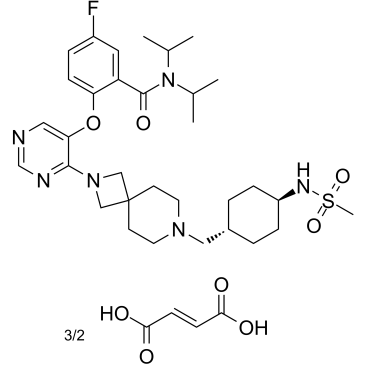
VTP50469 fumarate, the fumarate salt of VTP50469 (VTP-50469), is an orally bioavailable inhibitor of Menin-MLL interaction (Ki = 104 pM) with potential antineoplastic activity.
Physicochemical Properties
| Molecular Formula | C32H47FN6O4S.3/2C4H4O4 |
| Molecular Weight | 746.90 |
| Exact Mass | 1608.705 |
| CAS # | 2169919-29-1 |
| Related CAS # | VTP50469;2169916-18-9 |
| PubChem CID | 168012211 |
| Appearance | White to off-white solid powder |
| Hydrogen Bond Donor Count | 8 |
| Hydrogen Bond Acceptor Count | 32 |
| Rotatable Bond Count | 26 |
| Heavy Atom Count | 112 |
| Complexity | 1160 |
| Defined Atom Stereocenter Count | 0 |
| SMILES | C([C@H]1CC[C@H](NS(=O)(=O)C)CC1)N1CCC2(CN(C3=NC=NC=C3OC3C=CC(F)=CC=3C(=O)N(C(C)C)C(C)C)C2)CC1.C(/C(=O)O)=C\C(=O)O |
| InChi Key | DGSSIIRNGCQGQL-VQYXCCSOSA-N |
| InChi Code | InChI=1S/2C32H47FN6O4S.3C4H4O4/c2*1-22(2)39(23(3)4)31(40)27-16-25(33)8-11-28(27)43-29-17-34-21-35-30(29)38-19-32(20-38)12-14-37(15-13-32)18-24-6-9-26(10-7-24)36-44(5,41)42;3*5-3(6)1-2-4(7)8/h2*8,11,16-17,21-24,26,36H,6-7,9-10,12-15,18-20H2,1-5H3;3*1-2H,(H,5,6)(H,7,8)/b;;3*2-1+ |
| Chemical Name | (E)-but-2-enedioic acid;5-fluoro-2-[4-[7-[[4-(methanesulfonamido)cyclohexyl]methyl]-2,7-diazaspiro[3.5]nonan-2-yl]pyrimidin-5-yl]oxy-N,N-di(propan-2-yl)benzamide |
| Synonyms | VTP 50469 fumarate VTP-50469 fumarate |
| HS Tariff Code | 2934.99.9001 |
| Storage |
Powder-20°C 3 years 4°C 2 years In solvent -80°C 6 months -20°C 1 month Note: Please store this product in a sealed and protected environment (e.g. under nitrogen), avoid exposure to moisture and light. |
| Shipping Condition | Room temperature (This product is stable at ambient temperature for a few days during ordinary shipping and time spent in Customs) |
Biological Activity
| ln Vitro | VTP50469 exhibits activity in cells containing the following: mouse MLL-AF9 cells (IC50 = 15 nM), ALL (KOPN8 (IC50 = 15 nM), HB11;19 (IC50 = 36 nM), MV4;11 (IC50 = 17 nM), SEMK2 (IC50 = 27 nM), and RS4;11 (IC50 = 25 nM)) cell line. Early on, MLL-r B-cell ALL (B-ALL) cell lines respond to VTP50469. They experience dose-dependent apoptosis, but not MLL-r AML cell lines. Four to six days after being exposed to VTP50469, MLL-r AML cell lines start to differentiate in a dose-dependent manner [1]. Menin is replaced by VTP50469 in protein complexes, and it prevents MLL from occupying certain genes' chromatin. Apoptosis, differentiation, and gene expression are all altered by loss of MLL binding [1]. |
| ln Vivo | The VTP50469 (15–60 mg/kg) oral medication administered twice daily for 28 days to NSG mice was very effective at all dose levels and significantly increased survival in all treatment groups. VTP50469 dosages of 30 and 60 mg/kg provided mice with a sustained survival benefit [1]. |
| Animal Protocol |
Animal/Disease Models: Non-Conditioned Immunodeficient (NSG) Mice with MV4; 11 cells[1] Doses: 15 mg/kg, 30 mg/kg, and 60 mg/kg Route of Administration: Oral; :Oral administration. twice (two times) daily; for 28 days Experimental Results: Highly effective at all dose levels, and all treatment groups had a significant survival advantage over the control group. |
| References |
[1]. A Menin-MLL Inhibitor Induces Specific Chromatin Changes and Eradicates Disease in Models of MLL-Rearranged Leukemia. Cancer Cell. 2019 Dec 9;36(6):660-673.e11. [2]. Abstract 4958: VTP50469 is a novel, orally available menin-MLL1 inhibitor effective against MLL-rearranged and NPM1-mutant leukemia. Cancer Resceach. July 2018.Volume 78, Issue 13 Supplement. |
Solubility Data
| Solubility (In Vitro) | DMSO : ~100 mg/mL (~124.23 mM) |
| Solubility (In Vivo) |
Solubility in Formulation 1: ≥ 2.5 mg/mL (3.11 mM) (saturation unknown) in 10% DMSO + 40% PEG300 + 5% Tween80 + 45% Saline (add these co-solvents sequentially from left to right, and one by one), clear solution. For example, if 1 mL of working solution is to be prepared, you can add 100 μL of 25.0 mg/mL clear DMSO stock solution to 400 μL PEG300 and mix evenly; then add 50 μL Tween-80 to the above solution and mix evenly; then add 450 μL normal saline to adjust the volume to 1 mL. Preparation of saline: Dissolve 0.9 g of sodium chloride in 100 mL ddH₂ O to obtain a clear solution. Solubility in Formulation 2: ≥ 2.5 mg/mL (3.11 mM) (saturation unknown) in 10% DMSO + 90% (20% SBE-β-CD in Saline) (add these co-solvents sequentially from left to right, and one by one), clear solution. For example, if 1 mL of working solution is to be prepared, you can add 100 μL of 25.0 mg/mL clear DMSO stock solution to 900 μL of 20% SBE-β-CD physiological saline solution and mix evenly. Preparation of 20% SBE-β-CD in Saline (4°C,1 week): Dissolve 2 g SBE-β-CD in 10 mL saline to obtain a clear solution. Solubility in Formulation 3: ≥ 2.5 mg/mL (3.11 mM) (saturation unknown) in 10% DMSO + 90% Corn Oil (add these co-solvents sequentially from left to right, and one by one), clear solution. For example, if 1 mL of working solution is to be prepared, you can add 100 μL of 25.0 mg/mL clear DMSO stock solution to 900 μL of corn oil and mix evenly. Solubility in Formulation 4: 13.33 mg/mL (16.56 mM) in 0.5% Hypromellose (add these co-solvents sequentially from left to right, and one by one), clear solution; with ultrasonication. (Please use freshly prepared in vivo formulations for optimal results.) |
| Preparing Stock Solutions | 1 mg | 5 mg | 10 mg | |
| 1 mM | 1.3389 mL | 6.6943 mL | 13.3887 mL | |
| 5 mM | 0.2678 mL | 1.3389 mL | 2.6777 mL | |
| 10 mM | 0.1339 mL | 0.6694 mL | 1.3389 mL |