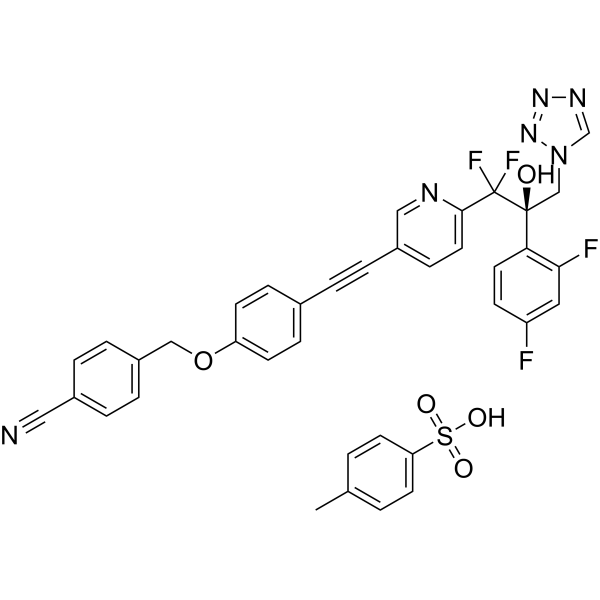
Physicochemical Properties
| Molecular Formula | C38H28F4N6O5S |
| Molecular Weight | 756.724740982056 |
| Exact Mass | 756.177 |
| CAS # | 2089321-00-4 |
| Related CAS # | VT-1598;2089320-99-8 |
| PubChem CID | 166450509 |
| Appearance | Typically exists as solid at room temperature |
| Hydrogen Bond Donor Count | 2 |
| Hydrogen Bond Acceptor Count | 14 |
| Rotatable Bond Count | 11 |
| Heavy Atom Count | 54 |
| Complexity | 1240 |
| Defined Atom Stereocenter Count | 1 |
| SMILES | CC1=CC=C(C=C1)S(=O)(=O)O.C1=CC(=CC=C1COC2=CC=C(C=C2)C#CC3=CN=C(C=C3)C([C@](CN4C=NN=N4)(C5=C(C=C(C=C5)F)F)O)(F)F)C#N |
| InChi Key | GKPRUVVZIHFHMK-CZCBIWLKSA-N |
| InChi Code | InChI=1S/C31H20F4N6O2.C7H8O3S/c32-25-10-13-27(28(33)15-25)30(42,19-41-20-38-39-40-41)31(34,35)29-14-9-23(17-37-29)4-1-21-7-11-26(12-8-21)43-18-24-5-2-22(16-36)3-6-24;1-6-2-4-7(5-3-6)11(8,9)10/h2-3,5-15,17,20,42H,18-19H2;2-5H,1H3,(H,8,9,10)/t30-;/m0./s1 |
| Chemical Name | 4-[[4-[2-[6-[(2R)-2-(2,4-difluorophenyl)-1,1-difluoro-2-hydroxy-3-(tetrazol-1-yl)propyl]pyridin-3-yl]ethynyl]phenoxy]methyl]benzonitrile;4-methylbenzenesulfonic acid |
| HS Tariff Code | 2934.99.9001 |
| Storage |
Powder-20°C 3 years 4°C 2 years In solvent -80°C 6 months -20°C 1 month |
| Shipping Condition | Room temperature (This product is stable at ambient temperature for a few days during ordinary shipping and time spent in Customs) |
Biological Activity
| Targets | CYP51[1] |
| ln Vitro | Clinical Candida (C. auris) is inhibited in vitro by VT-1598 tosylate (0.015-8 μg/mL; 24 h) [1]. Clinical Candida (C. auris) growth is significantly inhibited in vitro by VT-1598 tosylate (0.03125-0.125 μg/mL; 24 h) [2]. |
| ln Vivo | In addition to providing mice with a dose-dependent survival advantage, VT-1598 tosylate (oral gavage; 5, 15, and 50 mg/kg; once daily; 7 days) significantly decreases the fungal load in mice[1]. Act1-deficient mice infected with C had a lot of VT-1598 tosylate (or gavage; 3.2, 8, and 20 mg/kg; once daily; 4 days) in their tongue and plasma. Candida albicans[2]. |
| Animal Protocol |
Animal/Disease Models: Mice model of invasive candidiasis[1] Doses: 5 mg/kg, 15 mg/kg, and 50 mg/kg Route of Administration: Oral gavage; one time/day; 7 days Experimental Results: Observed median survival in the VT-1598 15 mg /kg and 50 mg/kg groups (15 days and >21 days, respectively) longer than the control group. Observed kidney fungal burden in mice treated with 15 mg/kg and 50 mg/kg doses (mean log10 CFU/g, 5.40 and 3.67, respectively) lower than the vehicle control group. demonstrated mean trough concentrations 1.55 μg/mL after 7 days of therapy in the 5 mg/kg group, 6.78 μg/mL in the 15 mg/kg group, and 14.2 μg/mL in the 50 mg/kg group. Animal/Disease Models: Act1-deficient mice infected with C. albicans[2] Doses: 3.2, 8, and 20 mg/kg Route of Administration: Oral gavage; one time/day; 4 days Experimental Results: Resulted in high concentrations in the plasma and tongues of Candida-infected mice. |
| References |
[1]. Nathan P Wiederhold, et al. The Fungal Cyp51-Specific Inhibitor VT-1598 Demonstrates In Vitro and In Vivo Activity against Candida auris. Antimicrob Agents Chemother. 2019 Feb 26;63(3):e02233-18. [2]. Timothy J Break, et al. VT-1598 inhibits the in vitro growth of mucosal Candida strains and protects against fluconazole-susceptible and -resistant oral candidiasis in IL-17 signalling-deficient mice. J Antimicrob Chemother. 2018 Aug 1;73(8):2089-2094. |
Solubility Data
| Solubility (In Vitro) | DMSO: 150 mg/mL (198.22 mM) |
| Solubility (In Vivo) |
Solubility in Formulation 1: ≥ 2.5 mg/mL (3.30 mM) (saturation unknown) in 10% DMSO + 40% PEG300 + 5% Tween80 + 45% Saline (add these co-solvents sequentially from left to right, and one by one), clear solution. For example, if 1 mL of working solution is to be prepared, you can add 100 μL of 25.0 mg/mL clear DMSO stock solution to 400 μL PEG300 and mix evenly; then add 50 μL Tween-80 to the above solution and mix evenly; then add 450 μL normal saline to adjust the volume to 1 mL. Preparation of saline: Dissolve 0.9 g of sodium chloride in 100 mL ddH₂ O to obtain a clear solution. Solubility in Formulation 2: ≥ 2.5 mg/mL (3.30 mM) (saturation unknown) in 10% DMSO + 90% Corn Oil (add these co-solvents sequentially from left to right, and one by one), clear solution. For example, if 1 mL of working solution is to be prepared, you can add 100 μL of 25.0 mg/mL clear DMSO stock solution to 900 μL of corn oil and mix evenly. (Please use freshly prepared in vivo formulations for optimal results.) |
| Preparing Stock Solutions | 1 mg | 5 mg | 10 mg | |
| 1 mM | 1.3215 mL | 6.6075 mL | 13.2149 mL | |
| 5 mM | 0.2643 mL | 1.3215 mL | 2.6430 mL | |
| 10 mM | 0.1321 mL | 0.6607 mL | 1.3215 mL |