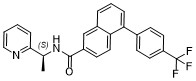
Physicochemical Properties
| Molecular Formula | C25H19F3N2O |
| Molecular Weight | 420.426376581192 |
| Exact Mass | 420.14 |
| Elemental Analysis | C, 71.42; H, 4.56; F, 13.56; N, 6.66; O, 3.81 |
| CAS # | 2417718-25-1 |
| Related CAS # | (R)-VT104;2417718-26-2; 2417718-25-1 (S-isomer); 2417720-80-8 (racemate) |
| PubChem CID | 146909371 |
| Appearance | White to off-white solid powder |
| LogP | 5.8 |
| Hydrogen Bond Donor Count | 1 |
| Hydrogen Bond Acceptor Count | 5 |
| Rotatable Bond Count | 4 |
| Heavy Atom Count | 31 |
| Complexity | 602 |
| Defined Atom Stereocenter Count | 1 |
| SMILES | C[C@@H](C1=CC=CC=N1)NC(=O)C2=CC3=C(C=C2)C(=CC=C3)C4=CC=C(C=C4)C(F)(F)F |
| InChi Key | AAZUPSFRSHFTGV-INIZCTEOSA-N |
| InChi Code | InChI=1S/C25H19F3N2O/c1-16(23-7-2-3-14-29-23)30-24(31)19-10-13-22-18(15-19)5-4-6-21(22)17-8-11-20(12-9-17)25(26,27)28/h2-16H,1H3,(H,30,31)/t16-/m0/s1 |
| Chemical Name | (S)-N-(1-(pyridin-2-yl)ethyl)-5-(4-(trifluoromethyl)phenyl)-2-naphthamide |
| Synonyms | VT-104; VT 104; VT104 |
| HS Tariff Code | 2934.99.9001 |
| Storage |
Powder-20°C 3 years 4°C 2 years In solvent -80°C 6 months -20°C 1 month |
| Shipping Condition | Room temperature (This product is stable at ambient temperature for a few days during ordinary shipping and time spent in Customs) |
Biological Activity
| Targets | TEAD1 Palmitoylation |
| ln Vitro |
VT-104 (0-1000 nM) prevents NF2 mutant/deficient cell lines from proliferating [1]. Upon co-incubation with VT103, TEAD1 showed the highest increase in melting temperature—a shift of 8.3°C—compared with other members of the TEAD family. The thermal denaturation curves clearly showed two separate peaks for TEAD1 alone (red curve) and TEAD1+VT103 (blue curve), while the peaks of the ±VT103 curves remained largely overlapping for the other TEAD proteins (Fig. 4A, top). This is consistent with the finding from the functional palmitoylation assays that VT103 is a TEAD1-selective inhibitor. On the other hand, VT107, which was determined to be a pan-TEAD inhibitor by TEAD palmitoylation assays, significantly shifted the melting temperatures of all four TEAD family members (Fig. 4A). VT-104 shifted the melting temperatures of all four TEAD family members, but higher shifts were observed for TEAD1 and TEAD3. VT106 only weakly shifted the melting temperatures of all four TEADs. [1] |
| ln Vivo |
VT-104 (0.3-3 mg/kg; po; NCI-H226 tumor-bearing mice) prevents the growth of NF2-deficient mesothelioma xenografts [1]. VT103 and VT-104 block growth of NF2-deficient mesothelioma xenografts [1] With excellent oral bioavailability (≥75%) and long half-life (>12 hours) in mice (Fig. 2), VT103 and VT-104 allowed us to evaluate target engagement and antitumor efficacy of TEAD auto-palmitoylation inhibition in human mesothelioma xenograft models in vivo. As shown in Fig. 6B, 4 hours after the third daily dose, VT103 significantly downregulated the expression of the Hippo pathway target genes, CTGF and CYR61, in the NF2-deficient NCI-H226 tumors in mice in a dose-dependent manner. Within the same NCI-H226-tumor bearing animals, VT103 also downregulated target gene expression in kidneys and livers in dose-dependent manner (Supplementary Fig. S6A). However, there did not seem to be any pathologic effect at the same time point as H&E images of kidneys and livers showed no difference between vehicle and drug-treated groups (Supplementary Fig. S6B). Bioanalysis showed that there was dose-dependent exposure of VT103 in circulation as well as in tumor tissues (Supplementary Fig. S6C). In addition, within the same animal, there appeared to be more compound accumulation in tumor than in circulation (Supplementary Fig. S6C). Examination of YAP and TEAD1 proteins in the VT103-treated NCI-H226 tumor tissues by IHC indicated no change in the cellular localization or levels of these proteins (Supplementary Fig. S6D). |
| Enzyme Assay |
Cell-free TEAD palmitoylation assay [1] Purified recombinant TEAD1–YBD was first incubated with compounds and then with 2 μmol/L alkyne-palmitoyl-CoA. The reaction was quenched with 1% SDS followed by click chemistry reaction with biotin-azide as described previously. In some experiments, APCoA was added at different concentrations and in different sequence. Palmitoylated TEAD and total TEAD proteins were detected by streptavidin HRP and anti-TEAD1 antibody immunoblotting, respectively. |
| Cell Assay |
Cell-based TEAD palmitoylation assays [1] Myc-TEAD expression plasmid transfected HEK293T cells were treated with DMSO or 100 μmol/L alkyne palmitate + DMSO/compound for 20 hours. Myc-TEAD protein was immunoprecipitated with anti-Myc antibody and subjected to click chemistry. Palmitoylated TEAD was detected by streptavidin immunoblotting. The Acyl-PEGyl Exchange Gel-Shift Assay was performed as described previously. Cell proliferation assay [1] Cells treated for various time periods with compounds in dose titration starting from 3 μmol/L were assayed by CellTiter-Glo Luminescent Cell Viability Assay Kit according to the manufacturers' protocol. The IC50 and maximum inhibition % were calculated using dose response curves. Immunofluorescence [1] After fixation with 4% paraformaldehyde for 10 to 15 minutes and permeabilization with 0.1% Triton X-100 in PBS, cells were blocked in 3% BSA in PBS for 1 to 2 hours at room temperature, stained with primary antibodies overnight at 4°C, and then with Alexa fluor-conjugated secondary antibodies for 2 to 3 hours at RT. Slides were mounted with prolong gold antifade reagent with DAPI. Images were captured with a Nikon Eclipse Ti confocal microscope. Immunoprecipitation [1] Cells were washed with PBS and lysed [50 mmol/L Tris pH 7.5, 150 mmol/L NaCl, 1% Triton-X100, 50 mmol/L NaF, 1 mmol/L PMSF, protease inhibitor cocktail, phosphatase inhibitor]. After sonication and centrifugation, supernatant was collected and incubated with anti-TEAD, anti-YAP, or control antibodies, precipitated by Protein A/G beads, and analyzed by immunoblotting (see antibody information in Supplementary Table S3) using standard protocols. |
| Animal Protocol |
Animal/Disease Models: NCI-H226 tumor-bearing mice [1] Usage and Doses: 0.3, 1 and 3 mg/kg Route of Administration: Oral Experimental Results:Blocked NCI-H226 tumor growth in mice in a dose-dependent manner. Mouse pharmacokinetics [1] VT103, VT-104, and VT107, formulated in 5% DMSO + 10% Solutol + 85% D5W, were dosed intravenously or orally at 7 or 10 mg/kg. Blood was drawn from the saphenous vein at indicated timepoints. Compounds were quantified by LC/MS-MS using a QTRAP 6500. Data were analyzed using Phoenix WinNonlin 6.3, and intravenously noncompartmental model 201, and orally noncompartmental model 200. The calculation method was linear/log trapezoidal. In vivo pharmacodynamic and efficacy studies [1] All the procedures related to animal handling, care, and the treatment were performed according to the guidelines approved by the Institutional Animal Care and Use Committee (IACUC) of WuXi AppTec or Crown Bioscience, Inc., following the guidance of the Association for Assessment and Accreditation of Laboratory Animal Care (AAALAC). The testing article formulated in dosing solution (5% DMSO + 10% solutol + 85% D5W; D5W = 5% glucose) was orally administrated daily at the indicated doses. Tumor volume and animal weights were monitored twice weekly. |
| ADME/Pharmacokinetics | VT103 is an analog of VT101, which has improved potency and good oral pharmacokinetics in mice (Fig. 2; Supplementary Table S1). VT-104 is an analog of VT102, which has improved potency and good oral pharmacokinetics in mice (Fig. 2; Supplementary Table S1). VT105 is a more soluble analog of VT-104 (Fig. 2), which was useful in TEAD X-ray crystallography experiments. VT106 and VT107 are enantiomers analogous to VT-104; they have quite different potencies, making them useful mutual controls in biochemical and cellular experiments (Fig. 2).[1] |
| References |
[1]. Small Molecule Inhibitors of TEAD Auto-palmitoylation Selectively Inhibit Proliferation and Tumor Growth of NF2-deficient Mesothelioma. Mol Cancer Ther. 2021 Jun;20(6):986-998. [2]. Recent Therapeutic Approaches to Modulate the Hippo Pathway in Oncology and Regenerative Medicine. Cells. 2021 Oct 11;10(10):2715. |
| Additional Infomation |
Mutations in the neurofibromatosis type 2 (NF2) gene that limit or abrogate expression of functional Merlin are common in malignant mesothelioma. Merlin activates the Hippo pathway to suppress nuclear translocation of YAP and TAZ, the major effectors of the pathway that associate with the TEAD transcription factors in the nucleus and promote expression of genes involved in cell proliferation and survival. In this article, we describe the discovery of compounds that selectively inhibit YAP/TAZ-TEAD promoted gene transcription, block TEAD auto-palmitoylation, and disrupt interaction between YAP/TAZ and TEAD. Optimization led to potent analogs with excellent oral bioavailability and pharmacokinetics that selectively inhibit NF2-deficient mesothelioma cell proliferation in vitro and growth of subcutaneous tumor xenografts in vivo These highly potent and selective TEAD inhibitors provide a way to target the Hippo-YAP pathway, which thus far has been undruggable and is dysregulated frequently in malignant mesothelioma and in other YAP-driven cancers and diseases. [1] Other than establishing the tolerability of our compounds in mice, the research described herein does not address any toxicity of the compounds, which could be related or unrelated to inhibition of TEAD palmitoylation. Formal toxicologic evaluation in multiple animal species will be required to characterize the safety of the small molecule compounds. If favorable, clinical evaluation of a TEAD palmitoylation inhibitor is warranted in NF2 mutant mesothelioma and cancers with activated YAP/TAZ-TEAD transcriptional activity as monotherapy or in combination with other targeted cancer therapies. [1] |
Solubility Data
| Solubility (In Vitro) | DMSO : ~100 mg/mL (~237.85 mM) |
| Solubility (In Vivo) |
Note: Listed below are some common formulations that may be used to formulate products with low water solubility (e.g. < 1 mg/mL), you may test these formulations using a minute amount of products to avoid loss of samples. Injection Formulations (e.g. IP/IV/IM/SC) Injection Formulation 1: DMSO : Tween 80: Saline = 10 : 5 : 85 (i.e. 100 μL DMSO stock solution → 50 μL Tween 80 → 850 μL Saline) *Preparation of saline: Dissolve 0.9 g of sodium chloride in 100 mL ddH ₂ O to obtain a clear solution. Injection Formulation 2: DMSO : PEG300 :Tween 80 : Saline = 10 : 40 : 5 : 45 (i.e. 100 μL DMSO → 400 μLPEG300 → 50 μL Tween 80 → 450 μL Saline) Injection Formulation 3: DMSO : Corn oil = 10 : 90 (i.e. 100 μL DMSO → 900 μL Corn oil) Example: Take the Injection Formulation 3 (DMSO : Corn oil = 10 : 90) as an example, if 1 mL of 2.5 mg/mL working solution is to be prepared, you can take 100 μL 25 mg/mL DMSO stock solution and add to 900 μL corn oil, mix well to obtain a clear or suspension solution (2.5 mg/mL, ready for use in animals). Injection Formulation 4: DMSO : 20% SBE-β-CD in saline = 10 : 90 [i.e. 100 μL DMSO → 900 μL (20% SBE-β-CD in saline)] *Preparation of 20% SBE-β-CD in Saline (4°C,1 week): Dissolve 2 g SBE-β-CD in 10 mL saline to obtain a clear solution. Injection Formulation 5: 2-Hydroxypropyl-β-cyclodextrin : Saline = 50 : 50 (i.e. 500 μL 2-Hydroxypropyl-β-cyclodextrin → 500 μL Saline) Injection Formulation 6: DMSO : PEG300 : castor oil : Saline = 5 : 10 : 20 : 65 (i.e. 50 μL DMSO → 100 μLPEG300 → 200 μL castor oil → 650 μL Saline) Injection Formulation 7: Ethanol : Cremophor : Saline = 10: 10 : 80 (i.e. 100 μL Ethanol → 100 μL Cremophor → 800 μL Saline) Injection Formulation 8: Dissolve in Cremophor/Ethanol (50 : 50), then diluted by Saline Injection Formulation 9: EtOH : Corn oil = 10 : 90 (i.e. 100 μL EtOH → 900 μL Corn oil) Injection Formulation 10: EtOH : PEG300:Tween 80 : Saline = 10 : 40 : 5 : 45 (i.e. 100 μL EtOH → 400 μLPEG300 → 50 μL Tween 80 → 450 μL Saline) Oral Formulations Oral Formulation 1: Suspend in 0.5% CMC Na (carboxymethylcellulose sodium) Oral Formulation 2: Suspend in 0.5% Carboxymethyl cellulose Example: Take the Oral Formulation 1 (Suspend in 0.5% CMC Na) as an example, if 100 mL of 2.5 mg/mL working solution is to be prepared, you can first prepare 0.5% CMC Na solution by measuring 0.5 g CMC Na and dissolve it in 100 mL ddH2O to obtain a clear solution; then add 250 mg of the product to 100 mL 0.5% CMC Na solution, to make the suspension solution (2.5 mg/mL, ready for use in animals). Oral Formulation 3: Dissolved in PEG400 Oral Formulation 4: Suspend in 0.2% Carboxymethyl cellulose Oral Formulation 5: Dissolve in 0.25% Tween 80 and 0.5% Carboxymethyl cellulose Oral Formulation 6: Mixing with food powders Note: Please be aware that the above formulations are for reference only. InvivoChem strongly recommends customers to read literature methods/protocols carefully before determining which formulation you should use for in vivo studies, as different compounds have different solubility properties and have to be formulated differently. (Please use freshly prepared in vivo formulations for optimal results.) |
| Preparing Stock Solutions | 1 mg | 5 mg | 10 mg | |
| 1 mM | 2.3785 mL | 11.8926 mL | 23.7852 mL | |
| 5 mM | 0.4757 mL | 2.3785 mL | 4.7570 mL | |
| 10 mM | 0.2379 mL | 1.1893 mL | 2.3785 mL |