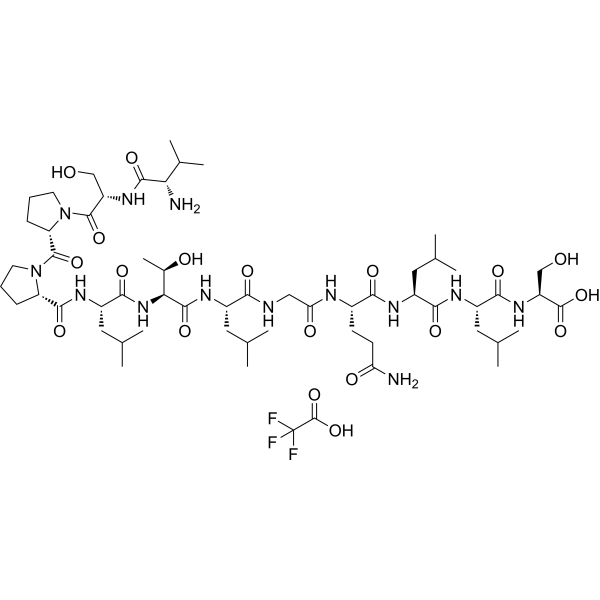
Physicochemical Properties
| Molecular Formula | C58H98F3N13O19 |
| Molecular Weight | 1338.47 |
| Related CAS # | VSPPLTLGQLLS;1206896-24-3 |
| Appearance | Typically exists as solid at room temperature |
| HS Tariff Code | 2934.99.9001 |
| Storage |
Powder-20°C 3 years 4°C 2 years In solvent -80°C 6 months -20°C 1 month |
| Shipping Condition | Room temperature (This product is stable at ambient temperature for a few days during ordinary shipping and time spent in Customs) |
Biological Activity
| Targets | FGFR3 K650M-FGFR3 K644E FGFR3 |
| ln Vitro | Human primary lymphatic endothelial cell (LEC) proliferation, migration, and tubule formation are inhibited by VSPPLTLGQLLS TFA (5 μM and 10 μM; 24 h and 48 h)[1]. In addition to LECs, VSPPLTLGQLLS TFA has been shown to effectively block FGFR3 phosphorylation in ATDC5 chondrogenic cells, 293T cells, explanted metatarsal bone cultures, and an in vivo mouse model of thanatophoric dysplasia II[1].[2]. Extracellular signal-regulated kinase and mitogen-activated protein kinase, two of FGFR3's usual downstream enzymes, are inhibited by VSPPLTLGQLLS TFA (10 μM; 6 h) on their tyrosine kinase activity[2]. Cultured ATDC5 chondrogenic cells are also encouraged to proliferate and undergo chondrogenic differentiation by VSPPLTLGQLLS TFA(0, 1, 10, and 50 μM; 24 hours and 3 or 7 days, respectively)[2]. In the FGFR3-expressing chondrocytic cell line ATDC5, VSPPLTLGQLLS TFA (10 μM; 0–60 min) suppresses the ERK/MAPK pathway[2]. Examining Western Blots[1][2] Human primary lymphatic endothelial cells (LECs); ATDC5 chondrogenic cells are the cell line used. Distillation: 10 μM 30 to 45 to 60 minutes is the incubation time. Result: In human primary lymphatic endothelial cells (LECs), inhibited FGFR3 phosphorylation at Tyr 724. FGFR3-expressing chondrocytic cell line ATDC5 showed inhibition of FGF2-mediated ERK/MAPK phosphorylation. |
| ln Vivo | VSPPLTLGQLLS TFA (1 mM; intranasal drops; once daily for 7 d) inhibits in vivo 9-cisRA-induced lymphangiogenesis, whereas 9-cisRA is an isoform of vitamin A implicated in Kaposi Sarcoma associated with AIDS[1]. In mice modelled by thanatophoric dysplasia type II (TDII), VSPPLTLGQLLS TFA reverses the neonatal mortality of TDII mice and alleviates the bone development retardation in bone rudiments[2]. |
| Cell Assay |
Western Blot Analysis[1][2] Cell Types: Human primary lymphatic endothelial cells(LEC)s; ATDC5 chondrogenic cells Tested Concentrations: 10 μM Incubation Duration: 0, 5, 10, 30, 45, 60 min Experimental Results: Inhibited FGFR3 phosphorylation at Tyr 724 in human primary lymphatic endothelial cells(LEC)s. Inhibited the FGF2-mediated ERK/MAPK phosphorylation in FGFR3-expressing chondrocytic cell line ATDC5. Cell Proliferation Assay[1] Cell Types: Human primary lymphatic endothelial cell(LEC)s Tested Concentrations: 2.5 μM, 5 μM, and 10 μM Incubation Duration: 15 min for pre-incubation and co-incubation with 1 μM 9-cisRA for 48 hr Experimental Results: Inhibited LEC proliferation. Cell Migration Assay [1] Cell Types: Human primary lymphatic endothelial cells(LEC)s Tested Concentrations: 5 μM Incubation Duration: 15 min for pre-incubation and co-incubation with 1 μM 9-cisRA for 24 hr; observed at 0, 24, 48 hr Experimental Results: Inhibited LEC migration tubule formation. |
| Animal Protocol |
Animal/Disease Models: Lymphatic reporter mice, Prox1-GFP model[1] Doses: 1 mM Route of Administration: Intranasal dropping; one time/day for 7 days; accompanied with 1 mM 9-cisRA or not Experimental Results: Dramatically inhibited total lymphatic vessel length and number of sprouts compared increase induced by 9-cisRA. Animal/Disease Models: Fgfr3Neo-K644E/+EIIa-Cre mice ( TDII mice) from Fgfr3Neo-K644E/+ mice crossed with heterozygous EIIa-Cre mice[2] Doses: 10 μM Route of Administration: Treated for 7 days Experimental Results: Suppressed FGFR3-mediated growth inhibition in cultured murine metatarsal bones. Rescued the lethal phenotype in thanatophoric dysplasia type II (TDII) mice. Rescued the abnormal growth plate and the lung phenotypes in the TDII mice. |
| References |
[1]. Small Peptide Modulation of Fibroblast Growth Factor Receptor 3-Dependent Postnatal Lymphangiogenesis. Lymphat Res Biol. 2019 Feb;17(1):19-29. [2]. A novel FGFR3-binding peptide inhibits FGFR3 signaling and reverses the lethal phenotype of mice mimicking human thanatophoric dysplasia. Hum Mol Genet. 2012 Dec 15;21(26):5443-55. |
Solubility Data
| Solubility (In Vitro) | May dissolve in DMSO (in most cases), if not, try other solvents such as H2O, Ethanol, or DMF with a minute amount of products to avoid loss of samples |
| Solubility (In Vivo) |
Note: Listed below are some common formulations that may be used to formulate products with low water solubility (e.g. < 1 mg/mL), you may test these formulations using a minute amount of products to avoid loss of samples. Injection Formulations (e.g. IP/IV/IM/SC) Injection Formulation 1: DMSO : Tween 80: Saline = 10 : 5 : 85 (i.e. 100 μL DMSO stock solution → 50 μL Tween 80 → 850 μL Saline) *Preparation of saline: Dissolve 0.9 g of sodium chloride in 100 mL ddH ₂ O to obtain a clear solution. Injection Formulation 2: DMSO : PEG300 :Tween 80 : Saline = 10 : 40 : 5 : 45 (i.e. 100 μL DMSO → 400 μLPEG300 → 50 μL Tween 80 → 450 μL Saline) Injection Formulation 3: DMSO : Corn oil = 10 : 90 (i.e. 100 μL DMSO → 900 μL Corn oil) Example: Take the Injection Formulation 3 (DMSO : Corn oil = 10 : 90) as an example, if 1 mL of 2.5 mg/mL working solution is to be prepared, you can take 100 μL 25 mg/mL DMSO stock solution and add to 900 μL corn oil, mix well to obtain a clear or suspension solution (2.5 mg/mL, ready for use in animals). Injection Formulation 4: DMSO : 20% SBE-β-CD in saline = 10 : 90 [i.e. 100 μL DMSO → 900 μL (20% SBE-β-CD in saline)] *Preparation of 20% SBE-β-CD in Saline (4°C,1 week): Dissolve 2 g SBE-β-CD in 10 mL saline to obtain a clear solution. Injection Formulation 5: 2-Hydroxypropyl-β-cyclodextrin : Saline = 50 : 50 (i.e. 500 μL 2-Hydroxypropyl-β-cyclodextrin → 500 μL Saline) Injection Formulation 6: DMSO : PEG300 : castor oil : Saline = 5 : 10 : 20 : 65 (i.e. 50 μL DMSO → 100 μLPEG300 → 200 μL castor oil → 650 μL Saline) Injection Formulation 7: Ethanol : Cremophor : Saline = 10: 10 : 80 (i.e. 100 μL Ethanol → 100 μL Cremophor → 800 μL Saline) Injection Formulation 8: Dissolve in Cremophor/Ethanol (50 : 50), then diluted by Saline Injection Formulation 9: EtOH : Corn oil = 10 : 90 (i.e. 100 μL EtOH → 900 μL Corn oil) Injection Formulation 10: EtOH : PEG300:Tween 80 : Saline = 10 : 40 : 5 : 45 (i.e. 100 μL EtOH → 400 μLPEG300 → 50 μL Tween 80 → 450 μL Saline) Oral Formulations Oral Formulation 1: Suspend in 0.5% CMC Na (carboxymethylcellulose sodium) Oral Formulation 2: Suspend in 0.5% Carboxymethyl cellulose Example: Take the Oral Formulation 1 (Suspend in 0.5% CMC Na) as an example, if 100 mL of 2.5 mg/mL working solution is to be prepared, you can first prepare 0.5% CMC Na solution by measuring 0.5 g CMC Na and dissolve it in 100 mL ddH2O to obtain a clear solution; then add 250 mg of the product to 100 mL 0.5% CMC Na solution, to make the suspension solution (2.5 mg/mL, ready for use in animals). Oral Formulation 3: Dissolved in PEG400 Oral Formulation 4: Suspend in 0.2% Carboxymethyl cellulose Oral Formulation 5: Dissolve in 0.25% Tween 80 and 0.5% Carboxymethyl cellulose Oral Formulation 6: Mixing with food powders Note: Please be aware that the above formulations are for reference only. InvivoChem strongly recommends customers to read literature methods/protocols carefully before determining which formulation you should use for in vivo studies, as different compounds have different solubility properties and have to be formulated differently. (Please use freshly prepared in vivo formulations for optimal results.) |
| Preparing Stock Solutions | 1 mg | 5 mg | 10 mg | |
| 1 mM | 0.7471 mL | 3.7356 mL | 7.4712 mL | |
| 5 mM | 0.1494 mL | 0.7471 mL | 1.4942 mL | |
| 10 mM | 0.0747 mL | 0.3736 mL | 0.7471 mL |