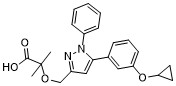
Physicochemical Properties
| Molecular Formula | C23H23CLN2O4 |
| Molecular Weight | 426.8927 |
| Exact Mass | 392.17 |
| Elemental Analysis | C, 70.39; H, 6.16; N, 7.14; O, 16.31 |
| CAS # | 2230186-18-0 |
| Related CAS # | 2230186-18-0; 2230186-91-9 (methyl-VB124); |
| Appearance | White to off-white solid powder |
| LogP | 4.6 |
| InChi Key | VDUYBQLCMARXKM-UHFFFAOYSA-N |
| InChi Code | InChI=1S/C23H24N2O4/c1-23(2,22(26)27)28-15-17-14-21(25(24-17)18-8-4-3-5-9-18)16-7-6-10-20(13-16)29-19-11-12-19/h3-10,13-14,19H,11-12,15H2,1-2H3,(H,26,27) |
| Chemical Name | 2-((5-(3-cyclopropoxyphenyl)-1-phenyl-1H-pyrazol-3-yl)methoxy)-2-methylpropanoic acid |
| Synonyms | VB124; VB 124; VB-124; |
| HS Tariff Code | 2934.99.9001 |
| Storage |
Powder-20°C 3 years 4°C 2 years In solvent -80°C 6 months -20°C 1 month |
| Shipping Condition | Room temperature (This product is stable at ambient temperature for a few days during ordinary shipping and time spent in Customs) |
Biological Activity
| ln Vitro | MDA-MB-231 cells' ability to proliferate is inhibited by VB124 (10 μM), with a cell proliferation rate of less than 50%[1]. VB124 exhibits minimal MCT1 inhibitory activity (lactate output IC50=24 μM) in MCT1-expressing BT20 cells and is more selective for MCT4 than MCT1 [1]. |
| ln Vivo | VB124 (30 mg/kg; oral; once daily for 28 days) reduces isoproterenol-induced cardiac hypertrophy in mice [1]. VB124 (30 mg/kg; twice daily for 180 days) had no effect on body, heart, liver, or lung weight in mice, indicating no apparent toxicity [1]. |
| Animal Protocol |
Animal/Disease Models: 12weeks old C57BL/6 mice[1] Doses: 30 mg/kg Route of Administration: po (oral gavage); one time/day for 28 days (dissolved in 0.5% methylcellulose and 0.1% Tween-20 ) Experimental Results: Prevention of cardiac hypertrophy in mice. |
| References |
[1]. Cluntun AA, et.al. The pyruvate-lactate axis modulates cardiac hypertrophy and heart failure. Cell Metab. 2021 Mar 2;33(3):629-648.e10. |
Solubility Data
| Solubility (In Vitro) | DMSO : ~100 mg/mL (~234.25 mM) |
| Solubility (In Vivo) |
Solubility in Formulation 1: 2.5 mg/mL (5.86 mM) in 10% DMSO + 40% PEG300 + 5% Tween80 + 45% Saline (add these co-solvents sequentially from left to right, and one by one), suspension solution; with sonication. For example, if 1 mL of working solution is to be prepared, you can add 100 μL of 25.0 mg/mL clear DMSO stock solution to 400 μL PEG300 and mix evenly; then add 50 μL Tween-80 to the above solution and mix evenly; then add 450 μL normal saline to adjust the volume to 1 mL. Preparation of saline: Dissolve 0.9 g of sodium chloride in 100 mL ddH₂ O to obtain a clear solution. Solubility in Formulation 2: ≥ 2.5 mg/mL (5.86 mM) (saturation unknown) in 10% DMSO + 90% (20% SBE-β-CD in Saline) (add these co-solvents sequentially from left to right, and one by one), clear solution. For example, if 1 mL of working solution is to be prepared, you can add 100 μL of 25.0 mg/mL clear DMSO stock solution to 900 μL of 20% SBE-β-CD physiological saline solution and mix evenly. Preparation of 20% SBE-β-CD in Saline (4°C,1 week): Dissolve 2 g SBE-β-CD in 10 mL saline to obtain a clear solution. Solubility in Formulation 3: ≥ 2.5 mg/mL (5.86 mM) (saturation unknown) in 10% DMSO + 90% Corn Oil (add these co-solvents sequentially from left to right, and one by one), clear solution. For example, if 1 mL of working solution is to be prepared, you can add 100 μL of 25.0 mg/mL clear DMSO stock solution to 900 μL of corn oil and mix evenly. (Please use freshly prepared in vivo formulations for optimal results.) |
| Preparing Stock Solutions | 1 mg | 5 mg | 10 mg | |
| 1 mM | 2.3425 mL | 11.7126 mL | 23.4252 mL | |
| 5 mM | 0.4685 mL | 2.3425 mL | 4.6850 mL | |
| 10 mM | 0.2343 mL | 1.1713 mL | 2.3425 mL |