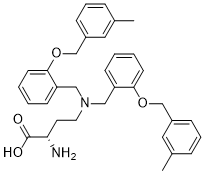
V-9302 (V9302) is a novel, potent, competitive, selective antagonist of transmembrane glutamine flux, specifically, ASCT2 inhibitor, with anticancer activity. It selectively and potently targets the amino acid transporter ASCT2 (alanine serine cysteine transporter 2) with IC50 of 9.6 uM. The neutral amino acid transporter alanine serine cysteine transporter 2 (ASCT2) belongs to the solute carrier 1 (SLC1) family of transport proteins and transports neutral amino acids, such as alanine and glutamine, into the cell in exchange with intracellular amino acids. This amino acid transport is sodium dependent, but not driven by the transmembrane Na+ concentration gradient. Glutamine transport by ASCT2 is proposed to be important for glutamine homoeostasis in rapidly growing cancer cells to fulfill the energy and nitrogen demands of these cells. Thus, ASCT2 is thought to be a potential anticancer drug target.
Physicochemical Properties
| Molecular Formula | C34H38N2O4 |
| Molecular Weight | 538.6765 |
| Exact Mass | 538.283 |
| CAS # | 1855871-76-9 |
| PubChem CID | 127035871 |
| Appearance | White to yellow solid powder |
| LogP | 3.7 |
| Hydrogen Bond Donor Count | 2 |
| Hydrogen Bond Acceptor Count | 6 |
| Rotatable Bond Count | 14 |
| Heavy Atom Count | 40 |
| Complexity | 687 |
| Defined Atom Stereocenter Count | 1 |
| SMILES | O(CC1=CC=CC(C)=C1)C1=CC=CC=C1CN(CC1=CC=CC=C1OCC1=CC=CC(C)=C1)CC[C@@H](C(=O)O)N |
| InChi Key | YGKNVAAMULVFNN-HKBQPEDESA-N |
| InChi Code | InChI=1S/C34H38N2O4/c1-25-9-7-11-27(19-25)23-39-32-15-5-3-13-29(32)21-36(18-17-31(35)34(37)38)22-30-14-4-6-16-33(30)40-24-28-12-8-10-26(2)20-28/h3-16,19-20,31H,17-18,21-24,35H2,1-2H3,(H,37,38)/t31-/m0/s1 |
| Chemical Name | (2S)-2-amino-4-[bis[[2-[(3-methylphenyl)methoxy]phenyl]methyl]amino]butanoic acid |
| HS Tariff Code | 2934.99.9001 |
| Storage |
Powder-20°C 3 years 4°C 2 years In solvent -80°C 6 months -20°C 1 month Note: Please store this product in a sealed and protected environment, avoid exposure to moisture. |
| Shipping Condition | Room temperature (This product is stable at ambient temperature for a few days during ordinary shipping and time spent in Customs) |
Biological Activity
| ln Vitro | V-9302 is 100 times more potent than gamma-L-glutamyl-p-nitroanilide and inhibits ASCT2-mediated glutamine absorption in human cells in a concentration-dependent manner[1]. When ASCT2 is pharmacologically blocked with V-9302, cancer cell growth and proliferation are slowed, cell death is increased, and oxidative stress is increased[1]. |
| ln Vivo | In both the HCT-116 and HT29 xenograft models, V-9302 (75 mg/kg; ip; daily for 21 days) inhibits the growth of tumors[1]. While single-drug treatment showed modest anti-tumor effects, the combination of CB-839 and V-9302 (30 mg/kg; ip; SNU398 and MHCC97H cells were grown as tumor xenografts in BALB/c nude mice; for 20 or 15 d, respectively) elicits a strong growth inhibition in both SNU398 and MHCC97H xenograft models[2]. V-9302 (i.p.; 50 mg/kg; every day for 5 days) exhibits a significant decrease in tumor growth[3]. |
| Animal Protocol |
Animal/Disease Models: 6-week old, female athymic nude mice (bearing HCT-116 (KRAS G13D) or HT29 (BRAF V600E) cell-line)[1] Doses: 75 mg/kg Route of Administration: Intraperitoneally; daily fo 21 days Experimental Results: Prevented tumor growth. |
| References |
[1]. Pharmacological blockade of ASCT2-dependent glutamine transport leads to antitumor efficacyin preclinical models. Nat Med. 2018 Feb;24(2):194-202. [2]. A powerful drug combination strategy targeting glutamine addiction for the treatment of human liver cancer. Elife. 2020;9:e56749. Published 2020 Oct 5. [3]. Selective glutamine metabolism inhibition in tumor cells improves antitumor T lymphocyte activity in triple-negative breast cancer. J Clin Invest. 2021;131(4):e140100. |
Solubility Data
| Solubility (In Vitro) |
DMSO : ~25 mg/mL (~46.41 mM) H2O : < 0.1 mg/mL |
| Solubility (In Vivo) |
Solubility in Formulation 1: ≥ 1 mg/mL (1.86 mM) (saturation unknown) in 10% DMSO + 40% PEG300 + 5% Tween80 + 45% Saline (add these co-solvents sequentially from left to right, and one by one), clear solution. For example, if 1 mL of working solution is to be prepared, you can add 100 μL of 10.0 mg/mL clear DMSO stock solution to 400 μL of PEG300 and mix evenly; then add 50 μL of Tween-80 to the above solution and mix evenly; then add 450 μL of normal saline to adjust the volume to 1 mL. Preparation of saline: Dissolve 0.9 g of sodium chloride in 100 mL ddH₂ O to obtain a clear solution. Solubility in Formulation 2: 1 mg/mL (1.86 mM) in 10% DMSO + 90% (20% SBE-β-CD in Saline) (add these co-solvents sequentially from left to right, and one by one), suspension solution; with ultrasonication. For example, if 1 mL of working solution is to be prepared, you can add 100 μL of 10.0 mg/mL clear DMSO stock solution to 900 μL of 20% SBE-β-CD physiological saline solution and mix evenly. Preparation of 20% SBE-β-CD in Saline (4°C,1 week): Dissolve 2 g SBE-β-CD in 10 mL saline to obtain a clear solution. Solubility in Formulation 3: ≥ 1 mg/mL (1.86 mM) (saturation unknown) in 10% DMSO + 90% Corn Oil (add these co-solvents sequentially from left to right, and one by one), clear solution. For example, if 1 mL of working solution is to be prepared, you can add 100 μL of 10.0 mg/mL clear DMSO stock solution to 900 μL of corn oil and mix evenly. (Please use freshly prepared in vivo formulations for optimal results.) |
| Preparing Stock Solutions | 1 mg | 5 mg | 10 mg | |
| 1 mM | 1.8564 mL | 9.2819 mL | 18.5639 mL | |
| 5 mM | 0.3713 mL | 1.8564 mL | 3.7128 mL | |
| 10 mM | 0.1856 mL | 0.9282 mL | 1.8564 mL |