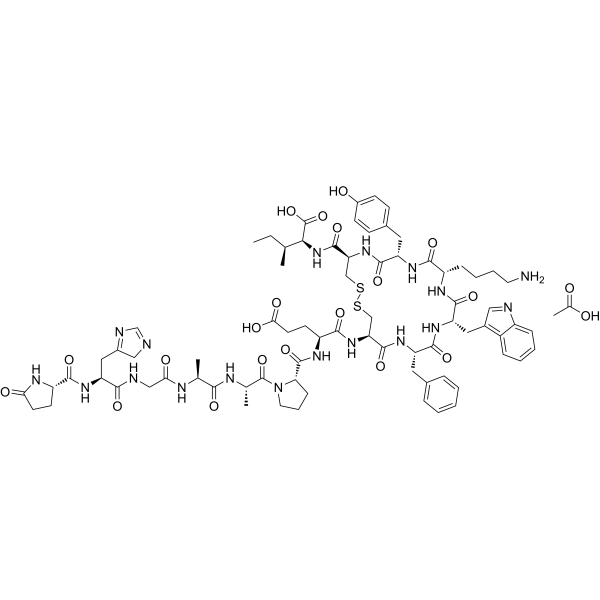
Physicochemical Properties
| Molecular Formula | C??H???N??O??S? |
| Molecular Weight | 1693.91 |
| Related CAS # | Urotensin II, mouse TFA;Urotensin II, mouse |
| Appearance | White to off-white solid powder |
| HS Tariff Code | 2934.99.9001 |
| Storage |
Powder-20°C 3 years 4°C 2 years In solvent -80°C 6 months -20°C 1 month Note: Please store this product in a sealed and protected environment, avoid exposure to moisture. |
| Shipping Condition | Room temperature (This product is stable at ambient temperature for a few days during ordinary shipping and time spent in Customs) |
Biological Activity
| ln Vivo | A cyclic peptide that resembles somatostatin, urotensin II is a modulator of bronchoconstriction, a vasodilator, and an arterial vasocontrictor[1]. In the elevated plus maze test and the hole-board test, urotensin II (0.1 nmol, 0.3 nmol, and 3 nmol; intracerebroventricular injection) dose-dependently causes anxiogenic-like behaviors in mice[1]. |
| Animal Protocol |
Animal/Disease Models: Male C57BL/6N mice (8 weeks old)[1] Doses: 0.1 nmol, 0.3 nmol, and 3 nmol Route of Administration: Intracerebroventricular (icv) administration Experimental Results: diminished the amount of head dipping without significant alteration of the motor activity. |
| References |
[1]. Intracerebroventricular administration of urotensin II promotes anxiogenic-like behaviors in rodents. Neurosci Lett. 2004 Mar 25;358(2):99-102. |
Solubility Data
| Solubility (In Vitro) | May dissolve in DMSO (in most cases), if not, try other solvents such as H2O, Ethanol, or DMF with a minute amount of products to avoid loss of samples |
| Solubility (In Vivo) |
Solubility in Formulation 1: ≥ 2.5 mg/mL (1.48 mM) (saturation unknown) in 10% DMSO + 40% PEG300 + 5% Tween80 + 45% Saline (add these co-solvents sequentially from left to right, and one by one), clear solution. For example, if 1 mL of working solution is to be prepared, you can add 100 μL of 25.0 mg/mL clear DMSO stock solution to 400 μL PEG300 and mix evenly; then add 50 μL Tween-80 to the above solution and mix evenly; then add 450 μL normal saline to adjust the volume to 1 mL. Preparation of saline: Dissolve 0.9 g of sodium chloride in 100 mL ddH₂ O to obtain a clear solution. Solubility in Formulation 2: ≥ 2.5 mg/mL (1.48 mM) (saturation unknown) in 10% DMSO + 90% Corn Oil (add these co-solvents sequentially from left to right, and one by one), clear solution. For example, if 1 mL of working solution is to be prepared, you can add 100 μL of 25.0 mg/mL clear DMSO stock solution to 900 μL of corn oil and mix evenly. (Please use freshly prepared in vivo formulations for optimal results.) |
| Preparing Stock Solutions | 1 mg | 5 mg | 10 mg | |
| 1 mM | 0.5904 mL | 2.9518 mL | 5.9035 mL | |
| 5 mM | 0.1181 mL | 0.5904 mL | 1.1807 mL | |
| 10 mM | 0.0590 mL | 0.2952 mL | 0.5904 mL |