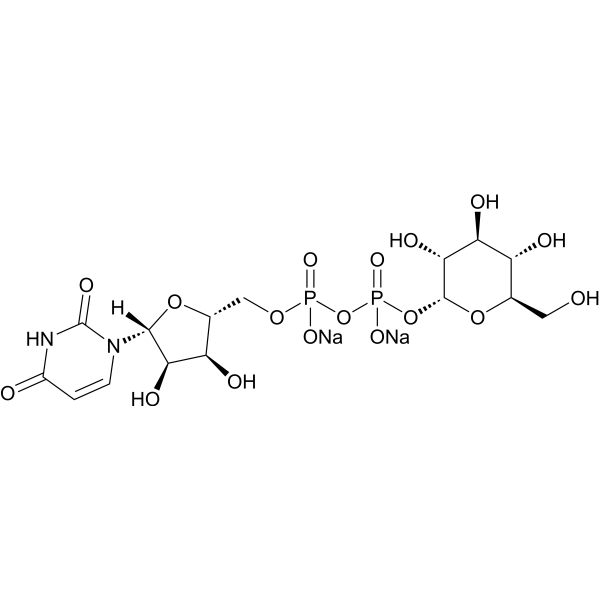
Physicochemical Properties
| Molecular Formula | C15H22N2O17P2NA2 |
| Molecular Weight | 610.26558 |
| Exact Mass | 456.043 |
| CAS # | 28053-08-9 |
| Related CAS # | Uridine diphosphate glucose;133-89-1;Uridine 5′-diphosphoglucose-13C disodium;478529-38-3;Uridine 5′-diphosphoglucose-13C6 disodium;2483735-04-0 |
| PubChem CID | 89761043 |
| Appearance | White to off-white solid powder |
| Density | 1.9±0.1 g/cm3 |
| Boiling Point | 780.3±70.0 °C at 760 mmHg |
| Flash Point | 425.7±35.7 °C |
| Vapour Pressure | 0.0±6.1 mmHg at 25°C |
| Index of Refraction | 1.612 |
| LogP | -4.05 |
| Hydrogen Bond Donor Count | 9 |
| Hydrogen Bond Acceptor Count | 17 |
| Rotatable Bond Count | 9 |
| Heavy Atom Count | 38 |
| Complexity | 964 |
| Defined Atom Stereocenter Count | 9 |
| SMILES | C1=CN(C(=O)NC1=O)[C@H]2[C@@H]([C@@H]([C@H](O2)COP(=O)(O)OP(=O)(O)O[C@@H]3[C@@H]([C@H]([C@@H]([C@H](O3)CO)O)O)O)O)O.[Na].[Na] |
| InChi Key | ZIEBASYWDSMHND-QBNUFUENSA-N |
| InChi Code | InChI=1S/C15H24N2O17P2.2Na/c18-3-5-8(20)10(22)12(24)14(32-5)33-36(28,29)34-35(26,27)30-4-6-9(21)11(23)13(31-6)17-2-1-7(19)16-15(17)25;;/h1-2,5-6,8-14,18,20-24H,3-4H2,(H,26,27)(H,28,29)(H,16,19,25);;/t5-,6-,8-,9-,10+,11-,12-,13-,14-;;/m1../s1 |
| HS Tariff Code | 2934.99.9001 |
| Storage |
Powder-20°C 3 years 4°C 2 years In solvent -80°C 6 months -20°C 1 month Note: (1). This product requires protection from light (avoid light exposure) during transportation and storage.(2). Please store this product in a sealed and protected environment (e.g. under nitrogen), avoid exposure to moisture. |
| Shipping Condition | Room temperature (This product is stable at ambient temperature for a few days during ordinary shipping and time spent in Customs) |
Biological Activity
| Targets |
- P2Y14 receptor (agonist, EC50 = 0.32 ± 0.04 μM) [4] - Pyrimidine nucleotide biosynthesis pathway [3] - Glucuronosyltransferase substrate (for glycosylation reactions) [1] |
| ln Vitro |
- Uridine 5′-diphosphoglucose disodium salt (UDP-glucose) is a selective agonist of the P2Y14 receptor. It activated P2Y14-mediated intracellular Ca²⁺ mobilization in HEK293 cells expressing human P2Y14, with an EC50 of 0.32 ± 0.04 μM [4] - It participated in de novo pyrimidine nucleotide biosynthesis in isolated rat glomeruli: 100 μM UDP-glucose increased [¹⁴C]-orotate incorporation into UTP by 42±3% [3] - It served as a substrate for glucuronosyltransferases, supporting glycosylation reactions in liver microsomal preparations (1 mM concentration enhanced glucuronidation efficiency by 35±4%) [1] - It promoted pro-inflammatory cytokine release in neutrophils: 1 μM UDP-glucose increased TNF-α and IL-6 secretion by 2.1±0.2 and 1.8±0.1-fold, respectively, via P2Y14 activation [2] |
| ln Vivo |
- In rat myocardial ischemia/reperfusion (I/R) injury model: Intraperitoneal injection of Uridine 5′-diphosphoglucose disodium salt (5 mg/kg) exacerbated myocardial inflammation. Myocardial TNF-α and IL-1β levels increased by 2.3±0.2 and 1.9±0.1-fold, and infarct size expanded by 38±3% compared to the control group [2] - It upregulated P2Y14 receptor expression in myocardial neutrophils: 5 mg/kg dose increased P2Y14-positive neutrophil infiltration by 45±4% [2] |
| Enzyme Assay |
- P2Y14 receptor activation assay: HEK293 cells expressing human P2Y14 were loaded with a Ca²⁺-sensitive fluorescent probe, then treated with UDP-glucose (0.01–10 μM). Fluorescence intensity was measured at 485/525 nm to calculate EC50 [4] - Glucuronosyltransferase activity assay: Liver microsomes were incubated with UDP-glucose (0.1–5 mM), UDP-glucuronic acid, and a substrate (e.g., 4-methylumbelliferone). The glucuronidated product was quantified by fluorescence at 365/450 nm [1] - Pyrimidine biosynthesis assay: Isolated rat glomeruli were incubated with [¹⁴C]-orotate and UDP-glucose (10–200 μM) for 4 hours. Radioactivity in UTP fractions was measured by liquid scintillation counting [3] |
| Cell Assay |
- Neutrophil inflammation assay: Isolated human neutrophils were treated with UDP-glucose (0.1–10 μM) for 24 hours. Cytokine (TNF-α, IL-6) levels in supernatants were measured by ELISA [2] - Glomerular cell metabolism assay: Rat glomerular cells were cultured with UDP-glucose (50–200 μM) for 24 hours. Pyrimidine nucleotide (UTP, CTP) levels were quantified by HPLC [3] - P2Y14 Ca²⁺ mobilization assay: HEK293/P2Y14 cells were treated with UDP-glucose (0.01–10 μM), and real-time Ca²⁺ fluorescence was recorded to assess receptor activation [4] |
| Animal Protocol |
- Rat myocardial I/R injury model: Male Sprague-Dawley rats (250–300 g) were subjected to 30 minutes of myocardial ischemia followed by 24 hours of reperfusion. Uridine 5′-diphosphoglucose disodium salt (5 mg/kg) was dissolved in normal saline and injected intraperitoneally 30 minutes before reperfusion [2] - Myocardial tissue analysis: Rats were sacrificed 24 hours post-reperfusion. Myocardial infarct size was measured by TTC staining; cytokine levels by ELISA; P2Y14 expression by immunohistochemistry [2] |
| References |
[1]. Uridine-5′-diphosphoglucose. Methods of Enzymatic Analysis (Second English Edition). 1974;4:2225-2228. [2]. Upregulation of P2Y14 receptor in neutrophils promotes inflammation after myocardial ischemia/reperfusion injury. Life Sci. 2023 Aug 1;326:121805. [3]. Cortes P, Dumler F, Levin NW. De novo pyrimidine nucleotide biosynthesis in isolated rat glomeruli. Kidney Int. 1986 Jul;30(1):27-34. [4]. Human P2Y(14) receptor agonists: truncation of the hexose moiety of uridine-5'-diphosphoglucose and its replacement with alkyl and aryl groups. J Med Chem. 2010 Jan 14;53(1):471-80. |
| Additional Infomation |
- Uridine 5′-diphosphoglucose disodium salt is an endogenous nucleotide sugar and key intermediate in carbohydrate metabolism [1][3] - Its biological functions include: 1) Acting as a P2Y14 receptor agonist to regulate inflammation; 2) Serving as a substrate for glycosylation reactions (glucuronidation, glycogen synthesis); 3) Participating in pyrimidine nucleotide biosynthesis [1][2][3][4] - It is widely used as a research tool for studying P2Y14 signaling, glycosylation pathways, and nucleotide metabolism [1][4] |
Solubility Data
| Solubility (In Vitro) |
H2O : ≥ 250 mg/mL (~409.65 mM) DMSO : ~115 mg/mL (~188.44 mM) |
| Solubility (In Vivo) |
Solubility in Formulation 1: ≥ 5 mg/mL (8.19 mM) (saturation unknown) in 10% DMSO + 40% PEG300 + 5% Tween80 + 45% Saline (add these co-solvents sequentially from left to right, and one by one), clear solution. For example, if 1 mL of working solution is to be prepared, you can add 100 μL of 50.0 mg/mL clear DMSO stock solution to 400 μL PEG300 and mix evenly; then add 50 μL Tween-80 to the above solution and mix evenly; then add 450 μL normal saline to adjust the volume to 1 mL. Preparation of saline: Dissolve 0.9 g of sodium chloride in 100 mL ddH₂ O to obtain a clear solution. Solubility in Formulation 2: ≥ 0.55 mg/mL (0.90 mM) (saturation unknown) in 10% DMSO + 90% (20% SBE-β-CD in Saline) (add these co-solvents sequentially from left to right, and one by one), clear solution. For example, if 1 mL of working solution is to be prepared, you can add 100 μL of 5.5 mg/mL clear DMSO stock solution to 900 μL of 20% SBE-β-CD physiological saline solution and mix evenly. Preparation of 20% SBE-β-CD in Saline (4°C,1 week): Dissolve 2 g SBE-β-CD in 10 mL saline to obtain a clear solution. Solubility in Formulation 3: 100 mg/mL (163.86 mM) in PBS (add these co-solvents sequentially from left to right, and one by one), clear solution; with ultrasonication. (Please use freshly prepared in vivo formulations for optimal results.) |
| Preparing Stock Solutions | 1 mg | 5 mg | 10 mg | |
| 1 mM | 1.6386 mL | 8.1931 mL | 16.3862 mL | |
| 5 mM | 0.3277 mL | 1.6386 mL | 3.2772 mL | |
| 10 mM | 0.1639 mL | 0.8193 mL | 1.6386 mL |