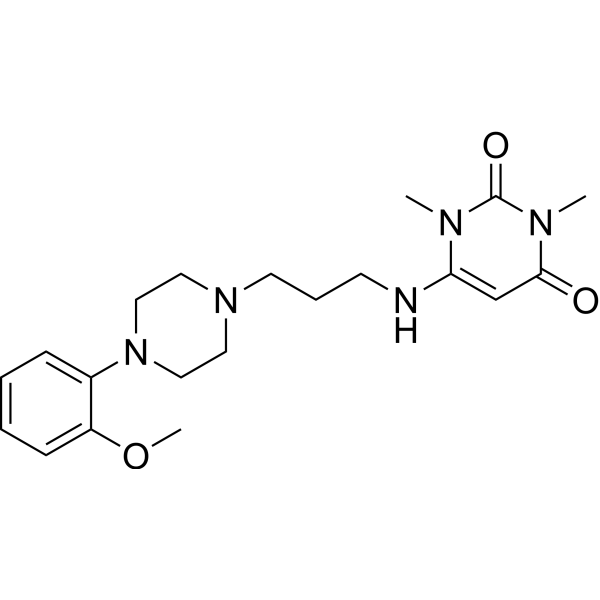
Physicochemical Properties
| Molecular Formula | C20H29N5O3 |
| Molecular Weight | 387.4760 |
| Exact Mass | 387.227 |
| CAS # | 34661-75-1 |
| Related CAS # | Urapidil hydrochloride;64887-14-5;Urapidil-d3;1398066-08-4;Urapidil-d4;1795122-12-1 |
| PubChem CID | 5639 |
| Appearance | White to off-white solid powder |
| Density | 1.3±0.1 g/cm3 |
| Boiling Point | 549.0±60.0 °C at 760 mmHg |
| Melting Point | 159 °C |
| Flash Point | 285.8±32.9 °C |
| Vapour Pressure | 0.0±1.5 mmHg at 25°C |
| Index of Refraction | 1.622 |
| LogP | 2.28 |
| Hydrogen Bond Donor Count | 1 |
| Hydrogen Bond Acceptor Count | 6 |
| Rotatable Bond Count | 7 |
| Heavy Atom Count | 28 |
| Complexity | 588 |
| Defined Atom Stereocenter Count | 0 |
| SMILES | O(C([H])([H])[H])C1=C([H])C([H])=C([H])C([H])=C1N1C([H])([H])C([H])([H])N(C([H])([H])C([H])([H])C([H])([H])N([H])C2=C([H])C(N(C([H])([H])[H])C(N2C([H])([H])[H])=O)=O)C([H])([H])C1([H])[H] |
| InChi Key | ICMGLRUYEQNHPF-UHFFFAOYSA-N |
| InChi Code | InChI=1S/C20H29N5O3/c1-22-18(15-19(26)23(2)20(22)27)21-9-6-10-24-11-13-25(14-12-24)16-7-4-5-8-17(16)28-3/h4-5,7-8,15,21H,6,9-14H2,1-3H3 |
| Chemical Name | 6-[3-[4-(2-methoxyphenyl)piperazin-1-yl]propylamino]-1,3-dimethylpyrimidine-2,4-dione |
| HS Tariff Code | 2934.99.9001 |
| Storage |
Powder-20°C 3 years 4°C 2 years In solvent -80°C 6 months -20°C 1 month |
| Shipping Condition | Room temperature (This product is stable at ambient temperature for a few days during ordinary shipping and time spent in Customs) |
Biological Activity
| Targets | α-1 adrenoceptor, 5-HT1A receptor [1] |
| ln Vitro |
Urapidil is an agonist of the 5-HT1A receptor and an antagonist of the α1-adrenergic receptor. Vascular tone is unaffected by urapidil at concentrations up to 10-5 M. The α1-adrenergic agonist (phenylephrine)-induced concentration-dependent contraction of endothelial-free aortic rings is significantly inhibited by urapidil (10-5 M), and it also somewhat inhibits the contraction of endothelial cells. people possessing endothelial cells. Additionally, urapidil's inhibitory effect was more noticeable in rings devoid of endothelium than in rings that had endothelium. Both vascular tone and serotonin's concentration-dependent contraction are unaffected by urapidil (10–5 M) [1]. - Urapidil dose-dependently inhibited norepinephrine (NE)-induced contraction in isolated porcine coronary arteries, with a pEC50 of 6.8 ± 0.2 (detected by vascular tone measurement). At 10 μM, it inhibited contraction by ~80% compared with the NE-only group [1] - Urapidil partially inhibited 5-hydroxytryptamine (5-HT)-induced contraction in porcine coronary arteries, with a maximal inhibition rate of ~40% at 10 μM [1] - In isolated porcine pulmonary arteries, Urapidil dose-dependently antagonized NE-induced contraction (pEC50 = 6.6 ± 0.3) but had no significant effect on 5-HT-induced contraction even at 10 μM [1] - Urapidil effectively inhibited NE-induced contraction in isolated rat aortas (pEC50 = 6.9 ± 0.2) and showed no obvious effect on 5-HT-induced contraction up to 10 μM [1] - In isolated human pulmonary arteries, Urapidil dose-dependently blocked NE-induced contraction (pEC50 = 6.7 ± 0.3) but did not alter 5-HT-induced contraction at concentrations up to 10 μM [1] |
| Enzyme Assay |
- Vascular tone measurement assay: Arteries (porcine coronary, porcine pulmonary, rat aortic, human pulmonary) were isolated and cut into 2-3 mm ring segments. Segments were mounted in organ baths containing oxygenated Krebs-Henseleit solution (37°C, pH 7.4) and connected to force transducers to record isometric tension [1] - After a 60-minute equilibration period, arteries were precontracted with NE (1 μM) or 5-HT (1 μM) to confirm contractile function. Then Urapidil (0.01-10 μM) was added cumulatively, and changes in vascular tension were recorded continuously. The concentration-response curves were constructed to calculate pEC50 values and maximal inhibition rates [1] - In antagonist specificity experiments, arteries were preincubated with Urapidil (10 μM) for 30 minutes before adding NE or 5-HT, to evaluate its selective effect on the two agonists [1] |
| References | [1]. Bopp C, et al. The effect of urapidil, an alpha-1 adrenoceptor antagonist and a 5-HT1A agonist, on the vascular tone of the porcine coronary and pulmonary arteries, the rat aorta and the human pulmonary artery. Eur J Pharmacol. 2016 May 15;779:53-8 |
| Additional Infomation |
Urapidil is a member of piperazines. Urapidil has been investigated for the treatment of Hypertension During Pre-Eclampsia. See also: Urapidil hydrochloride (annotation moved to). - Urapidil is a dual-acting agent with α-1 adrenoceptor antagonist and 5-HT1A receptor agonist activities [1] - The vascular effects of Urapidil are species- and vessel-specific: it potently inhibits NE-induced (α-1 adrenoceptor-mediated) contraction in all tested arteries, but its inhibitory effect on 5-HT-induced contraction is only observed in porcine coronary arteries [1] - The study aimed to evaluate the modulatory role of Urapidil on vascular tone across different species and vascular beds, providing insights into its potential clinical application in vascular-related disorders [1] |
Solubility Data
| Solubility (In Vitro) |
DMSO : ~25 mg/mL (~64.52 mM) H2O : ~0.1 mg/mL (~0.26 mM) |
| Solubility (In Vivo) |
Solubility in Formulation 1: ≥ 2.5 mg/mL (6.45 mM) (saturation unknown) in 10% DMSO + 40% PEG300 + 5% Tween80 + 45% Saline (add these co-solvents sequentially from left to right, and one by one), clear solution. For example, if 1 mL of working solution is to be prepared, you can add 100 μL of 25.0 mg/mL clear DMSO stock solution to 400 μL PEG300 and mix evenly; then add 50 μL Tween-80 to the above solution and mix evenly; then add 450 μL normal saline to adjust the volume to 1 mL. Preparation of saline: Dissolve 0.9 g of sodium chloride in 100 mL ddH₂ O to obtain a clear solution. Solubility in Formulation 2: ≥ 2.5 mg/mL (6.45 mM) (saturation unknown) in 10% DMSO + 90% (20% SBE-β-CD in Saline) (add these co-solvents sequentially from left to right, and one by one), clear solution. For example, if 1 mL of working solution is to be prepared, you can add 100 μL of 25.0 mg/mL clear DMSO stock solution to 900 μL of 20% SBE-β-CD physiological saline solution and mix evenly. Preparation of 20% SBE-β-CD in Saline (4°C,1 week): Dissolve 2 g SBE-β-CD in 10 mL saline to obtain a clear solution. Solubility in Formulation 3: ≥ 2.5 mg/mL (6.45 mM) (saturation unknown) in 10% DMSO + 90% Corn Oil (add these co-solvents sequentially from left to right, and one by one), clear solution. For example, if 1 mL of working solution is to be prepared, you can add 100 μL of 25.0 mg/mL clear DMSO stock solution to 900 μL of corn oil and mix evenly. (Please use freshly prepared in vivo formulations for optimal results.) |
| Preparing Stock Solutions | 1 mg | 5 mg | 10 mg | |
| 1 mM | 2.5808 mL | 12.9039 mL | 25.8078 mL | |
| 5 mM | 0.5162 mL | 2.5808 mL | 5.1616 mL | |
| 10 mM | 0.2581 mL | 1.2904 mL | 2.5808 mL |