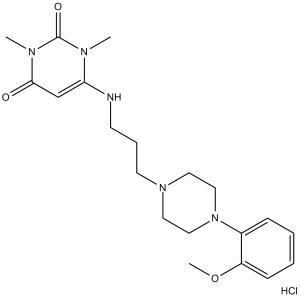
Urapidil HCl, the hydrochloride salt of uradipil which is a sympatholytic antihypertensive drug, is potent α1-adrenoceptor antagonist and 5-HT1A receptor agonist with pIC50 of 6.13 and 6.4 respectively. The FDA has not approved urapidil as of yet, but it is accessible in Europe.
Physicochemical Properties
| Molecular Formula | C20H30CLN5O3 | |
| Molecular Weight | 423.94 | |
| Exact Mass | 423.203 | |
| Elemental Analysis | C, 56.66; H, 7.13; Cl, 8.36; N, 16.52; O, 11.32 | |
| CAS # | 64887-14-5 | |
| Related CAS # | Urapidil; 34661-75-1 | |
| PubChem CID | 5639 | |
| Appearance | White to off-white solid powder | |
| Boiling Point | 549ºC at 760 mmHg | |
| Melting Point | 156-158ºC | |
| Flash Point | 285.8ºC | |
| LogP | 1.594 | |
| Hydrogen Bond Donor Count | 1 | |
| Hydrogen Bond Acceptor Count | 6 | |
| Rotatable Bond Count | 7 | |
| Heavy Atom Count | 28 | |
| Complexity | 588 | |
| Defined Atom Stereocenter Count | 0 | |
| SMILES | Cl[H].O(C([H])([H])[H])C1=C([H])C([H])=C([H])C([H])=C1N1C([H])([H])C([H])([H])N(C([H])([H])C([H])([H])C([H])([H])N([H])C2=C([H])C(N(C([H])([H])[H])C(N2C([H])([H])[H])=O)=O)C([H])([H])C1([H])[H] |
|
| InChi Key | KTMLZVUAXJERAT-UHFFFAOYSA-N | |
| InChi Code | InChI=1S/C20H29N5O3.ClH/c1-22-18(15-19(26)23(2)20(22)27)21-9-6-10-24-11-13-25(14-12-24)16-7-4-5-8-17(16)28-3;/h4-5,7-8,15,21H,6,9-14H2,1-3H3;1H | |
| Chemical Name | 6-[3-[4-(2-methoxyphenyl)piperazin-1-yl]propylamino]-1,3-dimethylpyrimidine-2,4-dione;hydrochloride | |
| Synonyms |
|
|
| HS Tariff Code | 2934.99.9001 | |
| Storage |
Powder-20°C 3 years 4°C 2 years In solvent -80°C 6 months -20°C 1 month Note: Please store this product in a sealed and protected environment, avoid exposure to moisture. |
|
| Shipping Condition | Room temperature (This product is stable at ambient temperature for a few days during ordinary shipping and time spent in Customs) |
Biological Activity
| Targets | 5-HT1A Receptor; α adrenergic receptor; α1-adrenergic receptor ( pIC50 = 6.13 ); α2-adrenergic receptor ( pIC50 = 4.38 ) | ||
| ln Vitro |
|
||
| ln Vivo | Urapidil (p.o. or i.v.) results in sedation and decreased tonus in mice and rats[3]. | ||
| Animal Protocol |
|
||
| References |
[1]. Urapidil and some analogues with hypotensive properties show high affinities for 5-hydroxytryptamine (5-HT) binding sites of the 5-HT1A subtype and for alpha 1-adrenoceptor binding sites. Naunyn Schmiedebergs Arch Pharmacol, 1987. 336(6): p. 597-601. [2]. Urapidil, a dual-acting antihypertensive agent: Current usage considerations. Adv Ther, 2010. 27(7): p. 426-43. [3]. Neonatal transient respiratory depression after maternal urapidil infusion for hypertension. Eur J Pediatr. 2009 Feb;168(2):221-3. |
||
| Additional Infomation |
Urapidil is a member of piperazines. Urapidil has been investigated for the treatment of Hypertension During Pre-Eclampsia. See also: Urapidil hydrochloride (annotation moved to). |
Solubility Data
| Solubility (In Vitro) |
|
|||
| Solubility (In Vivo) |
Solubility in Formulation 1: ≥ 1.25 mg/mL (2.95 mM) (saturation unknown) in 10% DMSO + 40% PEG300 + 5% Tween80 + 45% Saline (add these co-solvents sequentially from left to right, and one by one), clear solution. For example, if 1 mL of working solution is to be prepared, you can add 100 μL of 12.5 mg/mL clear DMSO stock solution to 400 μL PEG300 and mix evenly; then add 50 μL Tween-80 to the above solution and mix evenly; then add 450 μL normal saline to adjust the volume to 1 mL. Preparation of saline: Dissolve 0.9 g of sodium chloride in 100 mL ddH₂ O to obtain a clear solution. Solubility in Formulation 2: ≥ 1.25 mg/mL (2.95 mM) (saturation unknown) in 10% DMSO + 90% (20% SBE-β-CD in Saline) (add these co-solvents sequentially from left to right, and one by one), clear solution. For example, if 1 mL of working solution is to be prepared, you can add 100 μL of 12.5 mg/mL clear DMSO stock solution to 900 μL of 20% SBE-β-CD physiological saline solution and mix evenly. Preparation of 20% SBE-β-CD in Saline (4°C,1 week): Dissolve 2 g SBE-β-CD in 10 mL saline to obtain a clear solution. Solubility in Formulation 3: ≥ 1.25 mg/mL (2.95 mM) (saturation unknown) in 10% DMSO + 90% Corn Oil (add these co-solvents sequentially from left to right, and one by one), clear solution. For example, if 1 mL of working solution is to be prepared, you can add 100 μL of 12.5 mg/mL clear DMSO stock solution to 900 μL of corn oil and mix evenly. Solubility in Formulation 4: 50 mg/mL (117.94 mM) in PBS (add these co-solvents sequentially from left to right, and one by one), clear solution; with ultrasonication. (Please use freshly prepared in vivo formulations for optimal results.) |
| Preparing Stock Solutions | 1 mg | 5 mg | 10 mg | |
| 1 mM | 2.3588 mL | 11.7941 mL | 23.5882 mL | |
| 5 mM | 0.4718 mL | 2.3588 mL | 4.7176 mL | |
| 10 mM | 0.2359 mL | 1.1794 mL | 2.3588 mL |