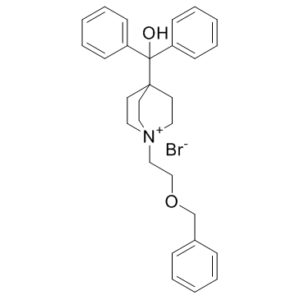
Umeclidinium bromide (formerly GSK-573719; GSK573719A; Incruse Ellipta) is a novel and inhaled long-acting muscarinic antagonist (LAMA) with the potential for treatment of pulmonary diseases (e.g. COPD). Umeclidinium is authorized for use in the COPD maintenance treatment. Along with vilanterol (marketed under the name Anoro Ellipta), it is also authorized for use in this indication in triple therapy as fluticasone furoate, umeclidinium bromide, and vilanterol.
Physicochemical Properties
| Molecular Formula | C29H34BRNO2 |
| Molecular Weight | 508.4898 |
| Exact Mass | 507.177 |
| Elemental Analysis | C, 68.50; H, 6.74; Br, 15.71; N, 2.75; O, 6.29 |
| CAS # | 869113-09-7 |
| Related CAS # | Umeclidinium-d10 bromide; Umeclidinium-d5 bromide |
| PubChem CID | 11519069 |
| Appearance | White to off-white solid powder |
| LogP | 2.102 |
| Hydrogen Bond Donor Count | 1 |
| Hydrogen Bond Acceptor Count | 3 |
| Rotatable Bond Count | 8 |
| Heavy Atom Count | 33 |
| Complexity | 543 |
| Defined Atom Stereocenter Count | 0 |
| SMILES | [Br-].OC(C12CC[N+](CC1)(CCOCC1C=CC=CC=1)CC2)(C1C=CC=CC=1)C1C=CC=CC=1 |
| InChi Key | PEJHHXHHNGORMP-UHFFFAOYSA-M |
| InChi Code | InChI=1S/C29H34NO2.BrH/c31-29(26-12-6-2-7-13-26,27-14-8-3-9-15-27)28-16-19-30(20-17-28,21-18-28)22-23-32-24-25-10-4-1-5-11-25;/h1-15,31H,16-24H2;1H/q+1;/p-1 |
| Chemical Name | diphenyl-[1-(2-phenylmethoxyethyl)-1-azoniabicyclo[2.2.2]octan-4-yl]methanol;bromide |
| Synonyms | GSK 573719A; GSK-573719; GSK573719; GSK573719A; Incruse Ellipta; GSK 573719; GSK-573719A; Umeclidinium bromide |
| HS Tariff Code | 2934.99.9001 |
| Storage |
Powder-20°C 3 years 4°C 2 years In solvent -80°C 6 months -20°C 1 month Note: Please store this product in a sealed and protected environment, avoid exposure to moisture. |
| Shipping Condition | Room temperature (This product is stable at ambient temperature for a few days during ordinary shipping and time spent in Customs) |
Biological Activity
| Targets | mAChR1; mAChR5 |
| ln Vitro | Umeclidinium is a potent antagonist of mAChR. Umeclidinium had an affinity (Ki) ranging from 0.05 to 0.16 nM for the cloned human M1-M5 mAChRs[1]. |
| ln Vivo | Umeclidinium exhibits a prolonged duration of action and slow functional reversibility at the human M3 mAChR, making it a powerful anticholinergic agent in animal models[1]. |
| Enzyme Assay | The [3H]-N-methyl scopolamine (0.5 nM) and umeclidinium bromide (GSK573719A) are used in ligand binding assays. For M1, M2, and M3 mAChRs, a scintillation proximity assay is used, and for M4 and M5 mAChRs, a filtration strategy. In order to perform the scintillation proximity assay, membranes are first incubated for 30 minutes at 4°C with wheat germ agglutinin beads in 50 mM HEPES buffer (pH 7.4). Afterward, the radioligand is added to a 96-well OptiPlate and left to sit at room temperature for two hours, either in the presence of GSK573719 (0.01-300 nM) or vehicle (1% DMSO). The plates are centrifuged (for five minutes at 2000 g) and the radioactivity is counted after the incubation period. Membranes (M4 and M5) are similarly incubated in HEPES buffer containing the radioligand for two hours at room temperature in the presence of either umeclidinium bromide (0.03-300 nM) or vehicle (1% DMSO) for the filtration assay. Atropine serves as a point of reference. Quick filtration through GF/C filters (glass microfiber binder free 1.2 μ) stops reactions in their tracks. Membranes are placed in scintillation vials after being cleaned with ice-cold 50 mM HEPES. A Scintillation Counter is used to measure radioactivity. Quick filtration puts an end to reactions. The information comes from three separate experiments. To calculate specific binding, deduct nonspecific binding from total binding (using 0.3 μM atropine). Umeclidinium bromide's inhibition constant (Ki) is computed. Additionally, membranes containing M3 mAChRs are incubated at room temperature for two hours with varying concentrations of [3H]-N-methyl scopolamine (0.08-9.24 nM) in 50 mM HEPES, pH 7.4, with or without umeclidinium bromide (0.2-0.5 nM). The measurement of nonspecific binding is done with 10 μM atropine. For analysis, the saturation data are transformed into a scatchard plot[1]. |
| Animal Protocol | Mice: Male BALB/c mice that are age-matched and weighing between 23 and 25 grams are given an intraperitoneal injection of either vehicle (0.9% saline) or umeclidinium bromide every 0 to 48 hours before being challenged with methacholine. The mice are then placed into separate plethysmograph chambers. Bias flow pumps bring in fresh air for the chambers. Following the collection of baseline respiratory [enhanced pause (Penh)] values, methacholine (30 mg/mL or EC80) was administered to the mice via aerosol delivery (flow=1.6 mL/min×2 minutes). After that, a Penh average is computed for five minutes. The relaxation time is the amount of time needed for 70% of the tidal volume to expire, and Penh=[(expiratory time/relaxation time)−1]×(peak expiratory flow/peak inspiratory flow). The figure legends describe instances in which animals receive treatment over a period of several consecutive days. The information is presented as the mean±S.E.M. percent inhibition of Penh or (mean Penh value of vehicle treated group-Penh for each drug-treated animal) / (mean Penh value of vehicle treated group)×100%. Commercial software is used to analyze data. |
| References |
[1]. Pharmacological characterization of GSK573719 (umeclidinium): a novel, long-acting, inhaled antagonist of the muscarinic cholinergic receptors for treatment of pulmonary diseases. J Pharmacol Exp Ther. 2013 May;345(2):260-70. [2]. Pharmacology and therapeutics of bronchodilators. Pharmacol Rev. 2012 Jul;64(3):450-504. [3]. Pharmacological characterization of the interaction between umeclidinium and vilanterol in human bronchi. Eur J Pharmacol. 2017 Jul 14. pii: S0014-2999(17)30470-3. |
| Additional Infomation |
Umeclidinium bromide is a quaternary ammonium salt that is the bromide salt of umeclidinium. Used in combination with vilanterol for long-term maintenance treatment of airflow obstruction in patients with chronic obstructive pulmonary disease. It has a role as a muscarinic antagonist. It is a quaternary ammonium salt and an organic bromide salt. It contains an umeclidinium. Umeclidinium Bromide is the bromide salt form of umeclidinium, a muscarinic receptor antagonist, with bronchodilator activity. Although it does not display selectivity for specific muscarinic receptors, on topical application, umeclidinium acts mainly on M3 muscarinic receptors located on smooth muscle cells, thereby preventing smooth muscle contraction and resulting in bronchodilatory effect. See also: Umeclidinium (has active moiety); Umeclidinium bromide; vilanterol trifenatate (component of) ... View More ... Drug Indication Rolufta is indicated as a maintenance bronchodilator treatment to relieve symptoms in adult patients with chronic obstructive pulmonary disease (COPD). , Indicated as a maintenance bronchodilator treatment to relieve symptoms in adult patients with chronic obstructive pulmonary disease (COPD). , |
Solubility Data
| Solubility (In Vitro) |
DMSO: ~100 mg/mL (~196.7 mM) Ethanol: ~12 mg/mL |
| Solubility (In Vivo) |
Solubility in Formulation 1: 2.5 mg/mL (4.92 mM) in 10% DMSO + 90% (20% SBE-β-CD in Saline) (add these co-solvents sequentially from left to right, and one by one), clear solution; with sonication. For example, if 1 mL of working solution is to be prepared, you can add 100 μL of 25.0 mg/mL clear DMSO stock solution to 900 μL of 20% SBE-β-CD physiological saline solution and mix evenly. Preparation of 20% SBE-β-CD in Saline (4°C,1 week): Dissolve 2 g SBE-β-CD in 10 mL saline to obtain a clear solution. Solubility in Formulation 2: 2.5 mg/mL (4.92 mM) in 10% DMSO + 90% Corn Oil (add these co-solvents sequentially from left to right, and one by one), suspension solution; with ultrasonication. For example, if 1 mL of working solution is to be prepared, you can add 100 μL of 25.0 mg/mL clear DMSO stock solution to 900 μL of corn oil and mix evenly. (Please use freshly prepared in vivo formulations for optimal results.) |
| Preparing Stock Solutions | 1 mg | 5 mg | 10 mg | |
| 1 mM | 1.9666 mL | 9.8330 mL | 19.6661 mL | |
| 5 mM | 0.3933 mL | 1.9666 mL | 3.9332 mL | |
| 10 mM | 0.1967 mL | 0.9833 mL | 1.9666 mL |