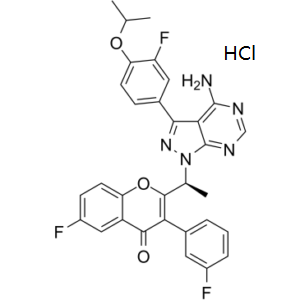
Umbralisib HCl (also known as TGR-1202; RP5264; trade name Ukoniq), the hydrochloride salt of Umbralisib, is an orally bioavailable PI3Kδ inhibitor that has gained FDA approval in 2021for treating marginal zone lymphoma and follicular lymphoma. With respective IC50 and EC50 values of 22.2 nM and 24.3 nM, it inhibits PI3Kδ.
Physicochemical Properties
| Molecular Formula | C31H25CLF3N5O3 |
| Molecular Weight | 608.01011633873 |
| Exact Mass | 607.159 |
| Elemental Analysis | C, 61.24; H, 4.14; Cl, 5.83; F, 9.37; N, 11.52; O, 7.89 |
| CAS # | 1532533-78-0 |
| Related CAS # | Umbralisib;1532533-67-7;Umbralisib R-enantiomer;1532533-69-9;Umbralisib tosylate;1532533-72-4;Umbralisib sulfate;1532533-75-7 |
| PubChem CID | 90030289 |
| Appearance | White to off-white solid powder |
| Hydrogen Bond Donor Count | 2 |
| Hydrogen Bond Acceptor Count | 10 |
| Rotatable Bond Count | 6 |
| Heavy Atom Count | 43 |
| Complexity | 1020 |
| Defined Atom Stereocenter Count | 1 |
| SMILES | Cl.FC1C=CC2=C(C=1)C(C(C1C=CC=C(C=1)F)=C([C@H](C)N1C3C(=C(N)N=CN=3)C(C3C=CC(=C(C=3)F)OC(C)C)=N1)O2)=O |
| InChi Key | QGVUVMVWYWMZIR-NTISSMGPSA-N |
| InChi Code | InChI=1S/C31H24F3N5O3.ClH/c1-15(2)41-24-9-7-18(12-22(24)34)27-26-30(35)36-14-37-31(26)39(38-27)16(3)29-25(17-5-4-6-19(32)11-17)28(40)21-13-20(33)8-10-23(21)42-29;/h4-16H,1-3H3,(H2,35,36,37);1H/t16-;/m0./s1 |
| Chemical Name | 2-[(1S)-1-[4-amino-3-(3-fluoro-4-propan-2-yloxyphenyl)pyrazolo[3,4-d]pyrimidin-1-yl]ethyl]-6-fluoro-3-(3-fluorophenyl)chromen-4-one;hydrochloride |
| Synonyms | TGR-1202 hydrochloride; TGR 1202 hydrochloride; TGR1202 hydrochloride; TGR-1202 HCl; TGR 1202 HCl; TGR1202 HCl |
| HS Tariff Code | 2934.99.9001 |
| Storage |
Powder-20°C 3 years 4°C 2 years In solvent -80°C 6 months -20°C 1 month Note: Please store this product in a sealed and protected environment, avoid exposure to moisture. |
| Shipping Condition | Room temperature (This product is stable at ambient temperature for a few days during ordinary shipping and time spent in Customs) |
Biological Activity
| Targets | PI3Kδ (IC50 = 22.2 nM); PI3Kδ (Kd = 6.2 nM); PI3Kγ (Kd = 1400 nM); PI3Kβ (Kd = >10000 nM); PI3Kα (Kd >10000 nM) |
| ln Vitro | Umbralisib hydrochloride causes a half-maximal inhibition of human whole blood CD19 cell proliferation between 100-300 nM[3]. Umbralisib hydrochloride (10 nM-100 μM) inhibits phosphorylated AKT at Ser473 in a concentration-dependent manner in human lymphoma and leukemia cell lines[4]. Umbralisib hydrochloride (15-50 μM) potently inhibits the expression of c-Myc in the DLBCL cell line LY7 and is structurally distinct enough to target CK1 in lymphoma cells[4]. |
| ln Vivo | Umbralisib hydrochloride (150 mg/kg, daily p.o.) significantly reduces the tumors by day 25 in a subcutaneous xenograft model of T-cell acute lymphoblastic leukemia (T-ALL) in NOD/SCID mice using the MOLT-4 cell line[4]. |
| Enzyme Assay | Umbralisib (TGR-1202) is a novelPI3Kδinhibitor, withIC50andEC50of 22.2 nM and 24.3 nM, respectively; Umbralisib (TGR-1202) is also active againstCK1ε, with anEC50value of 6.0 μM. |
| Cell Assay | Multiple Myeloma resistant (MM-1R) or sensitive (MM-1S) cells are incubated with desired concentrations of RP5264. Growth is assessed after 96 h by a MTT assay. |
| Animal Protocol | Oral gavage |
| References |
[1]. The dual PI3Kδ/CK1ε inhibitor umbralisib exhibits unique immunomodulatory effects on CLL T cells. Blood Adv. 2020 Jul 14;4(13):3072-3084. [2]. Umbralisib, a novel PI3Kδ and casein kinase-1ε inhibitor, in relapsed or refractory chronic lymphocytic leukaemia and lymphoma: an open-label, phase 1, dose-escalation, first-in-human study. Lancet Oncol. 2018 Apr;19(4):486-496. [3]. Inhibition of PI3Kδ kinase by a selective, small molecule inhibitor suppresses B-cell proliferation and leukemic cell growth. [4]. Silencing c-Myc translation as a therapeutic strategy through targeting PI3Kδ and CK1ε in hematological malignancies. Blood. 2017 Jan 5;129(1):88-99 |
Solubility Data
| Solubility (In Vitro) |
DMSO: ≥150 mg/mL (~246.7 mM) H2O: <0.1 mg/mL |
| Solubility (In Vivo) |
Solubility in Formulation 1: ≥ 2.5 mg/mL (4.11 mM) (saturation unknown) in 10% DMSO + 40% PEG300 + 5% Tween80 + 45% Saline (add these co-solvents sequentially from left to right, and one by one), clear solution. For example, if 1 mL of working solution is to be prepared, you can add 100 μL of 25.0 mg/mL clear DMSO stock solution to 400 μL PEG300 and mix evenly; then add 50 μL Tween-80 to the above solution and mix evenly; then add 450 μL normal saline to adjust the volume to 1 mL. Preparation of saline: Dissolve 0.9 g of sodium chloride in 100 mL ddH₂ O to obtain a clear solution. Solubility in Formulation 2: ≥ 2.5 mg/mL (4.11 mM) (saturation unknown) in 10% DMSO + 90% Corn Oil (add these co-solvents sequentially from left to right, and one by one), clear solution. For example, if 1 mL of working solution is to be prepared, you can add 100 μL of 25.0 mg/mL clear DMSO stock solution to 900 μL of corn oil and mix evenly. (Please use freshly prepared in vivo formulations for optimal results.) |
| Preparing Stock Solutions | 1 mg | 5 mg | 10 mg | |
| 1 mM | 1.6447 mL | 8.2235 mL | 16.4471 mL | |
| 5 mM | 0.3289 mL | 1.6447 mL | 3.2894 mL | |
| 10 mM | 0.1645 mL | 0.8224 mL | 1.6447 mL |