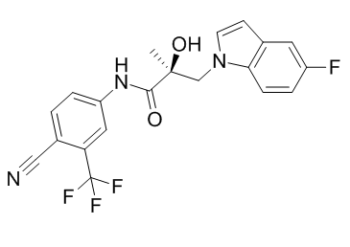
UT-155 is a potent and selective androgen receptor (AR) degrader (SARD) that, at submicromolar doses, significantly decreases the activity of wild-type and splice variant isoforms of AR. Two of these SARDs (UT-69 and UT-155) also bind the carboxy-terminal ligand binding domain. Three SARDs (UT-69, UT-155, and (R)-UT-155) bind the amino-terminal transcriptional activation domain AF-1, which has not previously been targeted for degradation. All three SARDs demonstrated higher inhibitory potency than the authorized AR antagonists, degrading wild-type AR and inhibiting AR function despite having distinct mechanisms of action. All of these findings point to a novel class of potential next-generation treatments for the treatment of advanced prostate cancer. The growth of prostate cancer is mediated by the androgen receptor (AR) at all stages of the disease's progression, including advanced stage castration-resistant disease caused by abnormal splice variants (AR-SV). Different from other steroid receptors, which are usually ubiquitinated and broken down by proteasomes following ligand binding, AR is stabilized by androgens. Consequently, in order to effectively treat advanced prostate cancer, agents that can degrade variant isoforms over time must be developed.
Physicochemical Properties
| Molecular Formula | C20H15F4N3O2 | |
| Molecular Weight | 405.345618486404 | |
| Exact Mass | 405.11 | |
| Elemental Analysis | C, 59.26; H, 3.73; F, 18.75; N, 10.37; O, 7.89 | |
| CAS # | 2031161-35-8 | |
| Related CAS # | (R)-UT-155;2031161-54-1 | |
| PubChem CID | 122640156 | |
| Appearance | White to off-white solid powder | |
| LogP | 3.1 | |
| Hydrogen Bond Donor Count | 2 | |
| Hydrogen Bond Acceptor Count | 7 | |
| Rotatable Bond Count | 4 | |
| Heavy Atom Count | 29 | |
| Complexity | 664 | |
| Defined Atom Stereocenter Count | 1 | |
| SMILES | C[C@](CN1C=CC2=C1C=CC(=C2)F)(C(=O)NC3=CC(=C(C=C3)C#N)C(F)(F)F)O |
|
| InChi Key | CFSAYQVTXBMPRF-IBGZPJMESA-N | |
| InChi Code | InChI=1S/C20H15F4N3O2/c1-19(29,11-27-7-6-12-8-14(21)3-5-17(12)27)18(28)26-15-4-2-13(10-25)16(9-15)20(22,23)24/h2-9,29H,11H2,1H3,(H,26,28)/t19-/m0/s1 | |
| Chemical Name | (2S)-N-[4-cyano-3-(trifluoromethyl)phenyl]-3-(5-fluoroindol-1-yl)-2-hydroxy-2-methylpropanamide | |
| Synonyms |
|
|
| HS Tariff Code | 2934.99.9001 | |
| Storage |
Powder-20°C 3 years 4°C 2 years In solvent -80°C 6 months -20°C 1 month |
|
| Shipping Condition | Room temperature (This product is stable at ambient temperature for a few days during ordinary shipping and time spent in Customs) |
Biological Activity
| Targets | AR-LBD (Ki = 267 nM) | ||
| ln Vitro | UT-155 binds at a Ki of 267 nM to the AR-LBD. UT-155 has 6–10 times the potency of enzalutamide in inhibiting the wildtype AR transactivation induced by R1881. Enzalutamide is two times less effective against the W742L mutant AR than it is against the wild type AR, even though UT-155 antagonizes both wildtype and mutant ARs in a comparable way. When applied to LNCaP cells, UT-155 has 5–10 times more potency than enzalutamide in inhibiting 0.1 nM R1881-induced PSA and FKBP5 gene expression between 10 and 100 nM[1]. | ||
| ln Vivo | As anticipated, enzalutamide has no effect on the growth of the 22RV1 tumors, but UT-155 dramatically inhibits the growth of the 22RV1 xenograft by 53%, which is consistent with the anti-proliferative effects in vitro. In animals treated with UT-155, there is a significant decrease in tumor weights, PSA, and the expression of AR and AR-SV [1]. | ||
| Enzyme Assay | UT-155 is a selective androgen receptor (AR) antagonist, with a Ki of 267 nM for AR-RBD. In addition to competing with one another for binding to the LBD, UT-69 and UT-155 also lower AR protein levels after 24 hours, which is similar to the reported decline in transcriptional activity. We assessed the effect of the SARDs on the pre-mRNA of the hormone-rapidly induced NDRG1 and MT2A genes to ascertain whether the reduction in expression was necessary to inhibit AR activity or whether the competitive displacement of androgen from the LBD is sufficient to inhibit transcriptional activity. | ||
| Cell Assay | Cells were cultured in 96-well plates according to the cell line, with different densities and serum-containing media. Viability was assessed using the cell-titer glo assay (Promega, Madison, WI) or sulforhodamine B (SRB), as shown in the figures. | ||
| Animal Protocol |
|
||
| References |
[1]. Novel Selective Agents for the Degradation of Androgen Receptor Variants to Treat Castration-Resistant Prostate Cancer. Cancer Res. 2017 Nov 15;77(22):6282-6298. |
Solubility Data
| Solubility (In Vitro) |
|
|||
| Solubility (In Vivo) |
Solubility in Formulation 1: ≥ 2.17 mg/mL (5.35 mM) (saturation unknown) in 10% DMSO + 40% PEG300 + 5% Tween80 + 45% Saline (add these co-solvents sequentially from left to right, and one by one), clear solution. For example, if 1 mL of working solution is to be prepared, you can add 100 μL of 21.7 mg/mL clear DMSO stock solution to 400 μL PEG300 and mix evenly; then add 50 μL Tween-80 to the above solution and mix evenly; then add 450 μL normal saline to adjust the volume to 1 mL. Preparation of saline: Dissolve 0.9 g of sodium chloride in 100 mL ddH₂ O to obtain a clear solution. Solubility in Formulation 2: ≥ 2.17 mg/mL (5.35 mM) (saturation unknown) in 10% DMSO + 90% (20% SBE-β-CD in Saline) (add these co-solvents sequentially from left to right, and one by one), suspension solution. For example, if 1 mL of working solution is to be prepared, you can add 100 μL of 21.7 mg/mL clear DMSO stock solution to 900 μL of 20% SBE-β-CD physiological saline solution and mix evenly. Preparation of 20% SBE-β-CD in Saline (4°C,1 week): Dissolve 2 g SBE-β-CD in 10 mL saline to obtain a clear solution. Solubility in Formulation 3: ≥ 2.17 mg/mL (5.35 mM) (saturation unknown) in 10% DMSO + 90% Corn Oil (add these co-solvents sequentially from left to right, and one by one), clear solution. For example, if 1 mL of working solution is to be prepared, you can add 100 μL of 21.7 mg/mL clear DMSO stock solution to 900 μL of corn oil and mix evenly. (Please use freshly prepared in vivo formulations for optimal results.) |
| Preparing Stock Solutions | 1 mg | 5 mg | 10 mg | |
| 1 mM | 2.4670 mL | 12.3350 mL | 24.6700 mL | |
| 5 mM | 0.4934 mL | 2.4670 mL | 4.9340 mL | |
| 10 mM | 0.2467 mL | 1.2335 mL | 2.4670 mL |