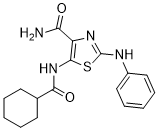
UNC3230 is a selective inhibitor of lipid kinase PIP5K1C. It acts by lowering PIP2 levels in DRG neurons and attenuating hypersensitivity.
Physicochemical Properties
| Molecular Formula | C17H20N4O2S |
| Molecular Weight | 344.43 |
| Exact Mass | 344.13 |
| Elemental Analysis | C, 59.28; H, 5.85; N, 16.27; O, 9.29; S, 9.31 |
| CAS # | 1031602-63-7 |
| Related CAS # | 1031602-63-7; |
| PubChem CID | 46355372 |
| Appearance | Off-white to light yellow solid powder |
| Density | 1.4±0.1 g/cm3 |
| Index of Refraction | 1.687 |
| LogP | 2.49 |
| Hydrogen Bond Donor Count | 3 |
| Hydrogen Bond Acceptor Count | 5 |
| Rotatable Bond Count | 5 |
| Heavy Atom Count | 24 |
| Complexity | 450 |
| Defined Atom Stereocenter Count | 0 |
| SMILES | O=C(N)C=1NC(SC1NC(C2CCCCC2)=O)=NC3=CC=CC=C3 |
| InChi Key | RZCNASHHHSKTGP-UHFFFAOYSA-N |
| InChi Code | InChI=1S/C17H20N4O2S/c18-14(22)13-16(21-15(23)11-7-3-1-4-8-11)24-17(20-13)19-12-9-5-2-6-10-12/h2,5-6,9-11H,1,3-4,7-8H2,(H2,18,22)(H,19,20)(H,21,23) |
| Chemical Name | 5-(Cyclohexanecarboxamido)-2-(phenylamino)thiazole-4-carboxamide |
| Synonyms | UNC3230 UNC-3230 UNC 3230 |
| HS Tariff Code | 2934.99.9001 |
| Storage |
Powder-20°C 3 years 4°C 2 years In solvent -80°C 6 months -20°C 1 month |
| Shipping Condition | Room temperature (This product is stable at ambient temperature for a few days during ordinary shipping and time spent in Customs) |
Biological Activity
| ln Vitro | When compared to vehicle control, membrane PIP2 levels in dorsal root ganglion (DRG) neurons treated with 100 nM UNC3230 (~2x the IC50) were significantly lower by about 45%. In DRG neurons, UNC3230-cultured cultures considerably inhibited lysophosphatidic acid (LPA)-evoked calcium signaling in comparison to vehicle cultures [1]. |
| ln Vivo | Two hours after intrathecal injection into wild-type mice, UNC3230 (2 nmol) dramatically enhances the heat-induced paw withdrawal latency of pests, indicating an anti-inflammatory impact [1]. UNC3230 (2 nmol; intrathecal), then co-injecting 1 nmol LPA with UNC3230 (2 nmol, intrathecal) one hour later. When compared to a car, UNC3230 dramatically reduces mechanical allodynia and thermal hyperalgesia [1]. Thermal hyperalgesia and mechanical allodynia are greatly reduced by UNC3230 (2 nmol; intrathecally) [1]. Over the course of many days, the adjuvant (CFA)-inflamed hindpaw showed both mechanical allodynia and thermal hyperalgesia in comparison to the control, but neither the thermal nor the mechanical texture of the non-inflamed hindpaw was impacted [1]. |
| References |
[1]. The lipid kinase PIP5K1C regulates pain signaling and sensitization. Neuron. 2014 May 21;82(4):836-47. [2]. Type Iγ phosphatidylinositol phosphate kinase promotes tumor growth by facilitating Warburg effect in colorectal cancer. EBioMedicine. 2019 Jun;44:375-386. [3]. Development of a High-Throughput Screening Assay to Identify Inhibitors of the Lipid Kinase PIP5K1C. J Biomol Screen. 2015 Jun;20(5):655-62. |
Solubility Data
| Solubility (In Vitro) | DMSO : ~125 mg/mL (~362.92 mM) |
| Solubility (In Vivo) |
Solubility in Formulation 1: ≥ 2.08 mg/mL (6.04 mM) (saturation unknown) in 10% DMSO + 90% Corn Oil (add these co-solvents sequentially from left to right, and one by one), clear solution. For example, if 1 mL of working solution is to be prepared, you can add 100 μL of 20.8 mg/mL clear DMSO stock solution to 900 μL of corn oil and mix evenly. (Please use freshly prepared in vivo formulations for optimal results.) |
| Preparing Stock Solutions | 1 mg | 5 mg | 10 mg | |
| 1 mM | 2.9033 mL | 14.5167 mL | 29.0335 mL | |
| 5 mM | 0.5807 mL | 2.9033 mL | 5.8067 mL | |
| 10 mM | 0.2903 mL | 1.4517 mL | 2.9033 mL |