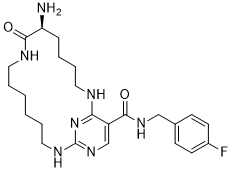
UNC2541 is a novel, potent and selective Mer tyrosine kinase (MerTK) inhibitor which binds in the MerTK ATP pocket with an IC50 of 4.4 nM, and it is more selective over Axl, Tyro3 and Flt3. UNC2541 suppresses phosphorylated MerTK (pMerTK; 510 nM EC50). The cell-based ELISA demonstrates sub-micromolar inhibitory activity for UNC2541. Furthermore, it was demonstrated that these macrocycles bind in the MerTK ATP pocket by resolving the X-ray structure of the MerTK protein in complex with UNC2541. According to UNC2541, the IC50 values for MerTH, AXL, TYRO3, and FLT3 were 4.4 nM, 120 nM, and 320 nM, respectively.
Physicochemical Properties
| Molecular Formula | C24H34FN7O2 |
| Molecular Weight | 471.570868015289 |
| Exact Mass | 471.581 |
| Elemental Analysis | C, 61.13; H, 7.27; F, 4.03; N, 20.79; O, 6.79 |
| CAS # | 1612782-86-1 |
| Related CAS # | 1612782-86-1 |
| PubChem CID | 74538669 |
| Appearance | White to off-white solid powder |
| LogP | 2.4 |
| Hydrogen Bond Donor Count | 5 |
| Hydrogen Bond Acceptor Count | 8 |
| Rotatable Bond Count | 3 |
| Heavy Atom Count | 34 |
| Complexity | 618 |
| Defined Atom Stereocenter Count | 1 |
| SMILES | C1CCCNC2=NC=C(C(=N2)NCCCC[C@@H](C(=O)NCC1)N)C(=O)NCC3=CC=C(C=C3)F |
| InChi Key | ONIHBIZGUJZDHG-FQEVSTJZSA-N |
| InChi Code | InChI=1S/C24H34FN7O2/c25-18-10-8-17(9-11-18)15-30-22(33)19-16-31-24-29-14-5-2-1-4-13-28-23(34)20(26)7-3-6-12-27-21(19)32-24/h8-11,16,20H,1-7,12-15,26H2,(H,28,34)(H,30,33)(H2,27,29,31,32)/t20-/m0/s1 |
| Chemical Name | (7S)-7-amino-N-[(4-fluorophenyl)methyl]-8-oxo-2,9,16,18,21-pentazabicyclo[15.3.1]henicosa-1(21),17,19-triene-20-carboxamide |
| Synonyms | UNC2541; UNC-2541; UNC 2541 |
| HS Tariff Code | 2934.99.9001 |
| Storage |
Powder-20°C 3 years 4°C 2 years In solvent -80°C 6 months -20°C 1 month |
| Shipping Condition | Room temperature (This product is stable at ambient temperature for a few days during ordinary shipping and time spent in Customs) |
Biological Activity
| Targets |
MERTK (IC50 = 4.4 nM) UNC2541 is a potent and specific inhibitor of Mer tyrosine kinase (MerTK). In a microfluidic capillary electrophoresis (MCE) enzymatic assay, its IC50 against MerTK is 4.4 ± 0.5 nM. It shows high selectivity over other TAM family kinases (Axl IC50 = 120 ± 60 nM, Tyro3 IC50 = 220 ± 8 nM) and FMS-like tyrosine kinase 3 (Flt3 IC50 = 2320 ± 110 nM), yielding a >500-fold selectivity window against Flt3. In a broader kinase panel of 30 kinases, at a concentration of 430 nM (100-fold above its MerTK IC50), UNC2541 inhibited five additional tyrosine kinases and three serine/threonine kinases by more than 50%. |
| ln Vitro |
UNC2541 is an effective and highly selective inhibitor of Mer tyrosine kinase (MerTK), with an IC50 of 4.4 nM. It binds in the MerTK ATP pocket and is more selective than Axl (IC50, 120 nM), Tyro3 (IC50, 220 nM), and Flt3 (IC50, 320 nM). Phosphorylated MerTK (pMerTK; EC50, 510 nM) is inhibited by UNC2541[1]. UNC2541 inhibits MerTK that has been phosphorylated (pMerTK; EC50, 510 nM)[1]. UNC2541 demonstrated potent inhibitory activity in a cell-based ELISA assay measuring tyrosine phosphorylation of a chimeric EGFR-MerTK protein (pMerTK). The reported EC50 in this assay was 510 nM. Its inhibitory activity and selectivity profile were characterized through structure-activity relationship (SAR) studies focusing on macrocycle ring size and linker modifications. The binding mode was confirmed by X-ray crystallography, showing that UNC2541 binds to the ATP pocket of MerTK. |
| Enzyme Assay |
Enzymatic activity against MerTK, Axl, Tyro3, and Flt3 was assessed using an in-house microfluidic capillary electrophoresis (MCE) assay. The assay was performed at the respective Km ATP concentration for each kinase. Inhibitory concentrations (IC50) were determined from dose-response curves. |
| Cell Assay |
A cell-based enzyme-linked immunosorbent assay (ELISA) was used to evaluate the inhibition of MerTK tyrosine phosphorylation in HEK293 cells. The cells were transfected with a cDNA encoding a chimeric protein consisting of the extracellular and transmembrane domains of the epidermal growth factor receptor (EGFR) fused to the intracellular kinase domain of MerTK. Kinase activity was stimulated by the addition of EGF. Compound activity was measured by quantifying the level of phosphorylated MerTK (pMerTK) using ELISA. The half-maximal effective concentration (EC50) was calculated from the dose-response curve. |
| References |
[1]. Discovery of Macrocyclic Pyrimidines as MerTK-Specific Inhibitors. ChemMedChem. 2017 Feb 3;12(3):207-213. |
| Additional Infomation |
UNC2541 (compound 11) is a macrocyclic pyrimidine discovered through a structure-based drug design approach aimed at developing MerTK-specific inhibitors. It was designed to improve selectivity over Flt3 compared to previous inhibitors like UNC2025. The X-ray co-crystal structure of MerTK with UNC2541 (PDB: 5K0X) confirmed the predicted binding mode within the ATP pocket, although it revealed an unanticipated orientation of the macrocycle's primary amine and carbonyl groups relative to residues R727, N728, and D741. The authors note that while UNC2541 exhibits good MerTK specificity within the TAM family and over Flt3, its selectivity over other kinase families and its cellular activity require further optimization for progression as a lead compound. |
Solubility Data
| Solubility (In Vitro) | DMSO: 10~94 mg/mL (21.2~199.3 mM) |
| Solubility (In Vivo) |
Note: Listed below are some common formulations that may be used to formulate products with low water solubility (e.g. < 1 mg/mL), you may test these formulations using a minute amount of products to avoid loss of samples. Injection Formulations (e.g. IP/IV/IM/SC) Injection Formulation 1: DMSO : Tween 80: Saline = 10 : 5 : 85 (i.e. 100 μL DMSO stock solution → 50 μL Tween 80 → 850 μL Saline) *Preparation of saline: Dissolve 0.9 g of sodium chloride in 100 mL ddH ₂ O to obtain a clear solution. Injection Formulation 2: DMSO : PEG300 :Tween 80 : Saline = 10 : 40 : 5 : 45 (i.e. 100 μL DMSO → 400 μLPEG300 → 50 μL Tween 80 → 450 μL Saline) Injection Formulation 3: DMSO : Corn oil = 10 : 90 (i.e. 100 μL DMSO → 900 μL Corn oil) Example: Take the Injection Formulation 3 (DMSO : Corn oil = 10 : 90) as an example, if 1 mL of 2.5 mg/mL working solution is to be prepared, you can take 100 μL 25 mg/mL DMSO stock solution and add to 900 μL corn oil, mix well to obtain a clear or suspension solution (2.5 mg/mL, ready for use in animals). Injection Formulation 4: DMSO : 20% SBE-β-CD in saline = 10 : 90 [i.e. 100 μL DMSO → 900 μL (20% SBE-β-CD in saline)] *Preparation of 20% SBE-β-CD in Saline (4°C,1 week): Dissolve 2 g SBE-β-CD in 10 mL saline to obtain a clear solution. Injection Formulation 5: 2-Hydroxypropyl-β-cyclodextrin : Saline = 50 : 50 (i.e. 500 μL 2-Hydroxypropyl-β-cyclodextrin → 500 μL Saline) Injection Formulation 6: DMSO : PEG300 : castor oil : Saline = 5 : 10 : 20 : 65 (i.e. 50 μL DMSO → 100 μLPEG300 → 200 μL castor oil → 650 μL Saline) Injection Formulation 7: Ethanol : Cremophor : Saline = 10: 10 : 80 (i.e. 100 μL Ethanol → 100 μL Cremophor → 800 μL Saline) Injection Formulation 8: Dissolve in Cremophor/Ethanol (50 : 50), then diluted by Saline Injection Formulation 9: EtOH : Corn oil = 10 : 90 (i.e. 100 μL EtOH → 900 μL Corn oil) Injection Formulation 10: EtOH : PEG300:Tween 80 : Saline = 10 : 40 : 5 : 45 (i.e. 100 μL EtOH → 400 μLPEG300 → 50 μL Tween 80 → 450 μL Saline) Oral Formulations Oral Formulation 1: Suspend in 0.5% CMC Na (carboxymethylcellulose sodium) Oral Formulation 2: Suspend in 0.5% Carboxymethyl cellulose Example: Take the Oral Formulation 1 (Suspend in 0.5% CMC Na) as an example, if 100 mL of 2.5 mg/mL working solution is to be prepared, you can first prepare 0.5% CMC Na solution by measuring 0.5 g CMC Na and dissolve it in 100 mL ddH2O to obtain a clear solution; then add 250 mg of the product to 100 mL 0.5% CMC Na solution, to make the suspension solution (2.5 mg/mL, ready for use in animals). Oral Formulation 3: Dissolved in PEG400 Oral Formulation 4: Suspend in 0.2% Carboxymethyl cellulose Oral Formulation 5: Dissolve in 0.25% Tween 80 and 0.5% Carboxymethyl cellulose Oral Formulation 6: Mixing with food powders Note: Please be aware that the above formulations are for reference only. InvivoChem strongly recommends customers to read literature methods/protocols carefully before determining which formulation you should use for in vivo studies, as different compounds have different solubility properties and have to be formulated differently. (Please use freshly prepared in vivo formulations for optimal results.) |
| Preparing Stock Solutions | 1 mg | 5 mg | 10 mg | |
| 1 mM | 2.1206 mL | 10.6029 mL | 21.2058 mL | |
| 5 mM | 0.4241 mL | 2.1206 mL | 4.2412 mL | |
| 10 mM | 0.2121 mL | 1.0603 mL | 2.1206 mL |