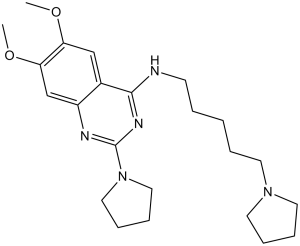
Description: UNC0379 is a substrate competitive lysine methyltransferase SETD8 (KMT5A) inhibitor with antineoplastic activity. It inhibits KMT5A with an IC50 of 7.9 μM, and shows higher selectivity for KMT5A over 15 other methyltransferases.
Physicochemical Properties
| Molecular Formula | C23H35N5O2 | |
| Molecular Weight | 413.56 | |
| Exact Mass | 413.279 | |
| CAS # | 1620401-82-2 | |
| Related CAS # | UNC0379 TFA;1620401-83-3 | |
| PubChem CID | 78357767 | |
| Appearance | Off-white to yellow solid powder | |
| Density | 1.2±0.1 g/cm3 | |
| Boiling Point | 606.3±65.0 °C at 760 mmHg | |
| Flash Point | 320.5±34.3 °C | |
| Vapour Pressure | 0.0±1.7 mmHg at 25°C | |
| Index of Refraction | 1.606 | |
| LogP | 2.76 | |
| Hydrogen Bond Donor Count | 1 | |
| Hydrogen Bond Acceptor Count | 7 | |
| Rotatable Bond Count | 10 | |
| Heavy Atom Count | 30 | |
| Complexity | 498 | |
| Defined Atom Stereocenter Count | 0 | |
| InChi Key | WEXCGGWTIDNVNT-UHFFFAOYSA-N | |
| InChi Code | InChI=1S/C23H35N5O2/c1-29-20-16-18-19(17-21(20)30-2)25-23(28-14-8-9-15-28)26-22(18)24-10-4-3-5-11-27-12-6-7-13-27/h16-17H,3-15H2,1-2H3,(H,24,25,26) | |
| Chemical Name | 6,7-dimethoxy-2-pyrrolidin-1-yl-N-(5-pyrrolidin-1-ylpentyl)quinazolin-4-amine | |
| Synonyms |
|
|
| HS Tariff Code | 2934.99.9001 | |
| Storage |
Powder-20°C 3 years 4°C 2 years In solvent -80°C 6 months -20°C 1 month |
|
| Shipping Condition | Room temperature (This product is stable at ambient temperature for a few days during ordinary shipping and time spent in Customs) |
Biological Activity
| ln Vitro | UNC0379 (1–10 μM, 9 days) prevents the growth of HGSOC cells[2]. UNC0379 (10 μM, 96 h) causes an increase in the percentage of HGSOC cells in the sub-G1 phase[2]. Myofibroblast de-differentiation is induced and further fibroblast to myofibroblast differentiation is inhibited by UNC0379 (10 μM, 96 h) 48 h][3]. |
| ln Vivo | In mice with lung fibrosis induced by bleomycin (BLM), UNC0379 (intratracheal administration, 1 mg/kg/day, on days 7, 8, and 9) ameliorates the lung fibrosis[3]. |
| Cell Assay |
Cell Viability Assay[1] Cell Types: JHOS2, JHOS3, JHOS4, OVCAR3, OVCAHO, OVKATE, KURAMOCHI, TYKnu Tested Concentrations: 1-10 μM Incubation Duration: 9 days Experimental Results: Inhibited HGSOC cells proliferation with IC50s ranging from 0.39 to 3.20 µM. Cell Cycle Analysis[1] Cell Types: JHOS3, OVCAR3 Tested Concentrations: 10 µM Incubation Duration: 96 h Experimental Results: Arrested cells in sub-G1 phase. |
| Animal Protocol |
Animal/Disease Models: Bleomycin (BLM)-induced lung fibrosis mouse model[3] Doses: 1 mg/kg/day Route of Administration: Intracheal administration, on day7, 8, and 9. Experimental Results: Ameliorated BLM-induced lung fibrosis (supported by the evaluation of the Ashcroft score and changes in the collagen content in the lung samples) without affecting pulmonary inflammation. |
| References |
[1]. Discovery of a Selective, Substrate-Competitive Inhibitor of the Lysine Methyltransferase SETD8. J Med Chem. 2014 Aug 14;57(15):6822-33. [2]. Epigenetic Modifier SETD8 as a Therapeutic Target for High-Grade Serous Ovarian Cancer. Biomolecules. 2020 Dec 16;10(12):1686. [3]. Inhibition of the SET8 Pathway Ameliorates Lung Fibrosis Even Through Fibroblast Dedifferentiation. Front Mol Biosci. 2020 Aug 5;7:192. |
Solubility Data
| Solubility (In Vitro) |
|
|||
| Solubility (In Vivo) |
Solubility in Formulation 1: ≥ 2.5 mg/mL (6.05 mM) (saturation unknown) in 10% DMSO + 40% PEG300 + 5% Tween80 + 45% Saline (add these co-solvents sequentially from left to right, and one by one), clear solution. For example, if 1 mL of working solution is to be prepared, you can add 100 μL of 25.0 mg/mL clear DMSO stock solution to 400 μL PEG300 and mix evenly; then add 50 μL Tween-80 to the above solution and mix evenly; then add 450 μL normal saline to adjust the volume to 1 mL. Preparation of saline: Dissolve 0.9 g of sodium chloride in 100 mL ddH₂ O to obtain a clear solution. Solubility in Formulation 2: ≥ 2.5 mg/mL (6.05 mM) (saturation unknown) in 10% DMSO + 90% (20% SBE-β-CD in Saline) (add these co-solvents sequentially from left to right, and one by one), clear solution. For example, if 1 mL of working solution is to be prepared, you can add 100 μL of 25.0 mg/mL clear DMSO stock solution to 900 μL of 20% SBE-β-CD physiological saline solution and mix evenly. Preparation of 20% SBE-β-CD in Saline (4°C,1 week): Dissolve 2 g SBE-β-CD in 10 mL saline to obtain a clear solution. Solubility in Formulation 3: ≥ 2.5 mg/mL (6.05 mM) (saturation unknown) in 10% DMSO + 90% Corn Oil (add these co-solvents sequentially from left to right, and one by one), clear solution. For example, if 1 mL of working solution is to be prepared, you can add 100 μL of 25.0 mg/mL clear DMSO stock solution to 900 μL of corn oil and mix evenly. (Please use freshly prepared in vivo formulations for optimal results.) |
| Preparing Stock Solutions | 1 mg | 5 mg | 10 mg | |
| 1 mM | 2.4180 mL | 12.0901 mL | 24.1803 mL | |
| 5 mM | 0.4836 mL | 2.4180 mL | 4.8361 mL | |
| 10 mM | 0.2418 mL | 1.2090 mL | 2.4180 mL |