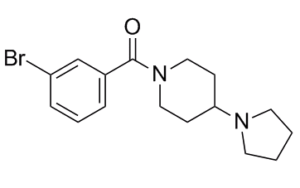
UNC-926 is a potent and selective inhibitor of the L3MBTL1 (Lethal(3)malignant brain tumor-like protein) domain (Kd = 3.9 μM), which is a methyl-lysine (Kme) reader domain. UNC-926 acts by binding to the MBT domain of the L3MBTL1 protein. In a peptide pull down assay, UNC-926 was found to be able to selectively inhibits the L3MBTL13XMBT-H4K20me1 interaction.
Physicochemical Properties
| Molecular Formula | C16H21BRN2O | |
| Molecular Weight | 337.25 | |
| Exact Mass | 336.084 | |
| Elemental Analysis | C, 56.98; H, 6.28; Br, 23.69; N, 8.31; O, 4.74 | |
| CAS # | 1184136-10-4 | |
| Related CAS # | UNC926 hydrochloride;1782573-49-2 | |
| PubChem CID | 61041645 | |
| Appearance | White to off-white solid powder | |
| LogP | 3.025 | |
| Hydrogen Bond Donor Count | 0 | |
| Hydrogen Bond Acceptor Count | 2 | |
| Rotatable Bond Count | 2 | |
| Heavy Atom Count | 20 | |
| Complexity | 335 | |
| Defined Atom Stereocenter Count | 0 | |
| SMILES | O=C(C1=CC=CC(Br)=C1)N2CCC(N3CCCC3)CC2 |
|
| InChi Key | OWGLFIKZKQOYHZ-UHFFFAOYSA-N | |
| InChi Code | InChI=1S/C16H21BrN2O/c17-14-5-3-4-13(12-14)16(20)19-10-6-15(7-11-19)18-8-1-2-9-18/h3-5,12,15H,1-2,6-11H2 | |
| Chemical Name |
|
|
| Synonyms |
|
|
| HS Tariff Code | 2934.99.9001 | |
| Storage |
Powder-20°C 3 years 4°C 2 years In solvent -80°C 6 months -20°C 1 month |
|
| Shipping Condition | Room temperature (This product is stable at ambient temperature for a few days during ordinary shipping and time spent in Customs) |
Biological Activity
| ln Vitro | In addition, UNC926 shows no binding to CBX7 and a low micromolar affinity (IC50 of 3.2 μM) for the near homolog L3MBTL3 along with a decrease in affinity for the other MBT domains[1]. UNC926 (1–25 μM) prevents the 3xMBT domain from attaching to H4K20me1. In a dose-dependent way, UNC926 prevents L3MBTL13xMBT from interacting with the relevant histonepeptides. The fact that UNC926 has no effect on 53BP1's binding to H4K20me1 indicates that it is more selective for L3MBTL1 than 53BP1[1]. | ||
| ln Vivo |
|
||
| Animal Protocol |
|
||
| References |
[1]. Structure–activity relationships of methyl-lysine reader antagonists. MedChemComm. 2012;3(45):45–51. |
Solubility Data
| Solubility (In Vitro) |
|
|||
| Solubility (In Vivo) |
Solubility in Formulation 1: ≥ 2.5 mg/mL (7.41 mM) (saturation unknown) in 10% DMSO + 40% PEG300 + 5% Tween80 + 45% Saline (add these co-solvents sequentially from left to right, and one by one), clear solution. For example, if 1 mL of working solution is to be prepared, you can add 100 μL of 25.0 mg/mL clear DMSO stock solution to 400 μL PEG300 and mix evenly; then add 50 μL Tween-80 to the above solution and mix evenly; then add 450 μL normal saline to adjust the volume to 1 mL. Preparation of saline: Dissolve 0.9 g of sodium chloride in 100 mL ddH₂ O to obtain a clear solution. Solubility in Formulation 2: ≥ 2.5 mg/mL (7.41 mM) (saturation unknown) in 10% DMSO + 90% (20% SBE-β-CD in Saline) (add these co-solvents sequentially from left to right, and one by one), clear solution. For example, if 1 mL of working solution is to be prepared, you can add 100 μL of 25.0 mg/mL clear DMSO stock solution to 900 μL of 20% SBE-β-CD physiological saline solution and mix evenly. Preparation of 20% SBE-β-CD in Saline (4°C,1 week): Dissolve 2 g SBE-β-CD in 10 mL saline to obtain a clear solution. Solubility in Formulation 3: ≥ 2.5 mg/mL (7.41 mM) (saturation unknown) in 10% DMSO + 90% Corn Oil (add these co-solvents sequentially from left to right, and one by one), clear solution. For example, if 1 mL of working solution is to be prepared, you can add 100 μL of 25.0 mg/mL clear DMSO stock solution to 900 μL of corn oil and mix evenly. (Please use freshly prepared in vivo formulations for optimal results.) |
| Preparing Stock Solutions | 1 mg | 5 mg | 10 mg | |
| 1 mM | 2.9652 mL | 14.8258 mL | 29.6516 mL | |
| 5 mM | 0.5930 mL | 2.9652 mL | 5.9303 mL | |
| 10 mM | 0.2965 mL | 1.4826 mL | 2.9652 mL |