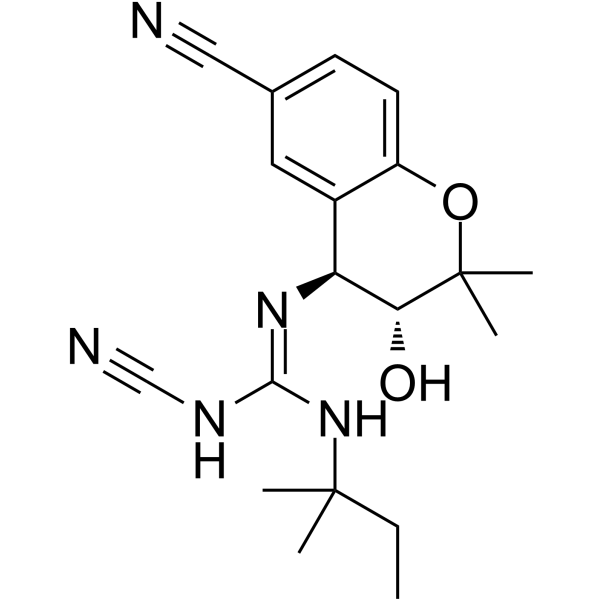
Physicochemical Properties
| Molecular Formula | C19H25N5O2 |
| Molecular Weight | 355.4341 |
| Exact Mass | 355.201 |
| CAS # | 134017-78-0 |
| PubChem CID | 3036061 |
| Appearance | Typically exists as solid at room temperature |
| Density | 1.18g/cm3 |
| Boiling Point | 492.2ºC at 760 mmHg |
| Flash Point | 251.5ºC |
| Vapour Pressure | 1.67E-10mmHg at 25°C |
| Index of Refraction | 1.585 |
| LogP | 3.117 |
| Hydrogen Bond Donor Count | 3 |
| Hydrogen Bond Acceptor Count | 5 |
| Rotatable Bond Count | 5 |
| Heavy Atom Count | 26 |
| Complexity | 639 |
| Defined Atom Stereocenter Count | 2 |
| SMILES | CCC(C)(C)N/C(NC#N)=N\[C@H]1C2=CC(C#N)=CC=C2OC(C)(C)[C@@H]1O |
| InChi Key | XOYZVGFXSLYSCF-JKSUJKDBSA-N |
| InChi Code | InChI=1S/C19H25N5O2/c1-6-18(2,3)24-17(22-11-21)23-15-13-9-12(10-20)7-8-14(13)26-19(4,5)16(15)25/h7-9,15-16,25H,6H2,1-5H3,(H2,22,23,24)/t15-,16+/m0/s1 |
| Chemical Name | 1-cyano-2-[(3R,4S)-6-cyano-3-hydroxy-2,2-dimethyl-3,4-dihydrochromen-4-yl]-3-(2-methylbutan-2-yl)guanidine |
| HS Tariff Code | 2934.99.9001 |
| Storage |
Powder-20°C 3 years 4°C 2 years In solvent -80°C 6 months -20°C 1 month |
| Shipping Condition | Room temperature (This product is stable at ambient temperature for a few days during ordinary shipping and time spent in Customs) |
Biological Activity
| ln Vivo | U-89232 is a product of Cromakalim, an ATP-sensitive potassium (KATP) channel opener. The left anterior descending coronary artery (LADCA) was blocked for 60 minutes and then reperfused for two hours in open-chest pig experiments. Four animal groups, with six animals each group, were examined. The mice were given either U-89232 (3 mg/kg IV for 15 min) or glyburide (1 mg/kg IV for 15 min), a selective KATP channel blocker, prior to LADCA occlusion (GLI). Before 60 minutes of ischemia, glyburide (1 mg/kg/15 minutes) was injected first in the GLI+U group, and then U-89232 (3 mg/kg/15 minutes). Animals treated with saline were used as controls (CON). Keep an eye on hemodynamic parameters all the time. By setting up ultrasonic crystals to assess wall thickening, you can quantify the function of the regional contractile wall. Upon completion of the experiment, the myocardium was incubated with p-nitroblue tetrazolium to assess the infarct size (IS, expressed as a percentage of the area at risk). While glyburide infarction had no effect on infarct size (IS, 69.5 ± 4.4%), infusion of U-89232 60 minutes prior to LADCA blockage significantly reduced infarct size (IS, 18.5±3.7%; p<0.001 vs. 63.2±3.3% in controls). Glyburide administration before U-89232 infusion reduces U-89232's ability to reduce infarct size. Given that it entirely reversibly blocks KATP channels and has strong cardioprotective effects even in the absence of hemodynamic alterations, U-89232, at least in the pig model, appears to be a cardioselective KATP channel opener [1]. |
| References | [1]. Rohmann S, et al. In swine myocardium, the infarct size reduction induced by U-89232 is glibenclamide sensitive: evidence that U-89232 is a cardioselective opener of ATP-sensitive potassium channels. J Cardiovasc Pharmacol. 1997 Jan;29(1):69-74. |
Solubility Data
| Solubility (In Vitro) | May dissolve in DMSO (in most cases), if not, try other solvents such as H2O, Ethanol, or DMF with a minute amount of products to avoid loss of samples |
| Solubility (In Vivo) |
Note: Listed below are some common formulations that may be used to formulate products with low water solubility (e.g. < 1 mg/mL), you may test these formulations using a minute amount of products to avoid loss of samples. Injection Formulations (e.g. IP/IV/IM/SC) Injection Formulation 1: DMSO : Tween 80: Saline = 10 : 5 : 85 (i.e. 100 μL DMSO stock solution → 50 μL Tween 80 → 850 μL Saline) *Preparation of saline: Dissolve 0.9 g of sodium chloride in 100 mL ddH ₂ O to obtain a clear solution. Injection Formulation 2: DMSO : PEG300 :Tween 80 : Saline = 10 : 40 : 5 : 45 (i.e. 100 μL DMSO → 400 μLPEG300 → 50 μL Tween 80 → 450 μL Saline) Injection Formulation 3: DMSO : Corn oil = 10 : 90 (i.e. 100 μL DMSO → 900 μL Corn oil) Example: Take the Injection Formulation 3 (DMSO : Corn oil = 10 : 90) as an example, if 1 mL of 2.5 mg/mL working solution is to be prepared, you can take 100 μL 25 mg/mL DMSO stock solution and add to 900 μL corn oil, mix well to obtain a clear or suspension solution (2.5 mg/mL, ready for use in animals). Injection Formulation 4: DMSO : 20% SBE-β-CD in saline = 10 : 90 [i.e. 100 μL DMSO → 900 μL (20% SBE-β-CD in saline)] *Preparation of 20% SBE-β-CD in Saline (4°C,1 week): Dissolve 2 g SBE-β-CD in 10 mL saline to obtain a clear solution. Injection Formulation 5: 2-Hydroxypropyl-β-cyclodextrin : Saline = 50 : 50 (i.e. 500 μL 2-Hydroxypropyl-β-cyclodextrin → 500 μL Saline) Injection Formulation 6: DMSO : PEG300 : castor oil : Saline = 5 : 10 : 20 : 65 (i.e. 50 μL DMSO → 100 μLPEG300 → 200 μL castor oil → 650 μL Saline) Injection Formulation 7: Ethanol : Cremophor : Saline = 10: 10 : 80 (i.e. 100 μL Ethanol → 100 μL Cremophor → 800 μL Saline) Injection Formulation 8: Dissolve in Cremophor/Ethanol (50 : 50), then diluted by Saline Injection Formulation 9: EtOH : Corn oil = 10 : 90 (i.e. 100 μL EtOH → 900 μL Corn oil) Injection Formulation 10: EtOH : PEG300:Tween 80 : Saline = 10 : 40 : 5 : 45 (i.e. 100 μL EtOH → 400 μLPEG300 → 50 μL Tween 80 → 450 μL Saline) Oral Formulations Oral Formulation 1: Suspend in 0.5% CMC Na (carboxymethylcellulose sodium) Oral Formulation 2: Suspend in 0.5% Carboxymethyl cellulose Example: Take the Oral Formulation 1 (Suspend in 0.5% CMC Na) as an example, if 100 mL of 2.5 mg/mL working solution is to be prepared, you can first prepare 0.5% CMC Na solution by measuring 0.5 g CMC Na and dissolve it in 100 mL ddH2O to obtain a clear solution; then add 250 mg of the product to 100 mL 0.5% CMC Na solution, to make the suspension solution (2.5 mg/mL, ready for use in animals). Oral Formulation 3: Dissolved in PEG400 Oral Formulation 4: Suspend in 0.2% Carboxymethyl cellulose Oral Formulation 5: Dissolve in 0.25% Tween 80 and 0.5% Carboxymethyl cellulose Oral Formulation 6: Mixing with food powders Note: Please be aware that the above formulations are for reference only. InvivoChem strongly recommends customers to read literature methods/protocols carefully before determining which formulation you should use for in vivo studies, as different compounds have different solubility properties and have to be formulated differently. (Please use freshly prepared in vivo formulations for optimal results.) |
| Preparing Stock Solutions | 1 mg | 5 mg | 10 mg | |
| 1 mM | 2.8135 mL | 14.0675 mL | 28.1349 mL | |
| 5 mM | 0.5627 mL | 2.8135 mL | 5.6270 mL | |
| 10 mM | 0.2813 mL | 1.4067 mL | 2.8135 mL |