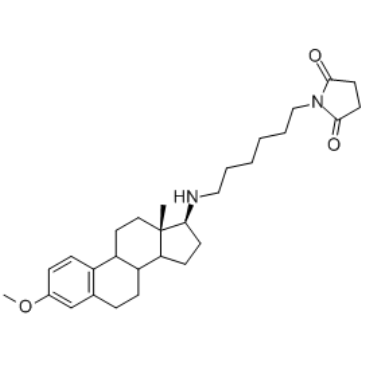
U-73343 is a novel inhibitor of PLC (phospholipase C)-dependent processes and an analogue of U-73122. It can be used as a negative control of U73122. U73343 was found to inhibit TxA2 formation; it therefore partially inhibited the rise in [Ca2+]i evoked by low concentrations of thrombin, by thapsigargin or by collagen. U73343 had a greater effect than aspirin on the action of collagen, indicating an action on the TxA2-independent component of the signal, via PLC gamma-U73343 lowered TxA2 production by inhibiting the activation of cPLA2, probably at a tyrosine phosphorylation step. U73343 seems to inhibit only the tyrosine kinases involved in the activation of PLC gamma and the generation of TxA2.
Physicochemical Properties
| Molecular Formula | C29H42N2O3 |
| Molecular Weight | 466.65538 |
| Exact Mass | 466.319 |
| CAS # | 142878-12-4 |
| PubChem CID | 114825 |
| Appearance | White to off-white solid powder |
| Density | 1.2±0.1 g/cm3 |
| Boiling Point | 641.5±55.0 °C at 760 mmHg |
| Flash Point | 341.8±31.5 °C |
| Vapour Pressure | 0.0±1.9 mmHg at 25°C |
| Index of Refraction | 1.578 |
| LogP | 5.49 |
| Hydrogen Bond Donor Count | 1 |
| Hydrogen Bond Acceptor Count | 4 |
| Rotatable Bond Count | 9 |
| Heavy Atom Count | 34 |
| Complexity | 725 |
| Defined Atom Stereocenter Count | 5 |
| SMILES | C[C@]12CC[C@H]3[C@H]([C@@H]1CC[C@@H]2NCCCCCCN4C(=O)CCC4=O)CCC5=C3C=CC(=C5)OC |
| InChi Key | CJHWFIUASFBCKN-ZRJUGLEFSA-N |
| InChi Code | InChI=1S/C29H42N2O3/c1-29-16-15-23-22-10-8-21(34-2)19-20(22)7-9-24(23)25(29)11-12-26(29)30-17-5-3-4-6-18-31-27(32)13-14-28(31)33/h8,10,19,23-26,30H,3-7,9,11-18H2,1-2H3/t23-,24-,25+,26+,29+/m1/s1 |
| Chemical Name | 1-(6-(((8R,9S,13S,14S,17S)-3-methoxy-13-methyl-7,8,9,11,12,13,14,15,16,17-decahydro-6H-cyclopenta[a]phenanthren-17-yl)amino)hexyl)pyrrolidine-2,5-dione |
| Synonyms | U73343; u-73343; u73343; U 73343; S2C4J8704C; 1-[6-[[(8R,9S,13S,14S,17S)-3-methoxy-13-methyl-6,7,8,9,11,12,14,15,16,17-decahydrocyclopenta[a]phenanthren-17-yl]amino]hexyl]pyrrolidine-2,5-dione; 1-(6-(((8R,9S,13S,14S,17S)-3-methoxy-13-methyl-7,8,9,11,12,13,14,15,16,17-decahydro-6H-cyclopenta[a]phenanthren-17-yl)amino)hexyl)pyrrolidine-2,5-dione; 1-(6-(((17beta)-3-methoxyestra-1,3,5(10)-trien-17-yl)amino)hexyl)-2,5-Pyrrolidinedione; U-73343; U 73343 |
| HS Tariff Code | 2934.99.9001 |
| Storage |
Powder-20°C 3 years 4°C 2 years In solvent -80°C 6 months -20°C 1 month |
| Shipping Condition | Room temperature (This product is stable at ambient temperature for a few days during ordinary shipping and time spent in Customs) |
Biological Activity
| Targets | Negative control for U-73122 |
| ln Vitro |
Although U73343 has no inhibitory impact on K+-pNPPase or H+,K+-ATPase activity, it can effectively reduce acid secretion. Histamine (Hist), carbachol (CCh), and dbcAMP-stimulated aminopyrine accumulation in gastric glands are all inhibited by U73343 in a dose-dependent manner [1]. In UMR-106 rat osteoblastic osteosarcoma cells, pretreatment with U-73343 at concentrations up to 8 μM for 3 minutes did not inhibit intracellular calcium transients induced by 100 nM endothelin-1 (ET-1) when measured in 1.8 mM calcium-containing medium. [2] Similarly, pretreatment with U-73343 at concentrations up to 8 μM for 3 minutes did not inhibit intracellular calcium transients induced by 100 nM parathyroid hormone (PTH) in 1.0 mM calcium-containing medium. [2] Preincubation of UMR-106 cells with 8 μM U-73343 for 3 minutes did not significantly inhibit the ET-1 (100 nM, 1 min)-stimulated production of inositol phosphates (IP1, IP2, IP3). The data showed that U-73343 did not affect the agonist-induced phosphatidylinositol turnover. [2] |
| Enzyme Assay | Endothelin-1 (ET-1) and parathyroid hormone (PTH) increase calcium transients in rodent osteoblastic cells. To investigate the role of phospholipase C (PLC) in these hormone-stimulated calcium signals, the effects of U-73122 (1-[6-[[17 beta-3-methoxyestra-1,3,5(10)- trien-17-yl]amino]hexyl]-1H-pyrrole-2,5-dione), a reported PLC inhibitor, and its inactive analog, U-73343 (1-[6[[17 beta-3-methoxyestra-1,3,5(10)-trien-17-yl]amino]hexyl]- 1H-pyrrolidine-2,5-dione), were determined. Intracellular calcium transients were measured in UMR-106 cells with the fluorescent indicator fluo-3. In normal calcium containing medium, prior exposure (3 min) to U-73122 inhibited ET-1 and PTH stimulated calcium transients in a dose-dependent (0.2-10 microM) manner with an IC50 of 1.5-1.8 microM. A concentration of 6-8 microM was required for complete inhibition of responses to 100 nM ET-1 or PTH. U-73343 elicited no effects over this concentration range. In cells in which external calcium was reduced to less than 1 microM by the addition of EGTA, ET-1 signals were completely inhibited by 4-6 microM U-73122 and the IC50 was 0.8 microM. In the low external calcium medium, the PTH response was abolished by 2 microM U-73122 (IC50 = 0.5 microM). U-73122, 8 microM, significantly (P < 0.01) inhibited the effect of ET-1 on inositol trisphosphate production at 3 min whereas U-73343 did not. Pertussis toxin (100 ng/ml) likewise significantly inhibited the effect of ET-1 on phosphoinositol turnover as well as on intracellular calcium concentration. In conclusion, the results support the hypothesis that PLC plays a role in the calcium transients elicited by ET-1 and PTH, and that ET-1 transmits its signal in part via a pertussis toxin sensitive G-protein coupled receptor. Furthermore they suggest that U-73122 is useful for investigating PLC-mediated process in osteoblastic cells.[2] |
| Cell Assay |
In order to elucidate the role of phospholipase C (PLC) in gastric acid secretion, we used U73122, a commonly employed specific inhibitor of receptor-mediated PLC, and its negative control, U73343. Although 10 microM U73122 inhibited the increase in [Ca++]i induced by U46619 in rabbit platelets, Ca++ transients in the rabbit parietal cells elicited by histamine and carbachol were both resistant to the inhibitor. U73122 augmented the acid secretion of isolated gastric glands stimulated by histamine, carbachol and dbcAMP, possibly through its indirect Ca++-releasing effect on the intracellular calcium store. U73122 potently inhibited K+-p-nitrophenylphosphatase without affecting overall H+,K+-ATPase activity. On the other hand, the negative control, U73343, strongly inhibited the acid secretion stimulated by all agonists tested. The inhibitory effect was also evident on digitonin-permeabilized glands and on the proton gradient of gastric vesicles. U73343 itself is not a proton pump inhibitor, so it was considered a protonophore. In conclusion, the widely used PLC-inhibitor, U73122, and its negative control, U73343, are both useless as tools for analyzing the role of PLC in rabbit parietal cells. The former is ineffective on gastric PLC and works as an intracellular calcium releaser, and the latter works as a protonophore.[1] Intracellular Calcium Measurement: UMR-106 cells were harvested by trypsin/EDTA treatment, loaded with 2 μM fluo-3 AM for 30 minutes at room temperature in a loading buffer, washed, and resuspended. The cell suspension was continuously stirred in a cuvette in a fluorometer. To test the effect of U-73343, cells were preincubated with varying concentrations (e.g., 8 μM) of U-73343 for 3 minutes before stimulation with 100 nM ET-1 or PTH. Fluorescence was measured (excitation 505 nm, emission 530 nm), and intracellular calcium concentration was calculated after calibration. U-73343 at 8 μM did not inhibit the calcium transients induced by either agonist. [2] Inositol Phosphate Production Assay: UMR-106 cells were seeded and incubated with [³H]inositol for 48 hours to label phospholipids. Cells were preincubated with 5 mM LiCl for 10 minutes, then treated with 8 μM U-73343 for 3 minutes before stimulation with 100 nM ET-1 for 1 minute. The reaction was stopped with trichloroacetic acid (TCA). Inositol phosphates (IP1, IP2, IP3) were separated by anion-exchange FPLC using an ammonium formate gradient, and radioactivity in fractions was measured by liquid scintillation counting. U-73343 did not significantly inhibit ET-1-stimulated inositol phosphate production. [2] |
| Toxicity/Toxicokinetics |
The study notes that, like its active analog U-73122 and the vehicle DMSO, a transient spike in fluorescence (possibly reflecting a non-specific disturbance) was sometimes observed when a high concentration of U-73343 was added to the cell suspension, but this did not affect the subsequent agonist responses. [2] |
| References |
[1]. The putative phospholipase C inhibitor U73122 and its negative control, U73343, elicit unexpected effects on the rabbit parietal cell. J Pharmacol Exp Ther. 1997 Sep;282(3):1379-88. [2]. U-73122, a phospholipase C antagonist, inhibits effects of endothelin-1 and parathyroid hormone on signal transduction in UMR-106 osteoblastic cells. Biochim Biophys Acta. 1994 Dec 30;1224(3):575-82. |
| Additional Infomation |
In order to elucidate the role of phospholipase C (PLC) in gastric acid secretion, we used U73122, a commonly employed specific inhibitor of receptor-mediated PLC, and its negative control, U73343. Although 10 microM U73122 inhibited the increase in [Ca++]i induced by U46619 in rabbit platelets, Ca++ transients in the rabbit parietal cells elicited by histamine and carbachol were both resistant to the inhibitor. U73122 augmented the acid secretion of isolated gastric glands stimulated by histamine, carbachol and dbcAMP, possibly through its indirect Ca++-releasing effect on the intracellular calcium store. U73122 potently inhibited K+-p-nitrophenylphosphatase without affecting overall H+,K+-ATPase activity. On the other hand, the negative control, U73343, strongly inhibited the acid secretion stimulated by all agonists tested. The inhibitory effect was also evident on digitonin-permeabilized glands and on the proton gradient of gastric vesicles. U73343 itself is not a proton pump inhibitor, so it was considered a protonophore. In conclusion, the widely used PLC-inhibitor, U73122, and its negative control, U73343, are both useless as tools for analyzing the role of PLC in rabbit parietal cells. The former is ineffective on gastric PLC and works as an intracellular calcium releaser, and the latter works as a protonophore.[1] Endothelin-1 (ET-1) and parathyroid hormone (PTH) increase calcium transients in rodent osteoblastic cells. To investigate the role of phospholipase C (PLC) in these hormone-stimulated calcium signals, the effects of U-73122 (1-[6-[[17 beta-3-methoxyestra-1,3,5(10)- trien-17-yl]amino]hexyl]-1H-pyrrole-2,5-dione), a reported PLC inhibitor, and its inactive analog, U-73343 (1-[6[[17 beta-3-methoxyestra-1,3,5(10)-trien-17-yl]amino]hexyl]- 1H-pyrrolidine-2,5-dione), were determined. Intracellular calcium transients were measured in UMR-106 cells with the fluorescent indicator fluo-3. In normal calcium containing medium, prior exposure (3 min) to U-73122 inhibited ET-1 and PTH stimulated calcium transients in a dose-dependent (0.2-10 microM) manner with an IC50 of 1.5-1.8 microM. A concentration of 6-8 microM was required for complete inhibition of responses to 100 nM ET-1 or PTH. U-73343 elicited no effects over this concentration range. In cells in which external calcium was reduced to less than 1 microM by the addition of EGTA, ET-1 signals were completely inhibited by 4-6 microM U-73122 and the IC50 was 0.8 microM. In the low external calcium medium, the PTH response was abolished by 2 microM U-73122 (IC50 = 0.5 microM). U-73122, 8 microM, significantly (P < 0.01) inhibited the effect of ET-1 on inositol trisphosphate production at 3 min whereas U-73343 did not. Pertussis toxin (100 ng/ml) likewise significantly inhibited the effect of ET-1 on phosphoinositol turnover as well as on intracellular calcium concentration. In conclusion, the results support the hypothesis that PLC plays a role in the calcium transients elicited by ET-1 and PTH, and that ET-1 transmits its signal in part via a pertussis toxin sensitive G-protein coupled receptor. Furthermore they suggest that U-73122 is useful for investigating PLC-mediated process in osteoblastic cells.[2] U-73343 (1-[6-[[17β-3-methoxyestra-1,3,5(10)-trien-17-yl]amino]hexyl]-1H-pyrrolidine-2,5-dione) is a structural analog of the aminosteroid PLC inhibitor U-73122. The key structural difference is that U-73343 contains a pyrrolidine-2,5-dione moiety, whereas the active compound U-73122 contains a pyrrole-2,5-dione moiety. [2] In this study, U-73343 serves as a critical negative control compound. Its lack of activity at concentrations where U-73122 shows potent inhibition (IC50 ~0.5-1.8 μM) helps to confirm that the observed inhibitory effects of U-73122 on ET-1 and PTH signaling are specific to its action on the PLC pathway, rather than being due to non-specific or cytotoxic effects. [2] The study concludes that U-73343 did not inhibit ET-1-stimulated calcium transients, PTH-stimulated calcium transients, or ET-1-stimulated inositol phosphate production, confirming its status as an inactive analog in this cellular context. [2] |
Solubility Data
| Solubility (In Vitro) | DMSO : ~3.33 mg/mL (~7.14 mM) |
| Solubility (In Vivo) |
Note: Listed below are some common formulations that may be used to formulate products with low water solubility (e.g. < 1 mg/mL), you may test these formulations using a minute amount of products to avoid loss of samples. Injection Formulations (e.g. IP/IV/IM/SC) Injection Formulation 1: DMSO : Tween 80: Saline = 10 : 5 : 85 (i.e. 100 μL DMSO stock solution → 50 μL Tween 80 → 850 μL Saline) *Preparation of saline: Dissolve 0.9 g of sodium chloride in 100 mL ddH ₂ O to obtain a clear solution. Injection Formulation 2: DMSO : PEG300 :Tween 80 : Saline = 10 : 40 : 5 : 45 (i.e. 100 μL DMSO → 400 μLPEG300 → 50 μL Tween 80 → 450 μL Saline) Injection Formulation 3: DMSO : Corn oil = 10 : 90 (i.e. 100 μL DMSO → 900 μL Corn oil) Example: Take the Injection Formulation 3 (DMSO : Corn oil = 10 : 90) as an example, if 1 mL of 2.5 mg/mL working solution is to be prepared, you can take 100 μL 25 mg/mL DMSO stock solution and add to 900 μL corn oil, mix well to obtain a clear or suspension solution (2.5 mg/mL, ready for use in animals). Injection Formulation 4: DMSO : 20% SBE-β-CD in saline = 10 : 90 [i.e. 100 μL DMSO → 900 μL (20% SBE-β-CD in saline)] *Preparation of 20% SBE-β-CD in Saline (4°C,1 week): Dissolve 2 g SBE-β-CD in 10 mL saline to obtain a clear solution. Injection Formulation 5: 2-Hydroxypropyl-β-cyclodextrin : Saline = 50 : 50 (i.e. 500 μL 2-Hydroxypropyl-β-cyclodextrin → 500 μL Saline) Injection Formulation 6: DMSO : PEG300 : castor oil : Saline = 5 : 10 : 20 : 65 (i.e. 50 μL DMSO → 100 μLPEG300 → 200 μL castor oil → 650 μL Saline) Injection Formulation 7: Ethanol : Cremophor : Saline = 10: 10 : 80 (i.e. 100 μL Ethanol → 100 μL Cremophor → 800 μL Saline) Injection Formulation 8: Dissolve in Cremophor/Ethanol (50 : 50), then diluted by Saline Injection Formulation 9: EtOH : Corn oil = 10 : 90 (i.e. 100 μL EtOH → 900 μL Corn oil) Injection Formulation 10: EtOH : PEG300:Tween 80 : Saline = 10 : 40 : 5 : 45 (i.e. 100 μL EtOH → 400 μLPEG300 → 50 μL Tween 80 → 450 μL Saline) Oral Formulations Oral Formulation 1: Suspend in 0.5% CMC Na (carboxymethylcellulose sodium) Oral Formulation 2: Suspend in 0.5% Carboxymethyl cellulose Example: Take the Oral Formulation 1 (Suspend in 0.5% CMC Na) as an example, if 100 mL of 2.5 mg/mL working solution is to be prepared, you can first prepare 0.5% CMC Na solution by measuring 0.5 g CMC Na and dissolve it in 100 mL ddH2O to obtain a clear solution; then add 250 mg of the product to 100 mL 0.5% CMC Na solution, to make the suspension solution (2.5 mg/mL, ready for use in animals). Oral Formulation 3: Dissolved in PEG400 Oral Formulation 4: Suspend in 0.2% Carboxymethyl cellulose Oral Formulation 5: Dissolve in 0.25% Tween 80 and 0.5% Carboxymethyl cellulose Oral Formulation 6: Mixing with food powders Note: Please be aware that the above formulations are for reference only. InvivoChem strongly recommends customers to read literature methods/protocols carefully before determining which formulation you should use for in vivo studies, as different compounds have different solubility properties and have to be formulated differently. (Please use freshly prepared in vivo formulations for optimal results.) |
| Preparing Stock Solutions | 1 mg | 5 mg | 10 mg | |
| 1 mM | 2.1429 mL | 10.7144 mL | 21.4289 mL | |
| 5 mM | 0.4286 mL | 2.1429 mL | 4.2858 mL | |
| 10 mM | 0.2143 mL | 1.0714 mL | 2.1429 mL |