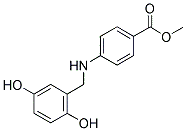
Physicochemical Properties
| Molecular Formula | C15H15NO4 |
| Molecular Weight | 273.2839 |
| Exact Mass | 273.1 |
| Elemental Analysis | C, 65.92; H, 5.53; N, 5.13; O, 23.42 |
| CAS # | 140674-76-6 |
| Related CAS # | Solid powder |
| PubChem CID | 2064 |
| Appearance | Off-white to light brown solid powder |
| LogP | 2.569 |
| Hydrogen Bond Donor Count | 3 |
| Hydrogen Bond Acceptor Count | 5 |
| Rotatable Bond Count | 5 |
| Heavy Atom Count | 20 |
| Complexity | 315 |
| Defined Atom Stereocenter Count | 0 |
| SMILES | O([H])C1C([H])=C([H])C(=C([H])C=1C([H])([H])N([H])C1C([H])=C([H])C(C(=O)OC([H])([H])[H])=C([H])C=1[H])O[H] |
| InChi Key | QSFREBZMBNRGOK-UHFFFAOYSA-N |
| InChi Code | InChI=1S/C15H15NO4/c1-20-15(19)10-2-4-12(5-3-10)16-9-11-8-13(17)6-7-14(11)18/h2-8,16-18H,9H2,1H3 |
| Chemical Name | methyl 4-[(2,5-dihydroxyphenyl)methylamino]benzoate |
| Synonyms | AG-957; AG 957; AG957; Tyrphostin AG957; Tyrphostin-AG957; TyrphostinAG957; Tyrphostin AG-957; Tyrphostin AG 957 |
| HS Tariff Code | 2934.99.03.00 |
| Storage |
Powder-20°C 3 years 4°C 2 years In solvent -80°C 6 months -20°C 1 month |
| Shipping Condition | Room temperature (This product is stable at ambient temperature for a few days during ordinary shipping and time spent in Customs) |
Biological Activity
| ln Vitro |
AG957 attenuates tyrosine kinase activity of p210bcr-abl. DNA synthesis is 40% inhibited at 20 microM by AG957 as early as 2 hours. While total protein phosphorylation is not inhibited, AG957 reduces the tyrosine phosphorylation of p210BCR/ABL in living cells by 1 hour[1]. Beta1 integrin function in CML progenitors is affected by Tyrphostin AG957, a protein tyrosine kinase (PTK) inhibitor that exhibits activity against the p210BCR/ABL kinase[2]. AG957 (0.1-100 μM ) pretreatment significantly reduces the proliferation of colony-forming cells (CFC) associated with chronic myelogenous leukemia (CML)[2]. AG957 (25 μM) partially inhibits the phosphorylation of multiple proteins that are substrates of BCR/ABL PTK and involved in normal integrin signaling in BCR/ABL expressing cells[2]. |
| ln Vivo | AG957 (10 mg/kg; intratracheally administered 1 h prior to intratracheal LPS challenge) inhibits c-Abl activity in the lung of mice[4]. |
| Cell Assay |
Cell Line: CML and CFC Concentration: 0, 0.1, 1, 10, 100 μM Incubation Time: Pretreatment for 1 hour Result: A significant dose-dependent inhibition of CML CFC growth was seen following preincubation with AG957. |
| Animal Protocol |
C57BL/6J mice 10 mg/kg Intratracheally 1 h before intratracheal LPS challenge |
| References |
[1]. Tyrphostin induced growth inhibition: correlation with effect on p210bcr-abl autokinase activity in K562 chronic myelogenous leukemia. Anticancer Drugs. 1994 Apr;5(2):213-22. [2]. Tyrphostin AG957, a tyrosine kinase inhibitor with anti-BCR/ABL tyrosine kinase activity restores beta1 integrin-mediated adhesion and inhibitory signaling in chronic myelogenous leukemia hematopoietic progenitors. Leukemia. 1998 Nov;12(1 [3]. Effects of the bcr/abl kinase inhibitors AG957 and NSC 680410 on chronic myelogenous leukemia cells in vitro. Clin Cancer Res. 2000 Jan;6(1):237-49. [4]. c-Abl mediated tyrosine phosphorylation of paxillin regulates LPS-induced endothelial dysfunction and lung injury. Am J Physiol Lung Cell Mol Physiol. 2015 May 15;308(10):L1025-38. |
| Additional Infomation |
4-[(2,5-dihydroxyphenyl)methylamino]benzoic acid methyl ester is an aromatic amine. Tyrphostin AG 957 is a member of the tyrphostin family of tyrosine kinase inhibitors that selectively inhibits human p210 tyrosine kinase activity. (NCI) |
Solubility Data
| Solubility (In Vitro) | May dissolve in DMSO (in most cases), if not, try other solvents such as H2O, Ethanol, or DMF with a minute amount of products to avoid loss of samples |
| Solubility (In Vivo) |
Note: Listed below are some common formulations that may be used to formulate products with low water solubility (e.g. < 1 mg/mL), you may test these formulations using a minute amount of products to avoid loss of samples. Injection Formulations (e.g. IP/IV/IM/SC) Injection Formulation 1: DMSO : Tween 80: Saline = 10 : 5 : 85 (i.e. 100 μL DMSO stock solution → 50 μL Tween 80 → 850 μL Saline) *Preparation of saline: Dissolve 0.9 g of sodium chloride in 100 mL ddH ₂ O to obtain a clear solution. Injection Formulation 2: DMSO : PEG300 :Tween 80 : Saline = 10 : 40 : 5 : 45 (i.e. 100 μL DMSO → 400 μLPEG300 → 50 μL Tween 80 → 450 μL Saline) Injection Formulation 3: DMSO : Corn oil = 10 : 90 (i.e. 100 μL DMSO → 900 μL Corn oil) Example: Take the Injection Formulation 3 (DMSO : Corn oil = 10 : 90) as an example, if 1 mL of 2.5 mg/mL working solution is to be prepared, you can take 100 μL 25 mg/mL DMSO stock solution and add to 900 μL corn oil, mix well to obtain a clear or suspension solution (2.5 mg/mL, ready for use in animals). Injection Formulation 4: DMSO : 20% SBE-β-CD in saline = 10 : 90 [i.e. 100 μL DMSO → 900 μL (20% SBE-β-CD in saline)] *Preparation of 20% SBE-β-CD in Saline (4°C,1 week): Dissolve 2 g SBE-β-CD in 10 mL saline to obtain a clear solution. Injection Formulation 5: 2-Hydroxypropyl-β-cyclodextrin : Saline = 50 : 50 (i.e. 500 μL 2-Hydroxypropyl-β-cyclodextrin → 500 μL Saline) Injection Formulation 6: DMSO : PEG300 : castor oil : Saline = 5 : 10 : 20 : 65 (i.e. 50 μL DMSO → 100 μLPEG300 → 200 μL castor oil → 650 μL Saline) Injection Formulation 7: Ethanol : Cremophor : Saline = 10: 10 : 80 (i.e. 100 μL Ethanol → 100 μL Cremophor → 800 μL Saline) Injection Formulation 8: Dissolve in Cremophor/Ethanol (50 : 50), then diluted by Saline Injection Formulation 9: EtOH : Corn oil = 10 : 90 (i.e. 100 μL EtOH → 900 μL Corn oil) Injection Formulation 10: EtOH : PEG300:Tween 80 : Saline = 10 : 40 : 5 : 45 (i.e. 100 μL EtOH → 400 μLPEG300 → 50 μL Tween 80 → 450 μL Saline) Oral Formulations Oral Formulation 1: Suspend in 0.5% CMC Na (carboxymethylcellulose sodium) Oral Formulation 2: Suspend in 0.5% Carboxymethyl cellulose Example: Take the Oral Formulation 1 (Suspend in 0.5% CMC Na) as an example, if 100 mL of 2.5 mg/mL working solution is to be prepared, you can first prepare 0.5% CMC Na solution by measuring 0.5 g CMC Na and dissolve it in 100 mL ddH2O to obtain a clear solution; then add 250 mg of the product to 100 mL 0.5% CMC Na solution, to make the suspension solution (2.5 mg/mL, ready for use in animals). Oral Formulation 3: Dissolved in PEG400 Oral Formulation 4: Suspend in 0.2% Carboxymethyl cellulose Oral Formulation 5: Dissolve in 0.25% Tween 80 and 0.5% Carboxymethyl cellulose Oral Formulation 6: Mixing with food powders Note: Please be aware that the above formulations are for reference only. InvivoChem strongly recommends customers to read literature methods/protocols carefully before determining which formulation you should use for in vivo studies, as different compounds have different solubility properties and have to be formulated differently. (Please use freshly prepared in vivo formulations for optimal results.) |
| Preparing Stock Solutions | 1 mg | 5 mg | 10 mg | |
| 1 mM | 3.6593 mL | 18.2963 mL | 36.5925 mL | |
| 5 mM | 0.7319 mL | 3.6593 mL | 7.3185 mL | |
| 10 mM | 0.3659 mL | 1.8296 mL | 3.6593 mL |