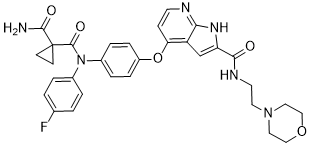
Physicochemical Properties
| Molecular Formula | C31H31FN6O5 |
| Molecular Weight | 586.61344 |
| Exact Mass | 586.234 |
| Elemental Analysis | C, 63.47; H, 5.33; F, 3.24; N, 14.33; O, 13.64 |
| CAS # | 1021950-26-4 |
| Related CAS # | 1021950-26-4 |
| PubChem CID | 24956525 |
| Appearance | White to off-white solid powder |
| LogP | 4.388 |
| Hydrogen Bond Donor Count | 4 |
| Hydrogen Bond Acceptor Count | 8 |
| Rotatable Bond Count | 10 |
| Heavy Atom Count | 43 |
| Complexity | 978 |
| Defined Atom Stereocenter Count | 0 |
| SMILES | O=C(NC1=CC=C(C=C1)F)C2(CC2)C(NC3=CC=C(C=C3)OC4=C5C(NC(C(NCCN6CCOCC6)=O)=C5)=NC=C4)=O |
| InChi Key | PKOVTRMHYNEBDU-UHFFFAOYSA-N |
| InChi Code | InChI=1S/C31H31FN6O5/c32-20-1-3-21(4-2-20)35-29(40)31(10-11-31)30(41)36-22-5-7-23(8-6-22)43-26-9-12-33-27-24(26)19-25(37-27)28(39)34-13-14-38-15-17-42-18-16-38/h1-9,12,19H,10-11,13-18H2,(H,33,37)(H,34,39)(H,35,40)(H,36,41) |
| Chemical Name | 1-N'-(4-fluorophenyl)-1-N-[4-[[2-(2-morpholin-4-ylethylcarbamoyl)-1H-pyrrolo[2,3-b]pyridin-4-yl]oxy]phenyl]cyclopropane-1,1-dicarboxamide |
| Synonyms | Tyrosine kinase inhibitor; B-Raf IN, B-Raf Inhibitor |
| HS Tariff Code | 2934.99.9001 |
| Storage |
Powder-20°C 3 years 4°C 2 years In solvent -80°C 6 months -20°C 1 month |
| Shipping Condition | Room temperature (This product is stable at ambient temperature for a few days during ordinary shipping and time spent in Customs) |
Biological Activity
| ln Vitro | Tyrosine kinases are crucial signaling cascade mediators that control a variety of biological processes in response to internal and external stimuli, including growth, differentiation, metabolism, and apoptosis[1]. |
| References |
[1]. Tyrosine kinase - Role and significance in Cancer. Int J Med Sci. 2004;1(2):101-115. [2]. Two cases of gastrointestinal perforation after radiotherapy in patients receiving tyrosine kinase inhibitor for advanced renal cell carcinoma. World J Surg Oncol. 2012 Aug 20;10(1):167. [3]. Development of a rat model of oral small molecule receptor tyrosine kinase inhibitor-induced diarrhea. Cancer Biol Ther. 2012 Nov 1;13(13). [4]. Multi-targeted tyrosine kinase inhibitor sunitinib: a novel strategy for sporadic malignant pheochromocytoma. Chin Med J (Engl). 2012 Jun;125(12):2231-4. [5]. Tyrosine kinase inhibitor special issue. Vet Comp Oncol. 2012 Sep;10(3):161-2. doi: 10.1111/j.1476-5829.2012.00339.x. [6]. The novel tyrosine kinase inhibitor AKN-028 has significant antileukemic activity in cell lines and primary cultures of acute myeloid leukemia. Blood Cancer J. 2012 Aug 3;2:e81. doi: 10.1038/bcj.2012.28. |
| Additional Infomation | Tyrosine Kinase Inhibitor is any substance that inhibits tyrosine kinase, an enzyme involved in the transduction and processing of many extracellular and intracellular signals including cell proliferation. Inhibition of tyrosine kinase may result in inhibition of cell growth and cell proliferation. |
Solubility Data
| Solubility (In Vitro) | DMSO: ≥ 46 mg/mL (~78.4 mM) |
| Solubility (In Vivo) |
Solubility in Formulation 1: ≥ 2.5 mg/mL (4.26 mM) (saturation unknown) in 10% DMSO + 40% PEG300 + 5% Tween80 + 45% Saline (add these co-solvents sequentially from left to right, and one by one), clear solution. For example, if 1 mL of working solution is to be prepared, you can add 100 μL of 25.0 mg/mL clear DMSO stock solution to 400 μL PEG300 and mix evenly; then add 50 μL Tween-80 to the above solution and mix evenly; then add 450 μL normal saline to adjust the volume to 1 mL. Preparation of saline: Dissolve 0.9 g of sodium chloride in 100 mL ddH₂ O to obtain a clear solution. Solubility in Formulation 2: ≥ 2.5 mg/mL (4.26 mM) (saturation unknown) in 10% DMSO + 90% (20% SBE-β-CD in Saline) (add these co-solvents sequentially from left to right, and one by one), clear solution. For example, if 1 mL of working solution is to be prepared, you can add 100 μL of 25.0 mg/mL clear DMSO stock solution to 900 μL of 20% SBE-β-CD physiological saline solution and mix evenly. Preparation of 20% SBE-β-CD in Saline (4°C,1 week): Dissolve 2 g SBE-β-CD in 10 mL saline to obtain a clear solution. Solubility in Formulation 3: ≥ 2.5 mg/mL (4.26 mM) (saturation unknown) in 10% DMSO + 90% Corn Oil (add these co-solvents sequentially from left to right, and one by one), clear solution. For example, if 1 mL of working solution is to be prepared, you can add 100 μL of 25.0 mg/mL clear DMSO stock solution to 900 μL of corn oil and mix evenly. (Please use freshly prepared in vivo formulations for optimal results.) |
| Preparing Stock Solutions | 1 mg | 5 mg | 10 mg | |
| 1 mM | 1.7047 mL | 8.5236 mL | 17.0471 mL | |
| 5 mM | 0.3409 mL | 1.7047 mL | 3.4094 mL | |
| 10 mM | 0.1705 mL | 0.8524 mL | 1.7047 mL |