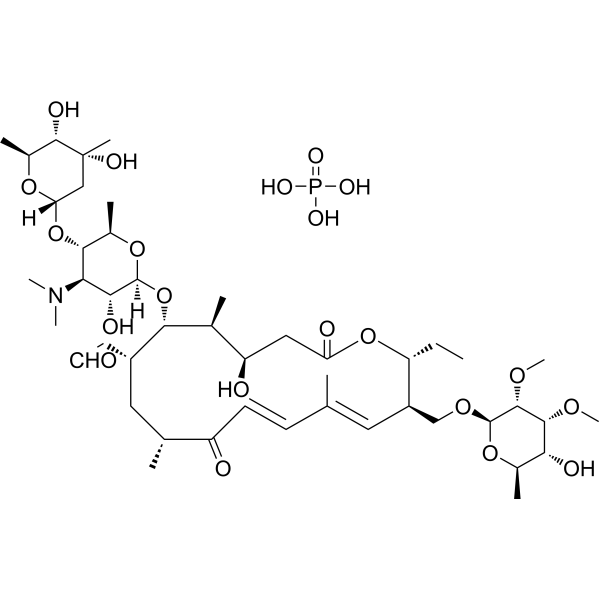
Physicochemical Properties
| Molecular Formula | C46H77NO17.H3PO4 |
| Molecular Weight | 1014.1 |
| Exact Mass | 1013.496 |
| CAS # | 1405-53-4 |
| Related CAS # | Tylosin tartrate;74610-55-2;Tylosin;1401-69-0 |
| PubChem CID | 6440844 |
| Appearance | White to off-white solid powder |
| Boiling Point | 980.7ºC at 760 mmHg |
| Flash Point | 546.9ºC |
| Vapour Pressure | 0mmHg at 25°C |
| LogP | 0.904 |
| Hydrogen Bond Donor Count | 8 |
| Hydrogen Bond Acceptor Count | 22 |
| Rotatable Bond Count | 13 |
| Heavy Atom Count | 69 |
| Complexity | 1610 |
| Defined Atom Stereocenter Count | 21 |
| SMILES | CC[C@@H]1[C@H](/C=C(/C=C/C(=O)[C@@H](C[C@@H]([C@@H]([C@H]([C@@H](CC(=O)O1)O)C)O[C@H]2[C@@H]([C@H]([C@@H]([C@H](O2)C)O[C@H]3C[C@@]([C@H]([C@@H](O3)C)O)(C)O)N(C)C)O)CC=O)C)\C)CO[C@H]4[C@@H]([C@@H]([C@@H]([C@H](O4)C)O)OC)OC.OP(=O)(O)O |
| InChi Key | NBOODGNJLRRJNA-IAGPQMRQSA-N |
| InChi Code | InChI=1S/C46H77NO17.H3O4P/c1-13-33-30(22-58-45-42(57-12)41(56-11)37(52)26(5)60-45)18-23(2)14-15-31(49)24(3)19-29(16-17-48)39(25(4)32(50)20-34(51)62-33)64-44-38(53)36(47(9)10)40(27(6)61-44)63-35-21-46(8,55)43(54)28(7)59-35;1-5(2,3)4/h14-15,17-18,24-30,32-33,35-45,50,52-55H,13,16,19-22H2,1-12H3;(H3,1,2,3,4)/b15-14+,23-18+;/t24-,25+,26-,27-,28+,29+,30-,32-,33-,35+,36-,37-,38-,39-,40-,41-,42-,43+,44+,45-,46-;/m1./s1 |
| Chemical Name | 2-[(4R,5S,6S,7R,9R,11E,13E,15R,16R)-6-[(2R,3R,4R,5S,6R)-5-[(2S,4R,5S,6S)-4,5-dihydroxy-4,6-dimethyloxan-2-yl]oxy-4-(dimethylamino)-3-hydroxy-6-methyloxan-2-yl]oxy-16-ethyl-4-hydroxy-15-[[(2R,3R,4R,5R,6R)-5-hydroxy-3,4-dimethoxy-6-methyloxan-2-yl]oxymethyl]-5,9,13-trimethyl-2,10-dioxo-1-oxacyclohexadeca-11,13-dien-7-yl]acetaldehyde;phosphoric acid |
| HS Tariff Code | 2934.99.9001 |
| Storage |
Powder-20°C 3 years 4°C 2 years In solvent -80°C 6 months -20°C 1 month Note: Please store this product in a sealed and protected environment, avoid exposure to moisture. |
| Shipping Condition | Room temperature (This product is stable at ambient temperature for a few days during ordinary shipping and time spent in Customs) |
Biological Activity
| ln Vitro | Tylosin phosphate binds to the 23S rRNA of the 50S subunit of the bacterial ribosome to initiate its antibacterial action [1]. Additionally, tylosin phosphate inhibits the growth of Gram-negative strains of bacteria against E. Coli, Pasteurella multocida 4407, and Mycobacterium haemolyticus 11935. bacteria ATCC 25922 and E. coli AS19rlmAI, in that order [3]. |
| ln Vivo | In rats treated with lipopolysaccharide (LPS), tylosin phosphate (10–500 mg/kg; subcutaneous injection) typically decreases increased TNF-α and IL-1β levels and raises IL-10 levels [4]. |
| Animal Protocol |
Animal/Disease Models: balb/c (Bagg ALBino) mouse (2-3 months old, 20-25 g) [4] Doses: 10 mg/kg, 100 mg/kg, 500 mg/kg Route of Administration: subcutaneous injection Experimental Results: diminished increase In mice treated with TNF-α LPS (250 µg), IL-1β and IL-1β levels were elevated, but IL-10 levels were increased. |
| References |
[1]. Resistance to the macrolide antibiotic tylosin is conferred by single methylations at 23S rRNA nucleotides G748 and A2058 acting in synergy. Proc Natl Acad Sci U S A. 2002 Nov 12; 99(23): 14658-14663. [2]. In Vitro Evaluation of the Effects of Tylosin on the Composition and Metabolism of Canine Fecal Microbiota. Animals (Basel). 2020 Jan; 10(1): 98. [3]. Inhibition of Protein Synthesis on the Ribosome by Tildipirosin Compared with Other Veterinary Macrolides. Antimicrob Agents Chemother. 2012 Nov; 56(11): 6033-6036. [4]. Effects of tylosin on serum cytokine levels in healthy and lipopolysaccharide-treated mice. Acta Vet Hung. 2010 Mar;58(1):75-81. |
| Additional Infomation | See also: Tylosin (has active moiety); Monensin; Tylosin Phosphate (component of); Decoquinate; Monensin USP; Tylosin Phosphate (component of) ... View More ... |
Solubility Data
| Solubility (In Vitro) | DMSO : ~100 mg/mL (~98.61 mM) |
| Solubility (In Vivo) |
Solubility in Formulation 1: ≥ 2.5 mg/mL (2.47 mM) (saturation unknown) in 10% DMSO + 40% PEG300 + 5% Tween80 + 45% Saline (add these co-solvents sequentially from left to right, and one by one), clear solution. For example, if 1 mL of working solution is to be prepared, you can add 100 μL of 25.0 mg/mL clear DMSO stock solution to 400 μL PEG300 and mix evenly; then add 50 μL Tween-80 to the above solution and mix evenly; then add 450 μL normal saline to adjust the volume to 1 mL. Preparation of saline: Dissolve 0.9 g of sodium chloride in 100 mL ddH₂ O to obtain a clear solution. Solubility in Formulation 2: ≥ 2.5 mg/mL (2.47 mM) (saturation unknown) in 10% DMSO + 90% (20% SBE-β-CD in Saline) (add these co-solvents sequentially from left to right, and one by one), clear solution. For example, if 1 mL of working solution is to be prepared, you can add 100 μL of 25.0 mg/mL clear DMSO stock solution to 900 μL of 20% SBE-β-CD physiological saline solution and mix evenly. Preparation of 20% SBE-β-CD in Saline (4°C,1 week): Dissolve 2 g SBE-β-CD in 10 mL saline to obtain a clear solution. Solubility in Formulation 3: ≥ 2.5 mg/mL (2.47 mM) (saturation unknown) in 10% DMSO + 90% Corn Oil (add these co-solvents sequentially from left to right, and one by one), clear solution. For example, if 1 mL of working solution is to be prepared, you can add 100 μL of 25.0 mg/mL clear DMSO stock solution to 900 μL of corn oil and mix evenly. (Please use freshly prepared in vivo formulations for optimal results.) |
| Preparing Stock Solutions | 1 mg | 5 mg | 10 mg | |
| 1 mM | 0.9861 mL | 4.9305 mL | 9.8610 mL | |
| 5 mM | 0.1972 mL | 0.9861 mL | 1.9722 mL | |
| 10 mM | 0.0986 mL | 0.4930 mL | 0.9861 mL |