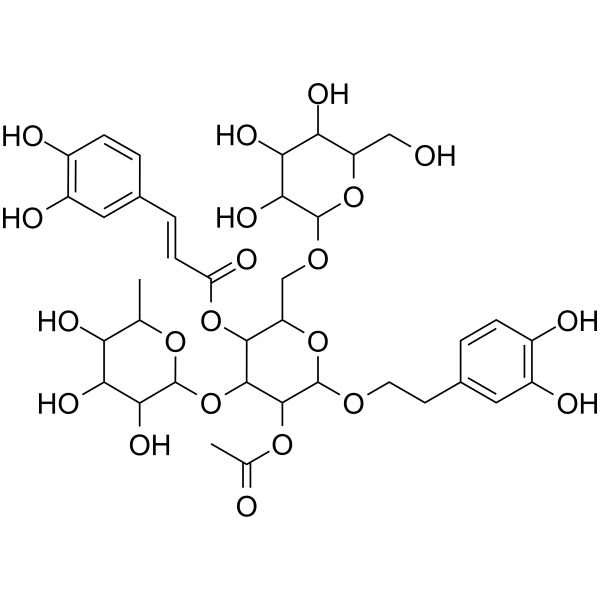
Physicochemical Properties
| Molecular Formula | C37H48O21 |
| Molecular Weight | 828.7644 |
| Exact Mass | 828.268 |
| CAS # | 112516-05-9 |
| PubChem CID | 21637830 |
| Appearance | Off-white to light yellow solid powder |
| Density | 1.6±0.1 g/cm3 |
| Boiling Point | 1045.5±65.0 °C at 760 mmHg |
| Flash Point | 317.7±27.8 °C |
| Vapour Pressure | 0.0±0.3 mmHg at 25°C |
| Index of Refraction | 1.676 |
| LogP | 0.75 |
| Hydrogen Bond Donor Count | 11 |
| Hydrogen Bond Acceptor Count | 21 |
| Rotatable Bond Count | 16 |
| Heavy Atom Count | 58 |
| Complexity | 1340 |
| Defined Atom Stereocenter Count | 15 |
| SMILES | C[C@H]1[C@@H]([C@H]([C@H]([C@@H](O1)O[C@H]2[C@@H]([C@H](O[C@H]([C@@H]2OC(=O)C)OCCC3=CC(=C(C=C3)O)O)CO[C@H]4[C@@H]([C@H]([C@@H]([C@H](O4)CO)O)O)O)OC(=O)/C=C/C5=CC(=C(C=C5)O)O)O)O)O |
| InChi Key | KZLDMAIXPXOZCX-BBQAUMBQSA-N |
| InChi Code | InChI=1S/C37H48O21/c1-15-26(45)28(47)31(50)36(53-15)58-33-32(57-25(44)8-5-17-3-6-19(40)21(42)11-17)24(14-52-35-30(49)29(48)27(46)23(13-38)55-35)56-37(34(33)54-16(2)39)51-10-9-18-4-7-20(41)22(43)12-18/h3-8,11-12,15,23-24,26-38,40-43,45-50H,9-10,13-14H2,1-2H3/b8-5+/t15-,23+,24+,26-,27+,28+,29-,30+,31+,32+,33-,34+,35+,36-,37+/m0/s1 |
| Chemical Name | [(2R,3R,4S,5R,6R)-5-acetyloxy-6-[2-(3,4-dihydroxyphenyl)ethoxy]-2-[[(2R,3R,4S,5S,6R)-3,4,5-trihydroxy-6-(hydroxymethyl)oxan-2-yl]oxymethyl]-4-[(2S,3R,4R,5R,6S)-3,4,5-trihydroxy-6-methyloxan-2-yl]oxyoxan-3-yl] (E)-3-(3,4-dihydroxyphenyl)prop-2-enoate |
| HS Tariff Code | 2934.99.9001 |
| Storage |
Powder-20°C 3 years 4°C 2 years In solvent -80°C 6 months -20°C 1 month Note: This product requires protection from light (avoid light exposure) during transportation and storage. |
| Shipping Condition | Room temperature (This product is stable at ambient temperature for a few days during ordinary shipping and time spent in Customs) |
Biological Activity
| Targets |
Antioxidant / Free radical scavenger Inhibitor of lipid peroxidation |
| ln Vitro |
Phenylethanol glycoside tubuloside A has hepatoprotective and antioxidant properties [1][2]. Hepatocyte mortality produced by D-GalN can be inhibited by tubuloside A (8.6 μM) [2]. - Tubuloside A demonstrated DPPH (1,1-diphenyl-2-picrylhydrazyl) radical scavenging activity with an IC₅₀ of 3.34 µM, which was stronger than α-tocopherol (IC₅₀ = 10.2 µM) and caffeic acid (IC₅₀ = 4.79 µM). [1] - Tubuloside A showed scavenging activity against xanthine/xanthine oxidase (XOD)-generated superoxide anion radical (O₂⁻) with an IC₅₀ of 3.17 µM. This activity was stronger than α-tocopherol (IC₅₀ > 10 µM) but weaker than caffeic acid (IC₅₀ = 1.82 µM). [1] - Tubuloside A did not show an inhibitory effect on xanthine oxidase (XOD) activity at the tested concentrations (25-200 µM). [1] - Tubuloside A significantly inhibited ascorbic acid/Fe²⁺-induced lipid peroxidation in rat liver microsomes with an IC₅₀ of 9.3 µM. Its activity was stronger than caffeic acid (IC₅₀ = 32.2 µM) and much stronger than α-tocopherol (IC₅₀ > 100 µM). [1] - Tubuloside A significantly inhibited ADP/NADPH/Fe³⁺-induced lipid peroxidation in rat liver microsomes with an IC₅₀ of 47.6 µM. Its activity was stronger than caffeic acid (IC₅₀ = 214.0 µM) and much stronger than α-tocopherol (IC₅₀ > 1000 µM). [1] |
| Enzyme Assay | The inhibitory effect of Tubuloside A on xanthine oxidase (XOD) activity was estimated. A reaction mixture consisting of phosphate buffer (pH 7.5), XOD solution, and the sample solution was pre-incubated. Xanthine solution was then added to start the enzyme reaction. After incubation, the reaction was terminated by adding HCl, and the absorbance of the reaction mixture was measured at 295 nm to determine the concentration of uric acid formed. The inhibitory effect was expressed as the percent inhibition of uric acid formation compared to the control (where water was used instead of the sample solution). [1] |
| References |
[1]. Antioxidative effects of phenylethanoids from Cistanche deserticola. Biol Pharm Bull. 1996 Dec;19(12):1580-5. [2]. Acylated phenylethanoid oligoglycosides with hepatoprotective activity from the desert plant Cistanche tubulosa. Bioorg Med Chem. 2010 Mar 1;18(5):1882-90. |
| Additional Infomation |
Tubuloside A is an oligosaccharide. Tubuloside A has been reported in Cistanche tubulosa, Cistanche phelypaea, and Cistanche deserticola with data available. Tubuloside A is a phenylethanoid glycoside isolated from the stem of Cistanche deserticola. Its chemical structure features a caffeoyl moiety attached to the 4-position of the glucose unit. [1] The antioxidative activity of Tubuloside A and related phenylethanoids is potentiated by an increase in the number of phenolic hydroxyl groups in the molecule. Compounds like Tubuloside A with four phenolic hydroxyl groups showed stronger activity. [1] The study suggests that the anti-lipid peroxidation effects of Tubuloside A may involve mechanisms such as chelating Fe²⁺ or Fe³⁺ ions, scavenging superoxide radicals (O₂⁻) to break the radical chain reaction, and directly scavenging more toxic radical species like hydroxyl radicals and lipid peroxyl radicals. [1] The order of DPPH radical scavenging activity of the tested compounds showed better parallelism with their anti-lipid peroxidation activity than did the order of superoxide anion radical scavenging activity. [1] |
Solubility Data
| Solubility (In Vitro) | DMSO : ~50 mg/mL (~60.33 mM) |
| Solubility (In Vivo) |
Solubility in Formulation 1: ≥ 2.5 mg/mL (3.02 mM) (saturation unknown) in 10% DMSO + 40% PEG300 + 5% Tween80 + 45% Saline (add these co-solvents sequentially from left to right, and one by one), clear solution. For example, if 1 mL of working solution is to be prepared, you can add 100 μL of 25.0 mg/mL clear DMSO stock solution to 400 μL PEG300 and mix evenly; then add 50 μL Tween-80 to the above solution and mix evenly; then add 450 μL normal saline to adjust the volume to 1 mL. Preparation of saline: Dissolve 0.9 g of sodium chloride in 100 mL ddH₂ O to obtain a clear solution. Solubility in Formulation 2: ≥ 2.5 mg/mL (3.02 mM) (saturation unknown) in 10% DMSO + 90% (20% SBE-β-CD in Saline) (add these co-solvents sequentially from left to right, and one by one), clear solution. For example, if 1 mL of working solution is to be prepared, you can add 100 μL of 25.0 mg/mL clear DMSO stock solution to 900 μL of 20% SBE-β-CD physiological saline solution and mix evenly. Preparation of 20% SBE-β-CD in Saline (4°C,1 week): Dissolve 2 g SBE-β-CD in 10 mL saline to obtain a clear solution. Solubility in Formulation 3: ≥ 2.5 mg/mL (3.02 mM) (saturation unknown) in 10% DMSO + 90% Corn Oil (add these co-solvents sequentially from left to right, and one by one), clear solution. For example, if 1 mL of working solution is to be prepared, you can add 100 μL of 25.0 mg/mL clear DMSO stock solution to 900 μL of corn oil and mix evenly. (Please use freshly prepared in vivo formulations for optimal results.) |
| Preparing Stock Solutions | 1 mg | 5 mg | 10 mg | |
| 1 mM | 1.2066 mL | 6.0331 mL | 12.0662 mL | |
| 5 mM | 0.2413 mL | 1.2066 mL | 2.4132 mL | |
| 10 mM | 0.1207 mL | 0.6033 mL | 1.2066 mL |