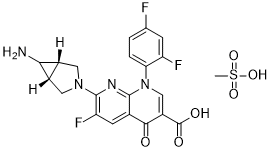
Description:Trovafloxacinmesylate (CP-99219) is a broad-spectrum quinolone antibiotic thatinhibits DNA supercoiling in various bacteria by blocking the activity of DNA gyrase and topoisomerase IV. It haspotent activity against Gram-positive, Gram-negative and anaerobic organisms. Trovafloxacin blocks the DNA gyrase and topoisomerase IV activity. Trovafloxacin is also a highly potent, specific and orally bioavailable pannexin 1 channel (PANX1) inhibitor with an IC50 of 4 μM for PANX1 inward current. Trovafloxacin does not inhibit connexin 43 gap junction or PANX2. Trovafloxacin leads to dysregulated fragmentation of apoptotic cells by inhibiting PANX1.
Physicochemical Properties
| Molecular Formula | C21H19F3N4O6S |
| Molecular Weight | 512.45896 |
| Exact Mass | 512.098 |
| CAS # | 147059-75-4 |
| Related CAS # | Trovafloxacin;147059-72-1 |
| PubChem CID | 62960 |
| Appearance | White to off-white solid powder |
| Boiling Point | 630.5ºC at 760mmHg |
| Melting Point | >250 °C (dec.) |
| Flash Point | 335.1ºC |
| Vapour Pressure | 2.59E-24mmHg at 25°C |
| LogP | 3.244 |
| Hydrogen Bond Donor Count | 3 |
| Hydrogen Bond Acceptor Count | 13 |
| Rotatable Bond Count | 3 |
| Heavy Atom Count | 35 |
| Complexity | 863 |
| Defined Atom Stereocenter Count | 2 |
| SMILES | CS(=O)(=O)O.C1[C@@H]2[C@@H](C2N)CN1C3=C(C=C4C(=O)C(=CN(C4=N3)C5=C(C=C(C=C5)F)F)C(=O)O)F |
| InChi Key | DYNZICQDCVYXFW-GIPYJWDTSA-N |
| InChi Code | InChI=1S/C20H15F3N4O3.CH4O3S/c21-8-1-2-15(13(22)3-8)27-7-12(20(29)30)17(28)9-4-14(23)19(25-18(9)27)26-5-10-11(6-26)16(10)24;1-5(2,3)4/h1-4,7,10-11,16H,5-6,24H2,(H,29,30);1H3,(H,2,3,4)/t10-,11+,16?; |
| Chemical Name | 7-[(1R,5S)-6-amino-3-azabicyclo[3.1.0]hexan-3-yl]-1-(2,4-difluorophenyl)-6-fluoro-4-oxo-1,8-naphthyridine-3-carboxylic acid;methanesulfonic acid |
| HS Tariff Code | 2934.99.9001 |
| Storage |
Powder-20°C 3 years 4°C 2 years In solvent -80°C 6 months -20°C 1 month Note: Please store this product in a sealed and protected environment (e.g. under nitrogen), avoid exposure to moisture. |
| Shipping Condition | Room temperature (This product is stable at ambient temperature for a few days during ordinary shipping and time spent in Customs) |
Biological Activity
| ln Vitro | Lactate dehydrogenase (LDH) leakage in HepG2 cells is increased and apoptosis is induced when trovafloxacin (20 µM; 24 hours; HepG2 cells) is incubated with tumor necrosis factor (TNF; 4 ng/mL). Early NF-κB-related factors A20 and IκBα are expressed more when HEG2 cells are incubated with trovafloxacin (20 µM; 24 hours) and TNF (4 ng/mL) [1]. The activation of IKKα/β and MAPK caused by TNF in HepG2 is prolonged by trovafloxacin [1]. Effectively preventing apoptotic cells from absorbing TO-PRO-3 is trovafloxacin. The release of ATP from apoptotic cells is likewise inhibited by trovafloxacin. Trovafloxacin does not prevent the activation of caspase 3/7 or the cleavage of PANX1 during apoptosis by caspase mediators [2]. MICs of 0.06-0.25 mg/mL have been reported for trovafloxacin against over 700 isolates, indicating that it is equally effective against both penicillin-susceptible and resistant pneumococci. Trovafloxacin inhibits 90% of the isolates of 55 pneumococci with a minimum inhibitory concentration (MIC) of 0.125 μg/mL [3]. |
| ln Vivo | TNF-induced p65 nuclear translocation was eliminated by trovafloxacin (150 mg/kg; oral; male C57BL/6 J mice). Early NF-κB-related factors A20 and IκBα are expressed more when trovafloxacin is used [1]. When lipopolysaccharide (LPS) or tumor necrosis factor (TNF) was given to mice, trovafloxacin resulted in significant hepatotoxicity. This was accompanied by significant apoptotic regions in the liver, elevated ALT and proinflammatory cytokines in the serum. connected to higher quantities [1]. |
| Cell Assay |
Apoptosis analysis [1] Cell Types: HepG2 Cell Tested Concentrations: 20 µM Incubation Duration: 24 hrs (hours) Experimental Results: Annexin V staining gradually increased and lactate dehydrogenase (LDH) leakage increased at 24 hrs (hours). RT-PCR[1] Cell Types: HepG2 cells Tested Concentrations: 20 µM Incubation Duration: 24 hrs (hours) Experimental Results: Caused higher increase in A20 and IκBα transcription in HepG2 cells. |
| Animal Protocol |
Animal/Disease Models: Male C57BL/6 J mice (9-11 weeks old) were injected with recombinant mouse TNF ions [1]. Doses: 150 mg/kg. Route of Administration: oral administration; injection administration. Experimental Results: An increased number of cells demonstrated an increased nuclear/cytoplasmic p65 ratio in the liver. |
| Toxicity/Toxicokinetics |
Effects During Pregnancy and Lactation ◉ Summary of Use during Lactation No information is available on the clinical use of trovafloxacin during breastfeeding; however, amounts in breastmilk appear to be low. Fluoroquinolones have traditionally not been used in infants because of concern about adverse effects on the infants' developing joints. However, recent studies indicate little risk. The calcium in milk might prevent absorption of the small amounts of fluoroquinolones in milk, but insufficient data exist to prove or disprove this assertion. Use of trovafloxacin is acceptable in nursing mothers with monitoring of the infant for possible effects on the gastrointestinal flora, such as diarrhea or candidiasis (thrush, diaper rash). However, it is preferable to use an alternate drug for which safety information is available. ◉ Effects in Breastfed Infants Relevant published information was not found as of the revision date. ◉ Effects on Lactation and Breastmilk Relevant published information was not found as of the revision date. |
| References |
[1]. The hepatotoxic fluoroquinolone trovafloxacin disturbs TNF- and LPS-induced p65 nuclear translocation in vivo and in vitro. Toxicol Appl Pharmacol. 2020 Mar 15;391:114915. [2]. Unexpected link between an antibiotic, pannexin channels and apoptosis. Nature. 2014 Mar 20;507(7492):329-34. [3]. Activity of the new fluoroquinolone trovafloxacin (CP-99,219) against DNA gyrase and topoisomerase IV mutants of Streptococcus pneumoniae selected in vitro. Antimicrob Agents Chemother. 1996 Dec;40(12):2691-7. |
| Additional Infomation |
Trovafloxacin mesylate is a methanesulfonate (mesylate) salt prepared from equimolar amounts of trovafloxacin and methanesulfonic acid. A broad-spectrum antibiotic that was withdrawn from the market due to risk of liver failure. It has a role as an antibacterial drug, an antimicrobial agent, a DNA synthesis inhibitor, a hepatotoxic agent and a topoisomerase IV inhibitor. It contains a trovafloxacin(1+). See also: Trovafloxacin Mesylate (annotation moved to). Drug Indication Trovafloxacin is a synthetic broad spectrum quinolone antibacterial agent indicated for the treatment of the following infections in adults: Pneumonia: Community Acquired Pneumonia and Nosocomial Pneumonia (mild, moderate, and severe). Note: Efficacy in patients with very severe nosocomial pneumonia and in particular infections due to less susceptible pathogens e. g. P. aeruginosa, has not been established. See also section 4. 2. Acute Exacerbations of Chronic BronchitisAcute SinusitisComplicated Intra-abdominal Infections and Acute Pelvic InfectionsSalpingitisUncomplicated Gonococcal Urethritis and CervicitisChlamydial CervicitisComplicated Skin and Soft Tissue InfectionsConsideration should be given to official guidance on the appropriate use of antibacterial agents. |
Solubility Data
| Solubility (In Vitro) |
DMSO : ~125 mg/mL (~243.92 mM) H2O : ~20 mg/mL (~39.03 mM) |
| Solubility (In Vivo) |
Solubility in Formulation 1: ≥ 2.08 mg/mL (4.06 mM) (saturation unknown) in 10% DMSO + 40% PEG300 + 5% Tween80 + 45% Saline (add these co-solvents sequentially from left to right, and one by one), clear solution. For example, if 1 mL of working solution is to be prepared, you can add 100 μL of 20.8 mg/mL clear DMSO stock solution to 400 μL PEG300 and mix evenly; then add 50 μL Tween-80 to the above solution and mix evenly; then add 450 μL normal saline to adjust the volume to 1 mL. Preparation of saline: Dissolve 0.9 g of sodium chloride in 100 mL ddH₂ O to obtain a clear solution. Solubility in Formulation 2: ≥ 2.08 mg/mL (4.06 mM) (saturation unknown) in 10% DMSO + 90% Corn Oil (add these co-solvents sequentially from left to right, and one by one), clear solution. For example, if 1 mL of working solution is to be prepared, you can add 100 μL of 20.8 mg/mL clear DMSO stock solution to 900 μL of corn oil and mix evenly. (Please use freshly prepared in vivo formulations for optimal results.) |
| Preparing Stock Solutions | 1 mg | 5 mg | 10 mg | |
| 1 mM | 1.9514 mL | 9.7569 mL | 19.5137 mL | |
| 5 mM | 0.3903 mL | 1.9514 mL | 3.9027 mL | |
| 10 mM | 0.1951 mL | 0.9757 mL | 1.9514 mL |