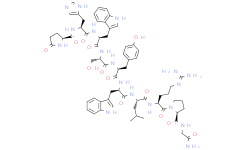
Physicochemical Properties
| Molecular Formula | C64H82N18O13 |
| Molecular Weight | 1311.4487 |
| Exact Mass | 1310.63 |
| Elemental Analysis | C, 58.61; H, 6.30; N, 19.22; O, 15.86 |
| CAS # | 57773-63-4 |
| Related CAS # | 2240176-35-4 (TFA); 140194-24-7 (acetate); 57773-63-4; 124508-66-3 (pamoate) |
| PubChem CID | 25074470 |
| Appearance | Solid powder |
| Density | 1.5±0.1 g/cm3 |
| Index of Refraction | 1.723 |
| LogP | -0.41 |
| Hydrogen Bond Donor Count | 17 |
| Hydrogen Bond Acceptor Count | 15 |
| Rotatable Bond Count | 33 |
| Heavy Atom Count | 95 |
| Complexity | 2710 |
| Defined Atom Stereocenter Count | 9 |
| SMILES | O=C([C@]([H])(C([H])([H])C([H])([H])C([H])([H])/N=C(\N([H])[H])/N([H])[H])N([H])C([C@]([H])(C([H])([H])C([H])(C([H])([H])[H])C([H])([H])[H])N([H])C([C@@]([H])(C([H])([H])C1=C([H])N([H])C2=C([H])C([H])=C([H])C([H])=C12)N([H])C([C@]([H])(C([H])([H])C1C([H])=C([H])C(=C([H])C=1[H])O[H])N([H])C([C@]([H])(C([H])([H])O[H])N([H])C([C@]([H])(C([H])([H])C1=C([H])N([H])C2=C([H])C([H])=C([H])C([H])=C12)N([H])C([C@]([H])(C([H])([H])C1=C([H])N=C([H])N1[H])N([H])C([C@]1([H])C([H])([H])C([H])([H])C(N1[H])=O)=O)=O)=O)=O)=O)=O)=O)N1C([H])([H])C([H])([H])C([H])([H])[C@@]1([H])C(N([H])C([H])([H])C(N([H])[H])=O)=O |
| InChi Key | VXKHXGOKWPXYNA-PGBVPBMZSA-N |
| InChi Code | InChI=1S/C64H82N18O13/c1-34(2)23-46(56(88)75-45(13-7-21-69-64(66)67)63(95)82-22-8-14-52(82)62(94)72-31-53(65)85)76-58(90)48(25-36-28-70-42-11-5-3-9-40(36)42)78-57(89)47(24-35-15-17-39(84)18-16-35)77-61(93)51(32-83)81-59(91)49(26-37-29-71-43-12-6-4-10-41(37)43)79-60(92)50(27-38-30-68-33-73-38)80-55(87)44-19-20-54(86)74-44/h3-6,9-12,15-18,28-30,33-34,44-52,70-71,83-84H,7-8,13-14,19-27,31-32H2,1-2H3,(H2,65,85)(H,68,73)(H,72,94)(H,74,86)(H,75,88)(H,76,90)(H,77,93)(H,78,89)(H,79,92)(H,80,87)(H,81,91)(H4,66,67,69)/t44-,45-,46-,47-,48+,49-,50-,51-,52-/m0/s1 |
| Chemical Name | 5-Oxo-L-prolyl-L-histidyl-L-tryptophyl-L-seryl-L-tyrosyl-D-tryptophyl-L-leucyl-L-arginyl-L-prolylglycinamide |
| Synonyms | Triptoreline; Arvekap; Triptorelina |
| HS Tariff Code | 2934.99.9001 |
| Storage |
Powder-20°C 3 years 4°C 2 years In solvent -80°C 6 months -20°C 1 month |
| Shipping Condition | Room temperature (This product is stable at ambient temperature for a few days during ordinary shipping and time spent in Customs) |
Biological Activity
| Targets | Gonadotropin-releasing hormone agonist (GnRH) |
| ln Vitro | Triptorelin has protection effects against tripterygium polyglycoside-induced damage to ovarian function on mouse ovarian cells [2]. |
| ln Vivo | Triptorelin has a protective effect on tripterygium polyglycoside-induced damage to ovarian function in female mice [2]. |
| Animal Protocol | For qualified, healthy SD female mice, the vaginal exfoliated cell method was used to select 30 mice with normal estrous cycle as test animals, which were randomly divided into 3 groups of 10 mice each: • Group A: blank control group, where 0.35 mL of saline was administered to the stomach once daily for 11 weeks; • Group B: tripterygium glycoside group, where 0.35 mL of tripterygium glycoside solution was administered to the stomach from the 8th day; once a day for 10 weeks; • Group C: triptolide + triptorelin group: 0.1 mg/kg daily subcutaneous injection of triptorelin injection; once a day; continuous injection for 11 weeks; from the 8th day, the triptolide solution was administered to the stomach 0.35 mL, once daily for 10 weeks. From the first day of the experiment, the general conditions of the mice were observed and recorded, including energy, activity, hair, food intake, water intake, stomach appetite, second stool, etc. The mice were weighed once a week to observe changes in body weight. The vagina exfoliation cell method, simple to operate, was used to observe the estrous cycle. After 11 weeks of treatment, the drug was stopped for 3 weeks and all mice were sacrificed. The ovaries were then obtained by laparotomy, and the ovarian wet weight was measured using an electronic analytical balance. The ovarian index was calculated by ovarian wet weight (mg) / mouse weight (g) × 100%. After weighing, the ovaries were fixed in a 4% paraformaldehyde solution for 3 days, and were routinely dehydrated, xylene-transparented, wax-impregnated, embedded, sectioned (4 µm), and operated according to the instructions of immunohistochemistry kit. Immunohistochemical average optical density (average optical) analysis method: each slice in each group randomly selected at least three positions with a 200× field of view (FoV) for photographing. When taking pictures, FoV was selected to ensure that the testing tissue fully filled the view. In addition, the background illumination of each photo was kept as consistent as possible. Image-Pro Plus 6.0 software was used to select the same brown-yellow color as the uniform standard for determining the positives of all photos. Each photo was analyzed to obtain the Integrated Optical Density (IOD) and the pixel area (AREA). The average optical density (AO) was obtained by AO = IOD/AREA. (1) The larger the AO value, the higher the positive expression level. [2] |
| ADME/Pharmacokinetics |
Absorption, Distribution and Excretion Following IV administration of triptorelin, triptorelin is completely absorbed. Elimination of triptorelin involves both the kidneys and the liver. After a single IV dose of 0.5mg, the volume of distribution of triptorelin peptide in healthy males was 30 - 33L. In healthy male volunteers, total clearance of triptorelin was 211.9 mL/min. Metabolism / Metabolites The metabolism of triptorelin in humans is not well understood; however, metabolism likely does not involve hepatic enzymes such as cytochrome P450. Whether or not triptorelin affects, or how it affects other metabolizing enzymes is also poorly understood. Triptorelin has no identified metabolites. Biological Half-Life The pharmacokinetics of triptorelin follows a 3 compartment model. The half lives are estimated to be 6 minutes, 45 minutes, and 3 hours respectively. |
| Toxicity/Toxicokinetics |
Hepatotoxicity Long term triptorelin is associated with serum enzyme elevations in 2% to 5% of patients, although the elevations are rarely above three times the upper limit of normal ( Likelihood score: E (unlikely cause of clinically apparent liver injury). Protein Binding Triptorelin does not bind to plasma proteins at clinically relevant concentrations. |
| References |
[1]. Efficacy and safety of triptorelin 6-month formulation in patients with central precocious puberty.2016 Nov 1;29(11):1241-1248. [2]. www.ejgo.net/articles/10.31083/j.ejgo.2021.02.2299 |
| Additional Infomation |
Triptorelin is an oligopeptide comprising pyroglutamyl, histidyl, tryptophyl, seryl, tyrosyl, D-tryptophyl, leucyl, arginyl, prolyl and glycinamide residues joined in sequence. It is an agonist analogue of gonadotropin-releasing hormone. It has a role as a gonadotropin releasing hormone agonist, an antineoplastic agent and a contraceptive drug. Triptorelin is a synthetic decapeptide agonist analog of luteinizing hormone releasing hormone (LHRH). Possessing greater potency than endogenous LHRH, triptorelin reversibly represses gonadotropin secretion. After chronic, continuous administration, this agent effects sustained decreases in LH and FSH production and testicular and ovarian steroidogenesis. Serum testosterone concentrations may fall to levels typically observed in surgically castrated men. Triptorelin is a gonadotropin releasing hormone (GnRH) agonist that is a potent inhibitor of the synthesis of testosterone (in men) and estrogen (in women) and is used to treat advanced prostate cancer. Triptorelin is associated with a low rate of transient serum enzyme elevations during therapy, but has not been linked convincingly to cases of clinically apparent acute liver injury. Triptorelin is a synthetic decapeptide agonist analog of luteinizing hormone releasing hormone (LHRH). Possessing greater potency than endogenous LHRH, triptorelin reversibly represses gonadotropin secretion. After chronic, continuous administration, this agent effects sustained decreases in LH and FSH production and testicular and ovarian steroidogenesis. Serum testosterone concentrations may fall to levels typically observed in surgically castrated men. (NCI04) A potent synthetic long-acting agonist of GONADOTROPIN-RELEASING HORMONE with D-tryptophan substitution at residue 6. See also: Triptorelin Pamoate (active moiety of); Triptorelin Acetate (active moiety of). Drug Indication Triptorelin is indicated for the palliative treatment of advanced prostate cancer. FDA Label For the synchronisation of ovulation in weaned sows to enable a single fixed-time artificial insemination. Mechanism of Action Triptorelin is a synthetic agonist analog of gonadotropin releasing hormone (GnRH). Animal studies comparing triptorelin to native GnRH found that triptorelin had 13 fold higher releasing activity for luteinizing hormone, and 21-fold higher releasing activity for follicle-stimulating hormone. Pharmacodynamics The first administration of triptorelin is followed by a transient surge of follicle stimulating hormone (FSH), luteinizing hormone (LH), estradiol,and testosterone. The time, peak and decline of testosterone in the body varies depending on the dose administered. This initial surge is often responsible for worsening of prostate cancer symptoms such as urethral or bladder outlet obstruction, bone pain, spinal cord injury and hematuria in the early stages. A sustained decrease in FSH and LH, and significant reduction of testicular steroidogenesis is usually seen 2-4 weeks post-initiation of therapy. This result is a reduction of serum testosterone to levels which are typically seen in surgically castrated men. Ultimately, tissues and functions that require these hormones become inactive. The effects of triptorelin can usually be reversed once the drug is discontinued. |
Solubility Data
| Solubility (In Vitro) | DMSO: > 10mM |
| Solubility (In Vivo) |
Note: Listed below are some common formulations that may be used to formulate products with low water solubility (e.g. < 1 mg/mL), you may test these formulations using a minute amount of products to avoid loss of samples. Injection Formulations (e.g. IP/IV/IM/SC) Injection Formulation 1: DMSO : Tween 80: Saline = 10 : 5 : 85 (i.e. 100 μL DMSO stock solution → 50 μL Tween 80 → 850 μL Saline) *Preparation of saline: Dissolve 0.9 g of sodium chloride in 100 mL ddH ₂ O to obtain a clear solution. Injection Formulation 2: DMSO : PEG300 :Tween 80 : Saline = 10 : 40 : 5 : 45 (i.e. 100 μL DMSO → 400 μLPEG300 → 50 μL Tween 80 → 450 μL Saline) Injection Formulation 3: DMSO : Corn oil = 10 : 90 (i.e. 100 μL DMSO → 900 μL Corn oil) Example: Take the Injection Formulation 3 (DMSO : Corn oil = 10 : 90) as an example, if 1 mL of 2.5 mg/mL working solution is to be prepared, you can take 100 μL 25 mg/mL DMSO stock solution and add to 900 μL corn oil, mix well to obtain a clear or suspension solution (2.5 mg/mL, ready for use in animals). Injection Formulation 4: DMSO : 20% SBE-β-CD in saline = 10 : 90 [i.e. 100 μL DMSO → 900 μL (20% SBE-β-CD in saline)] *Preparation of 20% SBE-β-CD in Saline (4°C,1 week): Dissolve 2 g SBE-β-CD in 10 mL saline to obtain a clear solution. Injection Formulation 5: 2-Hydroxypropyl-β-cyclodextrin : Saline = 50 : 50 (i.e. 500 μL 2-Hydroxypropyl-β-cyclodextrin → 500 μL Saline) Injection Formulation 6: DMSO : PEG300 : castor oil : Saline = 5 : 10 : 20 : 65 (i.e. 50 μL DMSO → 100 μLPEG300 → 200 μL castor oil → 650 μL Saline) Injection Formulation 7: Ethanol : Cremophor : Saline = 10: 10 : 80 (i.e. 100 μL Ethanol → 100 μL Cremophor → 800 μL Saline) Injection Formulation 8: Dissolve in Cremophor/Ethanol (50 : 50), then diluted by Saline Injection Formulation 9: EtOH : Corn oil = 10 : 90 (i.e. 100 μL EtOH → 900 μL Corn oil) Injection Formulation 10: EtOH : PEG300:Tween 80 : Saline = 10 : 40 : 5 : 45 (i.e. 100 μL EtOH → 400 μLPEG300 → 50 μL Tween 80 → 450 μL Saline) Oral Formulations Oral Formulation 1: Suspend in 0.5% CMC Na (carboxymethylcellulose sodium) Oral Formulation 2: Suspend in 0.5% Carboxymethyl cellulose Example: Take the Oral Formulation 1 (Suspend in 0.5% CMC Na) as an example, if 100 mL of 2.5 mg/mL working solution is to be prepared, you can first prepare 0.5% CMC Na solution by measuring 0.5 g CMC Na and dissolve it in 100 mL ddH2O to obtain a clear solution; then add 250 mg of the product to 100 mL 0.5% CMC Na solution, to make the suspension solution (2.5 mg/mL, ready for use in animals). Oral Formulation 3: Dissolved in PEG400 Oral Formulation 4: Suspend in 0.2% Carboxymethyl cellulose Oral Formulation 5: Dissolve in 0.25% Tween 80 and 0.5% Carboxymethyl cellulose Oral Formulation 6: Mixing with food powders Note: Please be aware that the above formulations are for reference only. InvivoChem strongly recommends customers to read literature methods/protocols carefully before determining which formulation you should use for in vivo studies, as different compounds have different solubility properties and have to be formulated differently. (Please use freshly prepared in vivo formulations for optimal results.) |
| Preparing Stock Solutions | 1 mg | 5 mg | 10 mg | |
| 1 mM | 0.7625 mL | 3.8126 mL | 7.6251 mL | |
| 5 mM | 0.1525 mL | 0.7625 mL | 1.5250 mL | |
| 10 mM | 0.0763 mL | 0.3813 mL | 0.7625 mL |