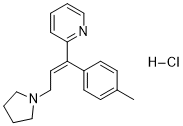
Physicochemical Properties
| Molecular Formula | C19H23CLN2 |
| Molecular Weight | 314.857 |
| Exact Mass | 314.155 |
| CAS # | 6138-79-0 |
| Related CAS # | Triprolidine;486-12-4;Triprolidine hydrochloride;550-70-9 |
| PubChem CID | 5702129 |
| Appearance | White to off-white solid powder |
| Boiling Point | 462ºC at 760 mmHg |
| Melting Point | 115-120ºC |
| Flash Point | 233.2ºC |
| LogP | 4.657 |
| Hydrogen Bond Donor Count | 1 |
| Hydrogen Bond Acceptor Count | 2 |
| Rotatable Bond Count | 4 |
| Heavy Atom Count | 22 |
| Complexity | 336 |
| Defined Atom Stereocenter Count | 0 |
| SMILES | CC1=CC=C(C=C1)/C(=C\CN2CCCC2)/C3=CC=CC=N3.Cl |
| InChi Key | WYUYEJNGHIOFOC-NWBUNABESA-N |
| InChi Code | InChI=1S/C19H22N2.ClH/c1-16-7-9-17(10-8-16)18(19-6-2-3-12-20-19)11-15-21-13-4-5-14-21/h2-3,6-12H,4-5,13-15H2,1H31H/b18-11+ |
| Chemical Name | 2-[(E)-1-(4-methylphenyl)-3-pyrrolidin-1-ylprop-1-enyl]pyridine hydrochloride |
| Synonyms | Triprolidine HCl Pro-Entra EntraVenenActidilat Pro-Actidil Actidilon. |
| HS Tariff Code | 2934.99.9001 |
| Storage |
Powder-20°C 3 years 4°C 2 years In solvent -80°C 6 months -20°C 1 month Note: Please store this product in a sealed and protected environment, avoid exposure to moisture. |
| Shipping Condition | Room temperature (This product is stable at ambient temperature for a few days during ordinary shipping and time spent in Customs) |
Biological Activity
| ln Vivo | In rats, intrathecal injection of triprolidine hydrochloride monohydrate (292.81-1467.20 μg/kg) results in dose-dependent inhibition of spinal motor and sensory function [3]. |
| Animal Protocol |
Animal/Disease Models: Male SD (SD (Sprague-Dawley)) rat (300-350 g) [3] Doses: 292.81 μg/kg, 488.02 μg/kg, 733.60 μg/kg, 1098.83 μg/kg, 1467.20 μg/kg Route of Administration: Intrathecal Injection Experimental Results: Induced dose-dependent spinal block. |
| References |
[1]. An investigation of the H1-receptor antagonist triprolidine: pharmacokinetics and antihistaminic effects. J Allergy Clin Immunol. 1986 Feb;77(2):326-30. [2]. Disposition and metabolism of triprolidine in mice. Drug Metab Dispos. Nov-Dec 1992;20(6):920-7. [3]. Spinal sensory and motor blockade by intrathecal doxylamine and triprolidine in rats. J Pharm Pharmacol. 2018 Dec;70(12):1654-1661. |
| Additional Infomation |
Triprolidine hydrochloride monohydrate is an odorless white crystalline powder. Bitter taste. (NTP, 1992) Triprolidine hydrochloride (anh.) is a hydrochloride resulting from the formal reaction of equimolar amounts of triprolidine and hydrogen chloride. Its monohydrate is used for the symptomatic relief of uticaria, rhinitis, and various pruritic skin disorders. It has a role as a H1-receptor antagonist. It contains a triprolidine(1+). Histamine H1 antagonist used in allergic rhinitis; ASTHMA; and URTICARIA. It is a component of COUGH and COLD medicines. It may cause drowsiness. See also: Triprolidine (has active moiety) ... View More ... |
Solubility Data
| Solubility (In Vitro) |
H2O : ~100 mg/mL (~300.42 mM) DMSO : ~100 mg/mL (~300.42 mM) |
| Solubility (In Vivo) |
Solubility in Formulation 1: ≥ 2.5 mg/mL (7.51 mM) (saturation unknown) in 10% DMSO + 40% PEG300 + 5% Tween80 + 45% Saline (add these co-solvents sequentially from left to right, and one by one), clear solution. For example, if 1 mL of working solution is to be prepared, you can add 100 μL of 25.0 mg/mL clear DMSO stock solution to 400 μL PEG300 and mix evenly; then add 50 μL Tween-80 to the above solution and mix evenly; then add 450 μL normal saline to adjust the volume to 1 mL. Preparation of saline: Dissolve 0.9 g of sodium chloride in 100 mL ddH₂ O to obtain a clear solution. Solubility in Formulation 2: ≥ 2.5 mg/mL (7.51 mM) (saturation unknown) in 10% DMSO + 90% (20% SBE-β-CD in Saline) (add these co-solvents sequentially from left to right, and one by one), clear solution. For example, if 1 mL of working solution is to be prepared, you can add 100 μL of 25.0 mg/mL clear DMSO stock solution to 900 μL of 20% SBE-β-CD physiological saline solution and mix evenly. Preparation of 20% SBE-β-CD in Saline (4°C,1 week): Dissolve 2 g SBE-β-CD in 10 mL saline to obtain a clear solution. Solubility in Formulation 3: ≥ 2.5 mg/mL (7.51 mM) (saturation unknown) in 10% DMSO + 90% Corn Oil (add these co-solvents sequentially from left to right, and one by one), clear solution. For example, if 1 mL of working solution is to be prepared, you can add 100 μL of 25.0 mg/mL clear DMSO stock solution to 900 μL of corn oil and mix evenly. Solubility in Formulation 4: 100 mg/mL (300.42 mM) in PBS (add these co-solvents sequentially from left to right, and one by one), clear solution; with ultrasonication. (Please use freshly prepared in vivo formulations for optimal results.) |
| Preparing Stock Solutions | 1 mg | 5 mg | 10 mg | |
| 1 mM | 3.1760 mL | 15.8801 mL | 31.7601 mL | |
| 5 mM | 0.6352 mL | 3.1760 mL | 6.3520 mL | |
| 10 mM | 0.3176 mL | 1.5880 mL | 3.1760 mL |