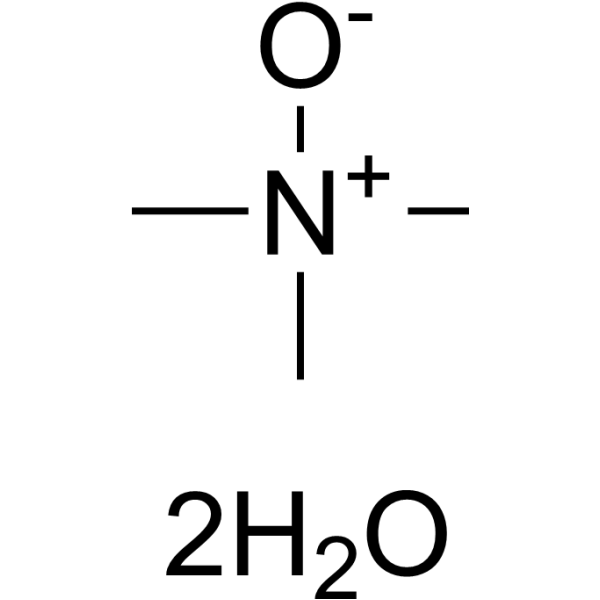
Physicochemical Properties
| Molecular Formula | C3H13NO3 |
| Molecular Weight | 111.14 |
| Exact Mass | 111.089 |
| CAS # | 62637-93-8 |
| Related CAS # | Trimethylamine N-oxide;1184-78-7;Trimethylamine N-oxide-d9;1161070-49-0;Trimethylamine-N-oxide-13C3 |
| PubChem CID | 198430 |
| Appearance | White to off-white solid powder |
| Density | 1.157 g/cm3 |
| Melting Point | 95-99 °C(lit.) |
| Flash Point | 95 °C |
| LogP | 0.082 |
| Hydrogen Bond Donor Count | 2 |
| Hydrogen Bond Acceptor Count | 3 |
| Rotatable Bond Count | 0 |
| Heavy Atom Count | 7 |
| Complexity | 28.4 |
| Defined Atom Stereocenter Count | 0 |
| InChi Key | PGFPZGKEDZGJQZ-UHFFFAOYSA-N |
| InChi Code | InChI=1S/C3H9NO.2H2O/c1-4(2,3)5;;/h1-3H3;2*1H2 |
| Chemical Name | N,N-dimethylmethanamine oxide;dihydrate |
| HS Tariff Code | 2934.99.9001 |
| Storage |
Powder-20°C 3 years 4°C 2 years In solvent -80°C 6 months -20°C 1 month |
| Shipping Condition | Room temperature (This product is stable at ambient temperature for a few days during ordinary shipping and time spent in Customs) |
Biological Activity
| Targets | Human Endogenous Metabolite NLRP3 Microbial Metabolite |
| ln Vitro | When fibroblasts were treated with trimethylamine N-oxide (TMAO) dihydrate in vitro, their size and migration increased in comparison to untreated fibroblasts. Trimethylamine N-oxide dihydrate promotes the phosphorylation of Smad2 and upregulates the expression of collagen I and α-SMA by increasing the expression of TGF-β receptor I. After treating newborn mouse fibroblasts with trimethylamine N-oxide dihydrate, there is a decrease in TGF-betaRI ubiquitination. Additionally, smurf2 expression is inhibited by trimethylamine N-oxide dihydrate[2]. Many marine animals have tissues that contain trimethylamine N-oxide, which is resistant to the negative effects of hydrostatic pressure, high urea, temperature, and salt [3]. |
| ln Vivo | Cardiovascular illness is brought on by dimethylamine N-oxide (TMAO) dihydrate, which increases inflammatory reactions. Three different diets—high choline, standard, or 3-dimethyl-1-butanol (DMB)—were given to C57BL/6 mice. In mice given choline, levels of trimethylamine N-oxide dihydrate and choline were elevated. When HFpEF mice are fed a high-choline diet, heart failure considerably worsens left ventricular hypertrophy, pulmonary congestion, and diastolic dysfunction in comparison to mice fed a control diet. When compared to animals given a control diet, HFpEF mice on a high-choline diet had noticeably higher levels of cardiac fibrosis and inflammation [1]. |
| References |
[1]. High-choline Diet Exacerbates Cardiac Dysfunction, Fibrosis, and Inflammation in a Mouse Model of Heart Failure With Preserved Ejection Fraction. J Card Fail. 2020 May 14;S1071-9164(19)31802-0. [2]. Gut Microbe-Derived Metabolite Trimethylamine N-oxide Accelerates Fibroblast-Myofibroblast Differentiation and Induces Cardiac Fibrosis. J Mol Cell Cardiol. 2019 Sep;134:119-130. [3]. Trimethylamine N-Oxide: The Good, the Bad and the Unknown. Toxins (Basel). 2016 Nov 8;8(11):326. |
Solubility Data
| Solubility (In Vitro) | H2O: 100 mg/mL (899.77 mM) |
| Solubility (In Vivo) |
Solubility in Formulation 1: ≥ 2.5 mg/mL (22.49 mM) (saturation unknown) in 10% DMSO + 40% PEG300 + 5% Tween80 + 45% Saline (add these co-solvents sequentially from left to right, and one by one), clear solution. For example, if 1 mL of working solution is to be prepared, you can add 100 μL of 25.0 mg/mL clear DMSO stock solution to 400 μL PEG300 and mix evenly; then add 50 μL Tween-80 to the above solution and mix evenly; then add 450 μL normal saline to adjust the volume to 1 mL. Preparation of saline: Dissolve 0.9 g of sodium chloride in 100 mL ddH₂ O to obtain a clear solution. Solubility in Formulation 2: ≥ 2.5 mg/mL (22.49 mM) (saturation unknown) in 10% DMSO + 90% (20% SBE-β-CD in Saline) (add these co-solvents sequentially from left to right, and one by one), clear solution. For example, if 1 mL of working solution is to be prepared, you can add 100 μL of 25.0 mg/mL clear DMSO stock solution to 900 μL of 20% SBE-β-CD physiological saline solution and mix evenly. Preparation of 20% SBE-β-CD in Saline (4°C,1 week): Dissolve 2 g SBE-β-CD in 10 mL saline to obtain a clear solution. Solubility in Formulation 3: ≥ 2.5 mg/mL (22.49 mM) (saturation unknown) in 10% DMSO + 90% Corn Oil (add these co-solvents sequentially from left to right, and one by one), clear solution. For example, if 1 mL of working solution is to be prepared, you can add 100 μL of 25.0 mg/mL clear DMSO stock solution to 900 μL of corn oil and mix evenly. Solubility in Formulation 4: 120 mg/mL (1079.72 mM) in PBS (add these co-solvents sequentially from left to right, and one by one), clear solution; with ultrasonication. (Please use freshly prepared in vivo formulations for optimal results.) |
| Preparing Stock Solutions | 1 mg | 5 mg | 10 mg | |
| 1 mM | 8.9977 mL | 44.9883 mL | 89.9766 mL | |
| 5 mM | 1.7995 mL | 8.9977 mL | 17.9953 mL | |
| 10 mM | 0.8998 mL | 4.4988 mL | 8.9977 mL |