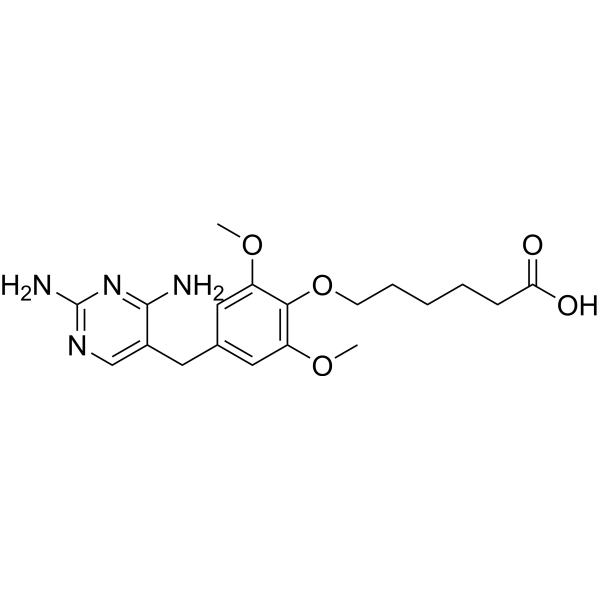
Physicochemical Properties
| Molecular Formula | C19H26N4O5 |
| Molecular Weight | 390.43 |
| CAS # | 78025-89-5 |
| Appearance | Typically exists as solid at room temperature |
| HS Tariff Code | 2934.99.9001 |
| Storage |
Powder-20°C 3 years 4°C 2 years In solvent -80°C 6 months -20°C 1 month |
| Shipping Condition | Room temperature (This product is stable at ambient temperature for a few days during ordinary shipping and time spent in Customs) |
Biological Activity
| ln Vitro | Antibodies with high titer and affinity to small molecules are critical in the field of vaccines against drugs of abuse, antidotes to toxins, and immunoassays for compounds. However, little is known regarding how properties of small molecules have influence and which molecular descriptors could indicate the degree of the antibody response. On the basis of our previous study, we designed and synthesized two groups of hapten molecules with varied hydrophobicity to investigate the relationship between the properties of the small molecules and the antibody response in terms of titer and affinity. We found that the magnitude of the antibody response was positively correlated with the degree of molecular hydrophobicity and related descriptors. This study provides insight into the immunological characteristics of small molecules themselves and useful clues to produce high-quality antibodies against small molecules.[1] |
| ln Vivo | Each hapten-BSA conjugate was used to immunize a set of 10 BALB/c mice with a total of three times at 25-day intervals. The use of 10 mice per hapten minimized the risk of obtaining results overly biased by any individual mouse (Table S3). Antisera are composed of the entire distribution of IgG antibodies present in mice and provide a comprehensive view of general trends associated with the overall antibody response. Thus, antisera titer and affinity were assessed by both noncompetitive ELISA and competitive ELISA against the corresponding homologous coating antigen, respectively (described in the SI). In the experiment, the antibody titer is defined as the dilution of antisera that furnished an ODmax between 1.5 and 2.0, while antibody affinity is expressed as the inhibition ratio calculated according to an equation (SI). In short, a higher antibody dilution or inhibition ratio indicates a higher antibody response. As shown in Figure 3A, both Hapten1a and Hapten1b induced a significant antibody response. A general trend of gradually increasing titers as immunization continued was seen. Importantly, the antibody titers from Hapten1b were obviously higher than those from Hapten1a. During the immunization period, the antibody titers of Hapten1b were always 10-fold higher than those of Hapten1a, implying a stronger immune response achieved by more hydrophobic Hapten1b (Figure 3A). The performance of antibodies against haptens should be judged by not only titer but also affinity. The latter is practically more important in the fields of bioanalysis, biochemistry, and biomedicine in most cases. Unexpectedly, the antibodies induced by Hapten1a showed a rather poor affinity with an inhibition ratio of only 1%, unlike the antibodies induced by Hapten1b, which showed a greater than 75% inhibition ratio after the third immunization (Figure 3B). Furthermore, no improvement in the inhibition ratio for Hapten1a was observed, while the inhibition ratio of Hapten1b slowly increased with subsequent immunizations. These results reveal an obvious relationship between hapten hydrophobicity and antibody response, i.e., a higher degree of hapten hydrophobicity induced a stronger antibody response, which is opposite of our initial hypothesis supported by our previous study of trimethoprim.[1] |
| References |
[1].Influence of Small Molecular Property on Antibody Response. J Agric Food Chem. 2020, 68, 39. |
Solubility Data
| Solubility (In Vitro) | Typically soluble in DMSO (e.g. 10 mM) |
| Solubility (In Vivo) |
Note: Listed below are some common formulations that may be used to formulate products with low water solubility (e.g. < 1 mg/mL), you may test these formulations using a minute amount of products to avoid loss of samples. Injection Formulations (e.g. IP/IV/IM/SC) Injection Formulation 1: DMSO : Tween 80: Saline = 10 : 5 : 85 (i.e. 100 μL DMSO stock solution → 50 μL Tween 80 → 850 μL Saline) *Preparation of saline: Dissolve 0.9 g of sodium chloride in 100 mL ddH ₂ O to obtain a clear solution. Injection Formulation 2: DMSO : PEG300 :Tween 80 : Saline = 10 : 40 : 5 : 45 (i.e. 100 μL DMSO → 400 μLPEG300 → 50 μL Tween 80 → 450 μL Saline) Injection Formulation 3: DMSO : Corn oil = 10 : 90 (i.e. 100 μL DMSO → 900 μL Corn oil) Example: Take the Injection Formulation 3 (DMSO : Corn oil = 10 : 90) as an example, if 1 mL of 2.5 mg/mL working solution is to be prepared, you can take 100 μL 25 mg/mL DMSO stock solution and add to 900 μL corn oil, mix well to obtain a clear or suspension solution (2.5 mg/mL, ready for use in animals). Injection Formulation 4: DMSO : 20% SBE-β-CD in saline = 10 : 90 [i.e. 100 μL DMSO → 900 μL (20% SBE-β-CD in saline)] *Preparation of 20% SBE-β-CD in Saline (4°C,1 week): Dissolve 2 g SBE-β-CD in 10 mL saline to obtain a clear solution. Injection Formulation 5: 2-Hydroxypropyl-β-cyclodextrin : Saline = 50 : 50 (i.e. 500 μL 2-Hydroxypropyl-β-cyclodextrin → 500 μL Saline) Injection Formulation 6: DMSO : PEG300 : castor oil : Saline = 5 : 10 : 20 : 65 (i.e. 50 μL DMSO → 100 μLPEG300 → 200 μL castor oil → 650 μL Saline) Injection Formulation 7: Ethanol : Cremophor : Saline = 10: 10 : 80 (i.e. 100 μL Ethanol → 100 μL Cremophor → 800 μL Saline) Injection Formulation 8: Dissolve in Cremophor/Ethanol (50 : 50), then diluted by Saline Injection Formulation 9: EtOH : Corn oil = 10 : 90 (i.e. 100 μL EtOH → 900 μL Corn oil) Injection Formulation 10: EtOH : PEG300:Tween 80 : Saline = 10 : 40 : 5 : 45 (i.e. 100 μL EtOH → 400 μLPEG300 → 50 μL Tween 80 → 450 μL Saline) Oral Formulations Oral Formulation 1: Suspend in 0.5% CMC Na (carboxymethylcellulose sodium) Oral Formulation 2: Suspend in 0.5% Carboxymethyl cellulose Example: Take the Oral Formulation 1 (Suspend in 0.5% CMC Na) as an example, if 100 mL of 2.5 mg/mL working solution is to be prepared, you can first prepare 0.5% CMC Na solution by measuring 0.5 g CMC Na and dissolve it in 100 mL ddH2O to obtain a clear solution; then add 250 mg of the product to 100 mL 0.5% CMC Na solution, to make the suspension solution (2.5 mg/mL, ready for use in animals). Oral Formulation 3: Dissolved in PEG400 Oral Formulation 4: Suspend in 0.2% Carboxymethyl cellulose Oral Formulation 5: Dissolve in 0.25% Tween 80 and 0.5% Carboxymethyl cellulose Oral Formulation 6: Mixing with food powders Note: Please be aware that the above formulations are for reference only. InvivoChem strongly recommends customers to read literature methods/protocols carefully before determining which formulation you should use for in vivo studies, as different compounds have different solubility properties and have to be formulated differently. (Please use freshly prepared in vivo formulations for optimal results.) |
| Preparing Stock Solutions | 1 mg | 5 mg | 10 mg | |
| 1 mM | 2.5613 mL | 12.8064 mL | 25.6128 mL | |
| 5 mM | 0.5123 mL | 2.5613 mL | 5.1226 mL | |
| 10 mM | 0.2561 mL | 1.2806 mL | 2.5613 mL |