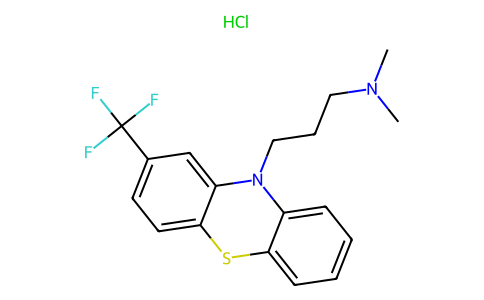
Physicochemical Properties
| Molecular Formula | C18H20CLF3N2S |
| Molecular Weight | 388.8780 |
| Exact Mass | 388.098 |
| CAS # | 1098-60-8 |
| Related CAS # | 146-54-3;1098-60-8 (HCl);17146-88-2; |
| PubChem CID | 5568 |
| Appearance | VISCOUS, LIGHT AMBER-COLORED, LIQ, WHICH CRYSTALLIZES ON PROLONGED STANDING INTO LARGE IRREGULAR CRYSTALS |
| Boiling Point | 427.6ºC at 760 mmHg |
| Melting Point | 174.0 to 179.0 °C |
| Flash Point | 212.4ºC |
| Vapour Pressure | 1.62E-07mmHg at 25°C |
| LogP | 6.126 |
| Hydrogen Bond Donor Count | 0 |
| Hydrogen Bond Acceptor Count | 6 |
| Rotatable Bond Count | 4 |
| Heavy Atom Count | 24 |
| Complexity | 416 |
| Defined Atom Stereocenter Count | 0 |
| SMILES | Cl[H].S1C2=C([H])C([H])=C([H])C([H])=C2N(C2C([H])=C(C(F)(F)F)C([H])=C([H])C1=2)C([H])([H])C([H])([H])C([H])([H])N(C([H])([H])[H])C([H])([H])[H] |
| InChi Key | XSCGXQMFQXDFCW-UHFFFAOYSA-N |
| InChi Code | InChI=1S/C18H19F3N2S/c1-22(2)10-5-11-23-14-6-3-4-7-16(14)24-17-9-8-13(12-15(17)23)18(19,20)21/h3-4,6-9,12H,5,10-11H2,1-2H3 |
| Chemical Name | N,N-dimethyl-3-[2-(trifluoromethyl)phenothiazin-10-yl]propan-1-amine |
| HS Tariff Code | 2934.99.9001 |
| Storage |
Powder-20°C 3 years 4°C 2 years In solvent -80°C 6 months -20°C 1 month |
| Shipping Condition | Room temperature (This product is stable at ambient temperature for a few days during ordinary shipping and time spent in Customs) |
Biological Activity
| ADME/Pharmacokinetics |
Absorption, Distribution and Excretion Absorption may be erratic and peak plasma concentrations show large interindividual differences. FATE OF SEVERAL (14)C QUATERNARY PHENOTHIAZINES, SUCH AS...TRIFLUPROMAZINE METHIODIDE...HAVE BEEN STUDIED IN RAT. ...MORE OF IP DOSE OF PHENOTHIAZINE WAS EXCRETED IN FECES (VIA BILE). WHERe EXAMINED, NO N-DEALKYLATION OF QUATERNARY NITROGEN WAS DETECTED. /METHIODIDE/ Metabolism / Metabolites Hepatic. ...METAB...BY OXIDATIVE PROCESSES MEDIATED LARGELY BY HEPATIC MICROSOMAL & OTHER DRUG-METABOLIZING ENZYMES. CONJUGATION WITH GLUCURONIC ACID...PROMINENT ROUTE.../PRC: REACTIONS INCL HYDROXYLATION, DEMETHYLATION, SULFOXIDE FORMATION; METABOLIC ALTERATIONS IN SIDE CHAIN MAY ALSO OCCUR/. /PHENOTHIAZINES/ Hepatic. |
| Toxicity/Toxicokinetics |
Toxicity Summary Triflupromazine binds to the dopamine D1 and dopamine D2 receptors and inhibits their activity. The mechanism of the anti-emetic effect is due predominantly to blockage of the dopamine D2 neurotransmitter receptors in the chemoreceptor trigger zone (CTZ) and vomiting centre. Triflupromazine blocks the neurotransmitter dopamine and the vagus nerve in the gastrointestinal tract. Triflupromazine also binds the muscarinic acetylcholine receptors (M1 and M2) and the tryptamine D receptors (5HT2B). Protein Binding Very high (90% or more). Interactions ...ANTIPSYCHOTIC DRUGS...MAY BLOCK ANTIHYPERTENSIVE EFFECTS OF GUANETHIDINE. PT BEING TREATED WITH PHENOTHIAZINES SHOULD BE ADVISED THAT THEIR SUSCEPTIBILITY TO ALCOHOL MAY BE INCR. /PHENOTHIAZINES/ ADDITIVE TO ACTION OF OTHER DEPRESSANTS & WILL POTENTIATE ANESTHETICS. MAY INCR TOXICITY OF ORGANOPHOSPHORUS OR OTHER ACETYLCHOLINESTERASE INHIBITORS & PROCAINE. DO NOT USE EPINEPHRINE TO COMBAT ITS HYPOTENSIVE OR DEPRESSANT EFFECTS AS IT POTENTIATES THEM. CONCURRENT ADMIN OF PHENOTHIAZINES & TRICYCLIC ANTIDEPRESSANTS MAY RESULT IN INCR IN SERUM LEVEL OF EITHER AGENT. /PHENOTHIAZINES/ For more Interactions (Complete) data for TRIFLUPROMAZINE (7 total), please visit the HSDB record page. |
| Additional Infomation |
Triflupromazine is a member of the class of phenothiazines that is 10H-phenothiazine having a trifluoromethyl subsitituent at the 2-position and a 3-(dimethylamino)propyl group at the N-10 position. It has a role as a dopaminergic antagonist, an antiemetic, a first generation antipsychotic and an anticoronaviral agent. It is a tertiary amine, a member of phenothiazines and an organofluorine compound. It derives from a hydride of a 10H-phenothiazine. A phenothiazine used as an antipsychotic agent and as an antiemetic. Triflupromazine is only found in individuals that have used or taken this drug. It is a phenothiazine used as an antipsychotic agent and as an antiemetic. Triflupromazine binds to the dopamine D1 and dopamine D2 receptors and inhibits their activity. The mechanism of the anti-emetic effect is due predominantly to blockage of the dopamine D2 neurotransmitter receptors in the chemoreceptor trigger zone (CTZ) and vomiting centre. Triflupromazine blocks the neurotransmitter dopamine and the vagus nerve in the gastrointestinal tract. Triflupromazine also binds the muscarinic acetylcholine receptors (M1 and M2) and the tryptamine D receptors (5HT2B). A phenothiazine used as an antipsychotic agent and as an antiemetic. See also: Phenothiazine (subclass of); Triflupromazine Hydrochloride (has salt form). Drug Indication Used mainly in the management of psychoses. Also used to control nausea and vomiting. Mechanism of Action Triflupromazine binds to the dopamine D1 and dopamine D2 receptors and inhibits their activity. The mechanism of the anti-emetic effect is due predominantly to blockage of the dopamine D2 neurotransmitter receptors in the chemoreceptor trigger zone (CTZ) and vomiting centre. Triflupromazine blocks the neurotransmitter dopamine and the vagus nerve in the gastrointestinal tract. Triflupromazine also binds the muscarinic acetylcholine receptors (M1 and M2) and the tryptamine D receptors (5HT2B). ...PHENOTHIAZINES, BLOCK DOPAMINE RECEPTORS & INCR TURNOVER RATE OF DOPAMINE IN CORPUS STRIATUM. INCR TURNOVER RATE IS BELIEVED TO BE RESULT OF NEURONAL FEEDBACK MECHANISM. ...FIRING OF.../IDENTIFIED DOPAMINERGIC NEURONS IN SUBSTANTIA NIGRA & VENTRAL TEGMENTAL AREAS/ IS INCR BY ANTIPSYCHOTIC PHENOTHIAZINES. /PHENOTHIAZINES/ THERE IS AN ADENYLATE CYCLASE IN LIMBIC SYSTEM, AS WELL AS IN CAUDATE NUCLEUS, THAT IS SPECIFICALLY ACTIVATED BY DOPAMINE. ...ACTIVATION OF...ENZYME IS... BLOCKED BY...PHENOTHIAZINES. ...THERAPEUTIC EFFICACY & SIDE EFFECTS MAY RELATE TO INHIBITION OF DOPAMINE ACTIVATION OF ADENYLATE CYCLASE. /PHENOTHIAZINES/ Therapeutic Uses Antiemetics; Antipsychotic Agents, Phenothiazine; Dopamine Antagonists THIS PHENOTHIAZINE IS EFFECTIVE IN MGMNT OF POSTOPERATIVE NAUSEA & VOMITING, RADIATION SICKNESS, & NAUSEA & VOMITING CAUSED BY TOXINS. /HYDROCHLORIDE/ TREATMENT OF ORG BRAIN SYNDROMES, BOTH CHRONIC & ACUTE, IS ANOTHER USE...USE... IN /TREATMENT OF/ MANIA & DEPRESSION HAS MET WITH SOME SUCCESS... ANXIETY IS CONSIDERED...INDICATION FOR USE... /PHENOTHIAZINES/ PHENOTHIAZINES...FAVORABLY MODIFY PATHOGNOMONIC SYMPTOMS OF SCHIZOPHRENIA, THAT IS, THOUGHT DISORDER; BLUNTED AFFECT, WITHDRAWAL, & RETARDATION; & AUTISTIC BEHAVIOR & MANNERISMS. FAVORABLE CHANGES IN BELLIGERENCE, RESISTIVENESS, PERCEPTUAL DISTURBANCES, & PARANOID PROJECTION ALSO OCCUR... /PHENOTHIAZINES/ For more Therapeutic Uses (Complete) data for TRIFLUPROMAZINE (6 total), please visit the HSDB record page. Drug Warnings TRIFLUPROMAZINE PRODUCES LESS SEDATION THAN SOME OTHER PHENOTHIAZINES (EG, PROMAZINE), BUT IT PROLONGS POSTANESTHESIA SLEEPING TIME. EXTRAPYRAMIDAL REACTIONS HAVE BEEN OBSERVED FOLLOWING EVEN SINGLE DOSES OF THIS ALIPHATIC COMPD. /HYDROCHLORIDE/ PHENOTHIAZINES ARE BEST UTILIZED IN CONTROL OF NAUSEA & VOMITING OF SHORT DURATION, SINCE WITH PROLONGED USE INCIDENCE OF MOST OF THEIR ADVERSE EFFECTS INCR. /PHENOTHIAZINES/ ...PRECAUTIONS SHOULD BE OBSERVED IN USE OF PHENOTHIAZINES FOR NAUSEA & VOMITING...BECAUSE THEY MAY MASK DIAGNOSTIC SYMPTOMS IN ACUTE SURGICAL CONDITIONS OR NEUROLOGICAL SYNDROMES. /PHENOTHIAZINES/ PHENOTHIAZINES SHOULD BE USED WITH EXTREME CAUTION, IF @ ALL, IN UNTREATED EPILEPTIC PT & IN PT UNDERGOING WITHDRAWAL FROM CENTRAL DEPRESSANT DRUGS SUCH AS ALCOHOL & BARBITURATES. /PHENOTHIAZINES/ For more Drug Warnings (Complete) data for TRIFLUPROMAZINE (8 total), please visit the HSDB record page. Pharmacodynamics Triflupromazine is a member of a class of drugs called phenthiazines, which are dopamine D1/D2 receptor antagonists. Phenothiazines are used to treat serious mental and emotional disorders, including schizophrenia and other psychotic disorders. It reduces anxiety, emotional withdrawal, hallucinations, disorganized thoughts, blunted mood, and suspiciousness. Triflupromazine is used particularly to control violent behavior during acute episodes of psychotic disorders. It can also be used to control severe nausea and vomiting, severe hiccups, and moderate to severe pain in some hospitalized patients. Triflupromazine acts on the central nervous system. |
Solubility Data
| Solubility (In Vitro) | May dissolve in DMSO (in most cases), if not, try other solvents such as H2O, Ethanol, or DMF with a minute amount of products to avoid loss of samples |
| Solubility (In Vivo) |
Note: Listed below are some common formulations that may be used to formulate products with low water solubility (e.g. < 1 mg/mL), you may test these formulations using a minute amount of products to avoid loss of samples. Injection Formulations (e.g. IP/IV/IM/SC) Injection Formulation 1: DMSO : Tween 80: Saline = 10 : 5 : 85 (i.e. 100 μL DMSO stock solution → 50 μL Tween 80 → 850 μL Saline) *Preparation of saline: Dissolve 0.9 g of sodium chloride in 100 mL ddH ₂ O to obtain a clear solution. Injection Formulation 2: DMSO : PEG300 :Tween 80 : Saline = 10 : 40 : 5 : 45 (i.e. 100 μL DMSO → 400 μLPEG300 → 50 μL Tween 80 → 450 μL Saline) Injection Formulation 3: DMSO : Corn oil = 10 : 90 (i.e. 100 μL DMSO → 900 μL Corn oil) Example: Take the Injection Formulation 3 (DMSO : Corn oil = 10 : 90) as an example, if 1 mL of 2.5 mg/mL working solution is to be prepared, you can take 100 μL 25 mg/mL DMSO stock solution and add to 900 μL corn oil, mix well to obtain a clear or suspension solution (2.5 mg/mL, ready for use in animals). Injection Formulation 4: DMSO : 20% SBE-β-CD in saline = 10 : 90 [i.e. 100 μL DMSO → 900 μL (20% SBE-β-CD in saline)] *Preparation of 20% SBE-β-CD in Saline (4°C,1 week): Dissolve 2 g SBE-β-CD in 10 mL saline to obtain a clear solution. Injection Formulation 5: 2-Hydroxypropyl-β-cyclodextrin : Saline = 50 : 50 (i.e. 500 μL 2-Hydroxypropyl-β-cyclodextrin → 500 μL Saline) Injection Formulation 6: DMSO : PEG300 : castor oil : Saline = 5 : 10 : 20 : 65 (i.e. 50 μL DMSO → 100 μLPEG300 → 200 μL castor oil → 650 μL Saline) Injection Formulation 7: Ethanol : Cremophor : Saline = 10: 10 : 80 (i.e. 100 μL Ethanol → 100 μL Cremophor → 800 μL Saline) Injection Formulation 8: Dissolve in Cremophor/Ethanol (50 : 50), then diluted by Saline Injection Formulation 9: EtOH : Corn oil = 10 : 90 (i.e. 100 μL EtOH → 900 μL Corn oil) Injection Formulation 10: EtOH : PEG300:Tween 80 : Saline = 10 : 40 : 5 : 45 (i.e. 100 μL EtOH → 400 μLPEG300 → 50 μL Tween 80 → 450 μL Saline) Oral Formulations Oral Formulation 1: Suspend in 0.5% CMC Na (carboxymethylcellulose sodium) Oral Formulation 2: Suspend in 0.5% Carboxymethyl cellulose Example: Take the Oral Formulation 1 (Suspend in 0.5% CMC Na) as an example, if 100 mL of 2.5 mg/mL working solution is to be prepared, you can first prepare 0.5% CMC Na solution by measuring 0.5 g CMC Na and dissolve it in 100 mL ddH2O to obtain a clear solution; then add 250 mg of the product to 100 mL 0.5% CMC Na solution, to make the suspension solution (2.5 mg/mL, ready for use in animals). Oral Formulation 3: Dissolved in PEG400 Oral Formulation 4: Suspend in 0.2% Carboxymethyl cellulose Oral Formulation 5: Dissolve in 0.25% Tween 80 and 0.5% Carboxymethyl cellulose Oral Formulation 6: Mixing with food powders Note: Please be aware that the above formulations are for reference only. InvivoChem strongly recommends customers to read literature methods/protocols carefully before determining which formulation you should use for in vivo studies, as different compounds have different solubility properties and have to be formulated differently. (Please use freshly prepared in vivo formulations for optimal results.) |
| Preparing Stock Solutions | 1 mg | 5 mg | 10 mg | |
| 1 mM | 2.5715 mL | 12.8574 mL | 25.7149 mL | |
| 5 mM | 0.5143 mL | 2.5715 mL | 5.1430 mL | |
| 10 mM | 0.2571 mL | 1.2857 mL | 2.5715 mL |