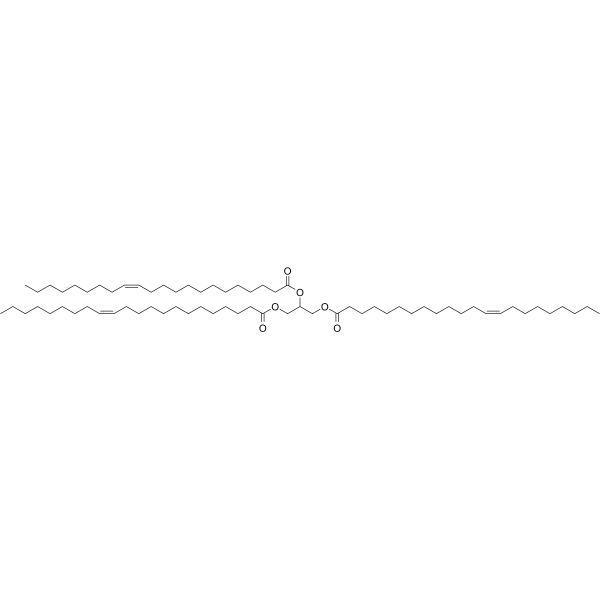
Physicochemical Properties
| Molecular Formula | C69H128O6 |
| Molecular Weight | 1053.75102 |
| Exact Mass | 1052.97 |
| CAS # | 2752-99-0 |
| PubChem CID | 5463075 |
| Appearance | White to off-white solid powder |
| Density | 0.909g/cm3 |
| Boiling Point | 909.6ºC at 760mmHg |
| Melting Point | 32 °C |
| Flash Point | 321.8ºC |
| Vapour Pressure | 6E-34mmHg at 25°C |
| Index of Refraction | 1.476 |
| LogP | 22.778 |
| Hydrogen Bond Donor Count | 0 |
| Hydrogen Bond Acceptor Count | 6 |
| Rotatable Bond Count | 65 |
| Heavy Atom Count | 75 |
| Complexity | 1190 |
| Defined Atom Stereocenter Count | 0 |
| SMILES | CCCCCCCC/C=C\CCCCCCCCCCCC(=O)OCC(OC(=O)CCCCCCCCCCC/C=C\CCCCCCCC)COC(=O)CCCCCCCCCCC/C=C\CCCCCCCC |
| InChi Key | XDSPGKDYYRNYJI-IUPFWZBJSA-N |
| InChi Code | InChI=1S/C69H128O6/c1-4-7-10-13-16-19-22-25-28-31-34-37-40-43-46-49-52-55-58-61-67(70)73-64-66(75-69(72)63-60-57-54-51-48-45-42-39-36-33-30-27-24-21-18-15-12-9-6-3)65-74-68(71)62-59-56-53-50-47-44-41-38-35-32-29-26-23-20-17-14-11-8-5-2/h25-30,66H,4-24,31-65H2,1-3H3/b28-25-,29-26-,30-27- |
| Chemical Name | 2,3-bis[[(Z)-docos-13-enoyl]oxy]propyl (Z)-docos-13-enoate |
| HS Tariff Code | 2934.99.9001 |
| Storage |
Powder-20°C 3 years 4°C 2 years In solvent -80°C 6 months -20°C 1 month Note: This product is not stable in solution, please use freshly prepared working solution for optimal results. |
| Shipping Condition | Room temperature (This product is stable at ambient temperature for a few days during ordinary shipping and time spent in Customs) |
Biological Activity
| Targets |
- Intracellular lipases [1][2] |
| ln Vitro |
- Trierucin (trierucoylglycerol) was not cleaved by lipases in heart homogenates. After 60 minutes of incubation, less than 5% of Trierucin was hydrolyzed, while triolein (control substrate) was hydrolyzed by 65±4% under the same conditions [1] - It was efficiently hydrolyzed by lipases in skeletal muscle homogenates: 60-minute incubation resulted in 58±3% hydrolysis of Trierucin [1] - It could be synthesized from 1,2-dierucoylglycerol by lipases/transferase in microspore-derived embryo homogenates of Brassica napus. The synthesis yield reached 42±3% after 4 hours of incubation [2] |
| Enzyme Assay |
- Lipase hydrolysis assay (heart and skeletal muscle): Heart and skeletal muscle tissues were homogenized in buffer to prepare enzyme extracts. Trierucin (or triolein as control) was added as substrate, and the mixture was incubated at 37°C for 60 minutes. The hydrolysis product (free fatty acids) was quantified by titration or chromatographic method to evaluate lipase activity [1] - Trierucin synthesis assay (Brassica napus embryo): Microspore-derived embryos were homogenized in reaction buffer containing 1,2-dierucoylglycerol (substrate) and acyl-CoA. Trierucin synthesis was detected by thin-layer chromatography (TLC) after 4 hours of incubation at 25°C, and the product was quantified by densitometry [2] |
| Toxicity/Toxicokinetics |
- The inability of heart lipases to cleave Trierucin may lead to erucic acid lipidosis in cardiac tissues, as undegraded Trierucin accumulates in heart cells [1] |
| References |
[1]. Intracellular lipase activities in heart and skeletal muscle homogenates. The absence of trierucin cleavage by the heart: a possible biochemical basis for erucic acid lipidosis. Biochim Biophys Acta. 1979 Feb 26;572(2):218-24. [2]. Formation of trierucoylglycerol (trierucin) from 1,2-Dierucoylglycerol by a homogenate of microspore-derived embryos ofBrassica napus L. J Am Oil Chem Soc.1992;69: 355. |
| Additional Infomation |
Glyceryl Trierucate has been investigated for the treatment of Adrenoleukodystrophy. - Trierucin is a triglyceride composed of three erucic acid (C22:1) chains esterified to glycerol [1][2] - Its metabolic characteristics are tissue-specific: skeletal muscle lipases can hydrolyze it, while cardiac lipases lack this activity [1] - It serves as a substrate to study tissue-specific lipase activity and is involved in the biosynthesis of storage lipids in Brassica napus embryos [2] |
Solubility Data
| Solubility (In Vitro) | DMSO : ~32.5 mg/mL (~30.84 mM) |
| Solubility (In Vivo) |
Solubility in Formulation 1: ≥ 1.08 mg/mL (1.02 mM) (saturation unknown) in 10% DMSO + 40% PEG300 + 5% Tween80 + 45% Saline (add these co-solvents sequentially from left to right, and one by one), clear solution. For example, if 1 mL of working solution is to be prepared, you can add 100 μL of 10.8 mg/mL clear DMSO stock solution to 400 μL PEG300 and mix evenly; then add 50 μL Tween-80 to the above solution and mix evenly; then add 450 μL normal saline to adjust the volume to 1 mL. Preparation of saline: Dissolve 0.9 g of sodium chloride in 100 mL ddH₂ O to obtain a clear solution. Solubility in Formulation 2: ≥ 1.08 mg/mL (1.02 mM) (saturation unknown) in 10% DMSO + 90% (20% SBE-β-CD in Saline) (add these co-solvents sequentially from left to right, and one by one), clear solution. For example, if 1 mL of working solution is to be prepared, you can add 100 μL of 10.8 mg/mL clear DMSO stock solution to 900 μL of 20% SBE-β-CD physiological saline solution and mix evenly. Preparation of 20% SBE-β-CD in Saline (4°C,1 week): Dissolve 2 g SBE-β-CD in 10 mL saline to obtain a clear solution. Solubility in Formulation 3: ≥ 1.08 mg/mL (1.02 mM) (saturation unknown) in 10% DMSO + 90% Corn Oil (add these co-solvents sequentially from left to right, and one by one), clear solution. For example, if 1 mL of working solution is to be prepared, you can add 100 μL of 10.8 mg/mL clear DMSO stock solution to 900 μL of corn oil and mix evenly. (Please use freshly prepared in vivo formulations for optimal results.) |
| Preparing Stock Solutions | 1 mg | 5 mg | 10 mg | |
| 1 mM | 0.9490 mL | 4.7450 mL | 9.4899 mL | |
| 5 mM | 0.1898 mL | 0.9490 mL | 1.8980 mL | |
| 10 mM | 0.0949 mL | 0.4745 mL | 0.9490 mL |