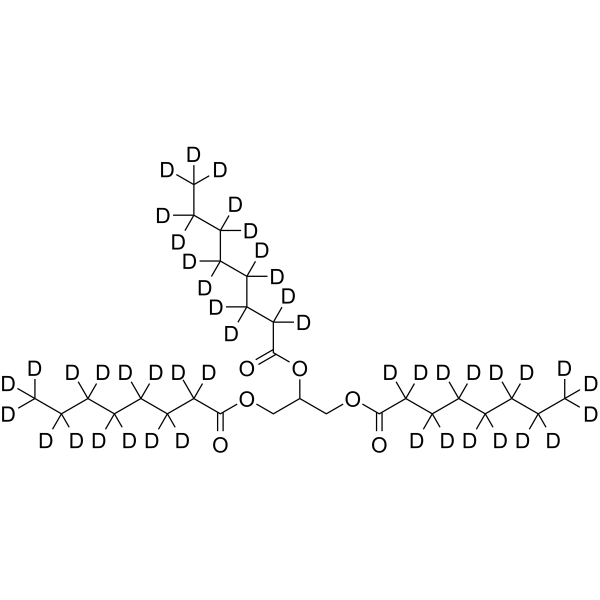
Physicochemical Properties
| Molecular Formula | C27H5D45O6 |
| Molecular Weight | 515.96 |
| Exact Mass | 515.643 |
| CAS # | 352431-24-4 |
| Related CAS # | Tricaprilin;538-23-8 |
| PubChem CID | 10850 |
| Appearance | Clear, colorless to amber liquid |
| Density | 1.0±0.1 g/cm3 |
| Boiling Point | 508.0±17.0 °C at 760 mmHg |
| Melting Point |
50 °F (NTP, 1992) 10 °C 9.00 to 11.00 °C. @ 760.00 mm Hg |
| Flash Point | 209.3±21.0 °C |
| Vapour Pressure | 0.0±1.3 mmHg at 25°C |
| Index of Refraction | 1.458 |
| LogP | 9.33 |
| Hydrogen Bond Donor Count | 0 |
| Hydrogen Bond Acceptor Count | 6 |
| Rotatable Bond Count | 26 |
| Heavy Atom Count | 33 |
| Complexity | 461 |
| Defined Atom Stereocenter Count | 0 |
| SMILES | O=C(OC(COC(C([2H])([2H])C([2H])([2H])C([2H])([2H])C([2H])([2H])C([2H])([2H])C([2H])([2H])C([2H])([2H])[2H])=O)COC(C([2H])([2H])C([2H])([2H])C([2H])([2H])C([2H])([2H])C([2H])([2H])C([2H])([2H])C([2H])([2H])[2H])=O)C([2H])([2H])C([2H])([2H])C([2H])([2H])C([2H])([2H])C([2H])([2H])C([2H])([2H])C([2H])([2H])[2H] |
| InChi Key | VLPFTAMPNXLGLX-UHFFFAOYSA-N |
| InChi Code | InChI=1S/C27H50O6/c1-4-7-10-13-16-19-25(28)31-22-24(33-27(30)21-18-15-12-9-6-3)23-32-26(29)20-17-14-11-8-5-2/h24H,4-23H2,1-3H3 |
| Chemical Name | 2,3-di(octanoyloxy)propyl octanoate |
| HS Tariff Code | 2934.99.9001 |
| Storage |
Powder-20°C 3 years 4°C 2 years In solvent -80°C 6 months -20°C 1 month |
| Shipping Condition | Room temperature (This product is stable at ambient temperature for a few days during ordinary shipping and time spent in Customs) |
Biological Activity
| ln Vitro | Drug compounds have included stable heavy isotopes of carbon, hydrogen, and other elements, mostly as quantitative tracers while the drugs were being developed. Because deuteration may have an effect on a drug's pharmacokinetics and metabolic properties, it is a cause for concern [1]. |
| ADME/Pharmacokinetics |
Absorption, Distribution and Excretion In the small intestine, most triglycerides are split into monoglycerides, free fatty acids, and glycerol, which are absorbed by the intestinal mucosa. Within the epithelial cells, resynthesized triglycerides collect into globules along with cholesterol and phospholipids and are encased in a protein coat as chylomicrons. Chylomicrons are transported in the lymph to the thoracic duct and eventually to the venous system. The chylomicrons are removed from the blood as they pass through the capillaries of adipose tissue. Fat is stored in adipose cells until it is transported to other tissues as free fatty acids which are used for cellular energy or incorporated into cell membranes. When 14C-labeled long-chain triglycerides are administered intravenously, 25% to 30% of the radiolabel is found in the liver within 30 to 60 minutes, with less than 5% remaining after 24 hours. Lesser amounts of radiolabel are found in the spleen and lungs. After 24 hours, nearly 50% of the radiolabel has been expired in carbon dioxide, with 1% of the carbon label remaining in the brown fat. The concentration of radioactivity in the epididymal fat is less than half that of the brown fat. After absorption, long- chain saturated fatty acids are transported mainly via the intestinal lymph as triglycerides. Fatty acids with 10 or less carbon atoms are transported mainly from the intestine via the portal blood vessels. There are also data indicating that unsaturated long-chain fatty acids are absorbed mainly via the lymph vessels. The skin penetration enhancement of drugs by tricaprylin has been demonstrated in vivo using Wistar rats and in vitro using hairless female mice. ... The drug permeation ratio in the presence of triglycerides increased in the following order: Tricaprylin (C8) > Triolein (CI8) > Tributyrin (C4) > Triacetin (C2). |
| Toxicity/Toxicokinetics |
Non-Human Toxicity Values LD50 Rat (female) 33.3 g/kg LD50 Rat (male) oral 34.2 g/kg LD50 Mouse (female) oral 29.6 g/kg LD50 Mouse (male) oral 34.2 g/kg LD50 Mouse iv 3,700 +/- 194 mg/kg |
| References |
[1]. Impact of Deuterium Substitution on the Pharmacokinetics of Pharmaceuticals. Ann Pharmacother. 2019;53(2):211-216. [2]. Tricaprylin. [3]. Re-thinking Alzheimer's disease therapeutic targets using gene-based tests. EBioMedicine. 2018 Nov;37:461-470. |
| Additional Infomation |
Tricaprylin is an odorless viscous clear colorless to amber-brown liquid. (NTP, 1992) Trioctanoin is a triglyceride obtained by acylation of the three hydroxy groups of glycerol by octanoic acid. Used as an alternative energy source to glucose for patients with mild to moderate Alzheimer's disease. It has a role as an anticonvulsant and a plant metabolite. It is a triglyceride and an octanoate ester. Tricaprilin has been used in trials studying the supportive care and treatment of Alzheimer's Disease. |
Solubility Data
| Solubility (In Vitro) | May dissolve in DMSO (in most cases), if not, try other solvents such as H2O, Ethanol, or DMF with a minute amount of products to avoid loss of samples |
| Solubility (In Vivo) |
Note: Listed below are some common formulations that may be used to formulate products with low water solubility (e.g. < 1 mg/mL), you may test these formulations using a minute amount of products to avoid loss of samples. Injection Formulations (e.g. IP/IV/IM/SC) Injection Formulation 1: DMSO : Tween 80: Saline = 10 : 5 : 85 (i.e. 100 μL DMSO stock solution → 50 μL Tween 80 → 850 μL Saline) *Preparation of saline: Dissolve 0.9 g of sodium chloride in 100 mL ddH ₂ O to obtain a clear solution. Injection Formulation 2: DMSO : PEG300 :Tween 80 : Saline = 10 : 40 : 5 : 45 (i.e. 100 μL DMSO → 400 μLPEG300 → 50 μL Tween 80 → 450 μL Saline) Injection Formulation 3: DMSO : Corn oil = 10 : 90 (i.e. 100 μL DMSO → 900 μL Corn oil) Example: Take the Injection Formulation 3 (DMSO : Corn oil = 10 : 90) as an example, if 1 mL of 2.5 mg/mL working solution is to be prepared, you can take 100 μL 25 mg/mL DMSO stock solution and add to 900 μL corn oil, mix well to obtain a clear or suspension solution (2.5 mg/mL, ready for use in animals). Injection Formulation 4: DMSO : 20% SBE-β-CD in saline = 10 : 90 [i.e. 100 μL DMSO → 900 μL (20% SBE-β-CD in saline)] *Preparation of 20% SBE-β-CD in Saline (4°C,1 week): Dissolve 2 g SBE-β-CD in 10 mL saline to obtain a clear solution. Injection Formulation 5: 2-Hydroxypropyl-β-cyclodextrin : Saline = 50 : 50 (i.e. 500 μL 2-Hydroxypropyl-β-cyclodextrin → 500 μL Saline) Injection Formulation 6: DMSO : PEG300 : castor oil : Saline = 5 : 10 : 20 : 65 (i.e. 50 μL DMSO → 100 μLPEG300 → 200 μL castor oil → 650 μL Saline) Injection Formulation 7: Ethanol : Cremophor : Saline = 10: 10 : 80 (i.e. 100 μL Ethanol → 100 μL Cremophor → 800 μL Saline) Injection Formulation 8: Dissolve in Cremophor/Ethanol (50 : 50), then diluted by Saline Injection Formulation 9: EtOH : Corn oil = 10 : 90 (i.e. 100 μL EtOH → 900 μL Corn oil) Injection Formulation 10: EtOH : PEG300:Tween 80 : Saline = 10 : 40 : 5 : 45 (i.e. 100 μL EtOH → 400 μLPEG300 → 50 μL Tween 80 → 450 μL Saline) Oral Formulations Oral Formulation 1: Suspend in 0.5% CMC Na (carboxymethylcellulose sodium) Oral Formulation 2: Suspend in 0.5% Carboxymethyl cellulose Example: Take the Oral Formulation 1 (Suspend in 0.5% CMC Na) as an example, if 100 mL of 2.5 mg/mL working solution is to be prepared, you can first prepare 0.5% CMC Na solution by measuring 0.5 g CMC Na and dissolve it in 100 mL ddH2O to obtain a clear solution; then add 250 mg of the product to 100 mL 0.5% CMC Na solution, to make the suspension solution (2.5 mg/mL, ready for use in animals). Oral Formulation 3: Dissolved in PEG400 Oral Formulation 4: Suspend in 0.2% Carboxymethyl cellulose Oral Formulation 5: Dissolve in 0.25% Tween 80 and 0.5% Carboxymethyl cellulose Oral Formulation 6: Mixing with food powders Note: Please be aware that the above formulations are for reference only. InvivoChem strongly recommends customers to read literature methods/protocols carefully before determining which formulation you should use for in vivo studies, as different compounds have different solubility properties and have to be formulated differently. (Please use freshly prepared in vivo formulations for optimal results.) |
| Preparing Stock Solutions | 1 mg | 5 mg | 10 mg | |
| 1 mM | 1.9381 mL | 9.6907 mL | 19.3813 mL | |
| 5 mM | 0.3876 mL | 1.9381 mL | 3.8763 mL | |
| 10 mM | 0.1938 mL | 0.9691 mL | 1.9381 mL |