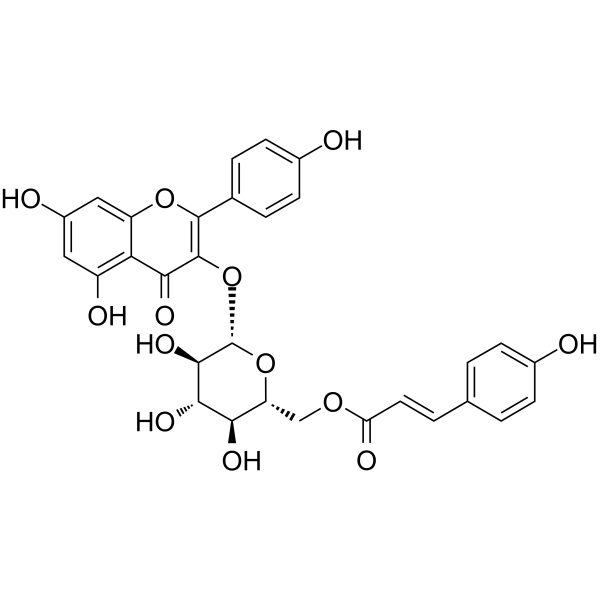
Physicochemical Properties
| Molecular Formula | C30H26O13 |
| Molecular Weight | 594.5196 |
| Exact Mass | 594.137 |
| CAS # | 22153-44-2 |
| PubChem CID | 5320686 |
| Appearance | Light yellow to yellow solid powder |
| Vapour Pressure | 0mmHg at 25°C |
| LogP | 1.725 |
| Hydrogen Bond Donor Count | 7 |
| Hydrogen Bond Acceptor Count | 13 |
| Rotatable Bond Count | 8 |
| Heavy Atom Count | 43 |
| Complexity | 1040 |
| Defined Atom Stereocenter Count | 5 |
| SMILES | C1=CC(=CC=C1/C=C/C(=O)OC[C@@H]2[C@H]([C@@H]([C@H]([C@@H](O2)OC3=C(OC4=CC(=CC(=C4C3=O)O)O)C5=CC=C(C=C5)O)O)O)O)O |
| InChi Key | DVGGLGXQSFURLP-VWMSDXGPSA-N |
| InChi Code | InChI=1S/C30H26O13/c31-16-6-1-14(2-7-16)3-10-22(35)40-13-21-24(36)26(38)27(39)30(42-21)43-29-25(37)23-19(34)11-18(33)12-20(23)41-28(29)15-4-8-17(32)9-5-15/h1-12,21,24,26-27,30-34,36,38-39H,13H2/b10-3+/t21-,24-,26+,27-,30+/m1/s1 |
| Chemical Name | [(2R,3S,4S,5R,6S)-6-[5,7-dihydroxy-2-(4-hydroxyphenyl)-4-oxochromen-3-yl]oxy-3,4,5-trihydroxyoxan-2-yl]methyl (E)-3-(4-hydroxyphenyl)prop-2-enoate |
| HS Tariff Code | 2934.99.9001 |
| Storage |
Powder-20°C 3 years 4°C 2 years In solvent -80°C 6 months -20°C 1 month Note: This product requires protection from light (avoid light exposure) during transportation and storage. |
| Shipping Condition | Room temperature (This product is stable at ambient temperature for a few days during ordinary shipping and time spent in Customs) |
Biological Activity
| Targets |
Tribuloside exhibits estrogen-like activity by interacting with estrogen receptors [1] Tribuloside exerts antimycobacterial and antioxidant effects [2] |
| ln Vitro |
Tribuloside (128 μg/mL) showed inhibitory activity against Mycobacterium tuberculosis H37Rv with a minimum inhibitory concentration (MIC) of 128 μg/mL [2] Tribuloside (25 μg/mL–100 μg/mL) exhibited dose-dependent antioxidant activity: it scavenged DPPH radicals with an IC50 of 42.5 μg/mL, and showed a ferric reducing antioxidant power (FRAP) value of 125 μmol Fe²⁺/g at 100 μg/mL [2] Tribuloside (50 μg/mL) inhibited the growth of Mycobacterium smegmatis with an inhibition rate of 38% after 72 hours of incubation [2] |
| ln Vivo |
In ovariectomized rats (model of estrogen deficiency), oral administration of Tribuloside (100 mg/kg, 200 mg/kg) once daily for 30 days exhibited estrogen-like effects: the 200 mg/kg dose increased uterine weight by 46% compared to the model group, elevated serum estradiol (E2) levels from 21.3 pg/mL to 48.7 pg/mL, and improved vaginal epithelial cell cornification rate (from 12% to 38%) [1] Tribuloside (200 mg/kg, p.o., q.d.) alleviated osteoporosis-related changes in ovariectomized rats, increasing bone mineral density (BMD) of the lumbar spine by 18% compared to the model group [1] |
| Enzyme Assay |
DPPH radical scavenging assay: Tribuloside was dissolved in ethanol to prepare concentrations of 25 μg/mL–100 μg/mL. Each concentration was mixed with DPPH ethanol solution (0.1 mM) and incubated in the dark at 25°C for 30 minutes. The absorbance was measured at 517 nm, and the scavenging rate was calculated. IC50 value was obtained by fitting the dose-response curve [2] Antimycobacterial activity assay: Mycobacterium tuberculosis H37Rv and Mycobacterium smegmatis were cultured in liquid medium. Tribuloside was added to final concentrations of 32 μg/mL–256 μg/mL, and the cultures were incubated at 37°C for 72 hours. Bacterial growth was assessed by measuring absorbance at 600 nm, and MIC value was determined as the lowest concentration inhibiting 90% of bacterial growth [2] FRAP antioxidant assay: Tribuloside solutions (25 μg/mL–100 μg/mL) were mixed with FRAP reagent (containing ferric tripyridyltriazine, TPTZ) and incubated at 37°C for 10 minutes. The absorbance was measured at 593 nm, and the antioxidant capacity was expressed as μmol Fe²⁺ equivalent per gram of sample [2] |
| Animal Protocol |
Ovariectomized rat model (estrogen deficiency): Female Sprague-Dawley rats were subjected to bilateral ovariectomy to establish the estrogen deficiency model. After 1 week of recovery, rats were randomized into model group, low-dose Tribuloside group (100 mg/kg), and high-dose Tribuloside group (200 mg/kg) (n=10/group). Tribuloside was dissolved in 0.5% carboxymethylcellulose sodium (CMC-Na) solution and administered orally once daily for 30 days. The model group received equal volume of 0.5% CMC-Na solution. At the end of the experiment, rats were sacrificed to collect uteri, serum, and bone samples for related index detection [1] |
| References |
[1]. Medicine composition with total tribuloside possessing effect similar to female bormone and its prepn process. Patent CN1706469A. [2]. A new cinnamoylglycoflavonoid, antimycobacterial and antioxidant constituents from Heritiera littoralis leaf extracts. Nat Prod Res. 2014;28(6):351-8. |
| Additional Infomation |
Tribuloside is a glycosyloxyflavone that is kaempferol attached to a 6-O-[(2E)-3-(4-hydroxyphenyl)prop-2-enoyl]-beta-D-glucopyranosyl residue at position 3 via a glycosidic linkage. It has a role as a plant metabolite. It is a glycosyloxyflavone, a cinnamate ester, a trihydroxyflavone and a monosaccharide derivative. It is functionally related to a kaempferol and a trans-4-coumaric acid. Tiliroside has been reported in Daphne genkwa, Leonurus japonicus, and other organisms with data available. Tribuloside is a natural glycoflavonoid isolated from plants such as Tribulus terrestris L. (tribulus) and Heritiera littoralis Dryand. (looking-glass tree) [1,2] Its estrogen-like mechanism is proposed to involve binding to estrogen receptors (ERα/ERβ), thereby regulating estrogen-responsive genes and exerting protective effects on reproductive organs and bones in estrogen-deficient animals [1] Tribuloside exhibits potential application in the treatment of menopause syndrome due to its estrogen-like activity, and may be developed as an antimicrobial and antioxidant agent for related infections or oxidative stress-related diseases [1,2] The antimycobacterial activity of Tribuloside suggests its potential in combating Mycobacterium tuberculosis infections, while its antioxidant property is attributed to the ability to scavenge free radicals and reduce oxidative damage [2] |
Solubility Data
| Solubility (In Vitro) | DMSO : ~125 mg/mL (~210.25 mM) |
| Solubility (In Vivo) |
Solubility in Formulation 1: ≥ 2.5 mg/mL (4.21 mM) (saturation unknown) in 10% DMSO + 40% PEG300 +5% Tween-80 + 45% Saline (add these co-solvents sequentially from left to right, and one by one), clear solution. For example, if 1 mL of working solution is to be prepared, you can add 100 μL of 25.0 mg/mL clear DMSO stock solution to 400 μL PEG300 and mix evenly; then add 50 μL Tween-80 + to the above solution and mix evenly; then add 450 μL normal saline to adjust the volume to 1 mL. Preparation of saline: Dissolve 0.9 g of sodium chloride in 100 mL ddH₂ O to obtain a clear solution. (Please use freshly prepared in vivo formulations for optimal results.) |
| Preparing Stock Solutions | 1 mg | 5 mg | 10 mg | |
| 1 mM | 1.6820 mL | 8.4101 mL | 16.8203 mL | |
| 5 mM | 0.3364 mL | 1.6820 mL | 3.3641 mL | |
| 10 mM | 0.1682 mL | 0.8410 mL | 1.6820 mL |