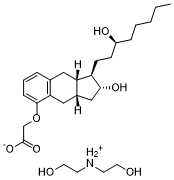
Treprostinil diethanolamine, EP2, DP1 and IP agonist with antihypertensive effects. IT activates EP2, DP1, IP, EP1, EP4, EP3 and FP with Ki values of 3.6, 4.4, 32.1, 212, 826, 2505 and 4680 nM, respectively.
Physicochemical Properties
| Molecular Formula | C27H45NO7 |
| Molecular Weight | 495.65 |
| Exact Mass | 495.32 |
| Elemental Analysis | C, 65.43; H, 9.15; N, 2.83; O, 22.59 |
| CAS # | 830354-48-8 |
| Related CAS # | Treprostinil;81846-19-7;Treprostinil sodium;289480-64-4 |
| PubChem CID | 11179459 |
| Appearance | Solid powder |
| Hydrogen Bond Donor Count | 6 |
| Hydrogen Bond Acceptor Count | 8 |
| Rotatable Bond Count | 14 |
| Heavy Atom Count | 35 |
| Complexity | 524 |
| Defined Atom Stereocenter Count | 5 |
| SMILES | CCCCC[C@@H](CC[C@@H]1[C@H]2CC3=C(C[C@H]2C[C@H]1O)C(=CC=C3)OCC(=O)O)O.C(CO)NCCO |
| InChi Key | RHWRWEUCEXUUAV-ZSESPEEFSA-N |
| InChi Code | InChI=1S/C23H34O5.C4H11NO2/c1-2-3-4-7-17(24)9-10-18-19-11-15-6-5-8-22(28-14-23(26)27)20(15)12-16(19)13-21(18)256-3-1-5-2-4-7/h5-6,8,16-19,21,24-25H,2-4,7,9-14H2,1H3,(H,26,27)5-7H,1-4H2/t16-,17-,18+,19-,21+/m0./s1 |
| Chemical Name | 2-((1R,2R,3aS,9aS)-2-Hydroxy-1-(3(S)-hydroxyoctyl)-2,3,3a,4,9,9a-hexahydro-1H-cyclopenta(b)naphthalen-5-yloxy)acetic acid diethanolamine salt |
| Synonyms | UT15C; UT-15C;Treprostinil diolamine; 830354-48-8; Treprostinil diethanolamine; UT-15C; treprostinil diolamin; Orenitram; UNII-H1FKG90039; Treprostinil diolamine [USAN]; UT 15C |
| HS Tariff Code | 2934.99.9001 |
| Storage |
Powder-20°C 3 years 4°C 2 years In solvent -80°C 6 months -20°C 1 month |
| Shipping Condition | Room temperature (This product is stable at ambient temperature for a few days during ordinary shipping and time spent in Customs) |
Biological Activity
| Targets | IP Receptor ( EC50 = 1.9 nM ); TP Receptor ( EC50 = 919 nM ); IP Receptor ( Ki = 32.1 nM ); IP Receptor ( Ki = 4680 nM ) |
| ln Vitro | With EC50 values of 0.6 nM, 6.2 nM, and 1.9 nM, respectively, 36-vs, trezostinil diethanolamine (UT-15C; 0.001-10,000 nM; 60 minutes; HEK293 cells) potently activates IP receptors, DP1 and EP2 receptors, and IP receptors. The activity of the EP3 receptor is 95 times lower, the activity of the EP4 receptor is 95 times lower, and the activity of the EP1 site is 150 times lower than that of IP receptors [1]. Human and mouse hematopoietic stem and progenitor cells (HSPCs) accumulate more cAMP when treated with treprostinil diethanolamine (10 μM) [2]. The effects of SDF-1 are enhanced by treprostinil diethanolamine (10 μM; 2–6 hours; PC3 cells) through CXCR4 [2]. |
| ln Vivo | The administration of treprostinil diethanolamine (UT-15C; 0.15 mg/kg; i.h.; every 8 hours; for 10 days; BALB/c mice) improves bone marrow reconstitution and HSPC repopulation [2]. In lethally irradiated recipient mice, treprostinil diethanolamine (0.15 mg/kg) administered intravenously every 8 hours for 10 days increases survival [2]. Male Lewis rats treated with treprostinil diethanolamine (0.1 mg/kg; ih; 24 h) had increased expression of IL-10 and decreased mRNA expression of TNF-α and IFN-γ [3]. |
| Animal Protocol |
Animal/Disease Models: balb/c (Bagg ALBino) mouse [2] Doses: 0.15 mg/kg Route of Administration: subcutaneous injection; every 8 hrs (hrs (hours)); for 10 days Experimental Results: Increased survival rate of recipient mice exposed to lethal radiation. Animal/Disease Models: Male Lewis rat [3] Doses: 0.1 mg/kg Route of Administration: subcutaneous injection; 24-hour Experimental Results: The mRNA expression of TNF-α and IFN-γ diminished, and the expression of IL-10 increased. |
| Toxicity/Toxicokinetics |
Effects During Pregnancy and Lactation ◉ Summary of Use during Lactation One patient taking treprostinil breastfed her infant for one year without any complications. However, until more data are available, treprostinil should only be used with careful monitoring during breastfeeding. ◉ Effects in Breastfed Infants A woman developed pulmonary artery hypertension and was treated with intravenous treprostinil beginning at 32 weeks of gestation and titrated up to 26 ng/kg/min. The dose was nearly doubled postpartum because of worsening symptoms. She breastfed (extent not stated) her infant for one year with no apparent drug-related problems, although there was concern for obesity at 6 months of age. The infant was healthy and developing normally at 2 years of age. ◉ Effects on Lactation and Breastmilk Relevant published information was not found as of the revision date. |
| References |
[1]. Whittle BJ, et, al. Binding and activity of the prostacyclin receptor (IP) agonists, treprostinil and iloprost, at human prostanoid receptors: treprostinil is a potent DP1 and EP2 agonist. Biochem Pharmacol. 2012 Jul 1;84(1):68-75. [2]. Kazemi Z, et, al. Repurposing Treprostinil for Enhancing Hematopoietic Progenitor Cell Transplantation. Mol Pharmacol. 2016 Jun;89(6):630-44. [3]. Ghonem N, et, al. Treprostinil, a prostacyclin analog, ameliorates ischemia-reperfusion injury in rat orthotopic liver transplantation. Am J Transplant. 2011 Nov;11(11):2508-16. |
| Additional Infomation |
See also: Treprostinil (has active moiety). Drug Indication Treatment of pulmonary hypertension |
Solubility Data
| Solubility (In Vitro) | May dissolve in DMSO (in most cases), if not, try other solvents such as H2O, Ethanol, or DMF with a minute amount of products to avoid loss of samples |
| Solubility (In Vivo) |
Note: Listed below are some common formulations that may be used to formulate products with low water solubility (e.g. < 1 mg/mL), you may test these formulations using a minute amount of products to avoid loss of samples. Injection Formulations (e.g. IP/IV/IM/SC) Injection Formulation 1: DMSO : Tween 80: Saline = 10 : 5 : 85 (i.e. 100 μL DMSO stock solution → 50 μL Tween 80 → 850 μL Saline) *Preparation of saline: Dissolve 0.9 g of sodium chloride in 100 mL ddH ₂ O to obtain a clear solution. Injection Formulation 2: DMSO : PEG300 :Tween 80 : Saline = 10 : 40 : 5 : 45 (i.e. 100 μL DMSO → 400 μLPEG300 → 50 μL Tween 80 → 450 μL Saline) Injection Formulation 3: DMSO : Corn oil = 10 : 90 (i.e. 100 μL DMSO → 900 μL Corn oil) Example: Take the Injection Formulation 3 (DMSO : Corn oil = 10 : 90) as an example, if 1 mL of 2.5 mg/mL working solution is to be prepared, you can take 100 μL 25 mg/mL DMSO stock solution and add to 900 μL corn oil, mix well to obtain a clear or suspension solution (2.5 mg/mL, ready for use in animals). Injection Formulation 4: DMSO : 20% SBE-β-CD in saline = 10 : 90 [i.e. 100 μL DMSO → 900 μL (20% SBE-β-CD in saline)] *Preparation of 20% SBE-β-CD in Saline (4°C,1 week): Dissolve 2 g SBE-β-CD in 10 mL saline to obtain a clear solution. Injection Formulation 5: 2-Hydroxypropyl-β-cyclodextrin : Saline = 50 : 50 (i.e. 500 μL 2-Hydroxypropyl-β-cyclodextrin → 500 μL Saline) Injection Formulation 6: DMSO : PEG300 : castor oil : Saline = 5 : 10 : 20 : 65 (i.e. 50 μL DMSO → 100 μLPEG300 → 200 μL castor oil → 650 μL Saline) Injection Formulation 7: Ethanol : Cremophor : Saline = 10: 10 : 80 (i.e. 100 μL Ethanol → 100 μL Cremophor → 800 μL Saline) Injection Formulation 8: Dissolve in Cremophor/Ethanol (50 : 50), then diluted by Saline Injection Formulation 9: EtOH : Corn oil = 10 : 90 (i.e. 100 μL EtOH → 900 μL Corn oil) Injection Formulation 10: EtOH : PEG300:Tween 80 : Saline = 10 : 40 : 5 : 45 (i.e. 100 μL EtOH → 400 μLPEG300 → 50 μL Tween 80 → 450 μL Saline) Oral Formulations Oral Formulation 1: Suspend in 0.5% CMC Na (carboxymethylcellulose sodium) Oral Formulation 2: Suspend in 0.5% Carboxymethyl cellulose Example: Take the Oral Formulation 1 (Suspend in 0.5% CMC Na) as an example, if 100 mL of 2.5 mg/mL working solution is to be prepared, you can first prepare 0.5% CMC Na solution by measuring 0.5 g CMC Na and dissolve it in 100 mL ddH2O to obtain a clear solution; then add 250 mg of the product to 100 mL 0.5% CMC Na solution, to make the suspension solution (2.5 mg/mL, ready for use in animals). Oral Formulation 3: Dissolved in PEG400 Oral Formulation 4: Suspend in 0.2% Carboxymethyl cellulose Oral Formulation 5: Dissolve in 0.25% Tween 80 and 0.5% Carboxymethyl cellulose Oral Formulation 6: Mixing with food powders Note: Please be aware that the above formulations are for reference only. InvivoChem strongly recommends customers to read literature methods/protocols carefully before determining which formulation you should use for in vivo studies, as different compounds have different solubility properties and have to be formulated differently. (Please use freshly prepared in vivo formulations for optimal results.) |
| Preparing Stock Solutions | 1 mg | 5 mg | 10 mg | |
| 1 mM | 2.0176 mL | 10.0878 mL | 20.1755 mL | |
| 5 mM | 0.4035 mL | 2.0176 mL | 4.0351 mL | |
| 10 mM | 0.2018 mL | 1.0088 mL | 2.0176 mL |