Physicochemical Properties
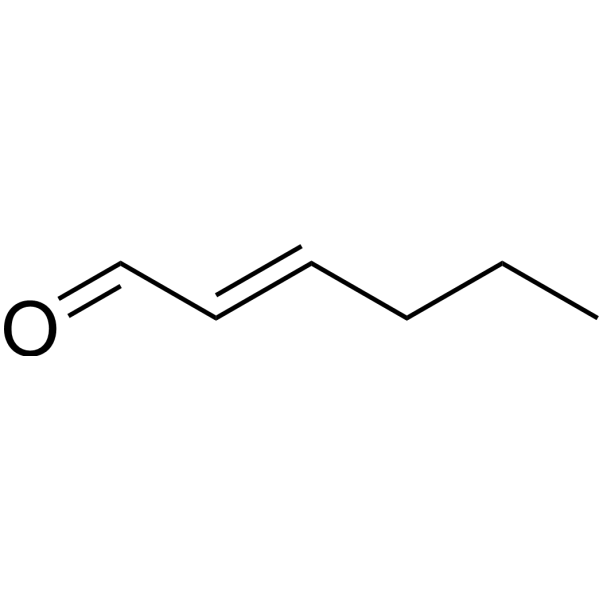
| Molecular Formula | C₆H₁₀O |
| Molecular Weight | 98.14 |
| Exact Mass | 98.073 |
| CAS # | 6728-26-3 |
| PubChem CID | 5281168 |
| Appearance | Colorless to light yellow liquid |
| Density | 0.8±0.1 g/cm3 |
| Boiling Point | 146.5±0.0 °C at 760 mmHg |
| Flash Point | 38.3±0.0 °C |
| Vapour Pressure | 4.6±0.2 mmHg at 25°C |
| Index of Refraction | 1.422 |
| LogP | 1.58 |
| Hydrogen Bond Donor Count | 0 |
| Hydrogen Bond Acceptor Count | 1 |
| Rotatable Bond Count | 3 |
| Heavy Atom Count | 7 |
| Complexity | 64.6 |
| Defined Atom Stereocenter Count | 0 |
| SMILES | O=C([H])/C(/[H])=C(\[H])/C([H])([H])C([H])([H])C([H])([H])[H] |
| InChi Key | MBDOYVRWFFCFHM-SNAWJCMRSA-N |
| InChi Code | InChI=1S/C6H10O/c1-2-3-4-5-6-7/h4-6H,2-3H2,1H3/b5-4+ |
| Chemical Name | (E)-hex-2-enal |
| Synonyms | Trans2Hexenal; Trans 2 Hexenal |
| HS Tariff Code | 2934.99.9001 |
| Storage |
Powder-20°C 3 years 4°C 2 years In solvent -80°C 6 months -20°C 1 month Note: Please store this product in a sealed and protected environment (e.g. under nitrogen), avoid exposure to moisture. |
| Shipping Condition | Room temperature (This product is stable at ambient temperature for a few days during ordinary shipping and time spent in Customs) |
Biological Activity
| ADME/Pharmacokinetics |
Metabolism / Metabolites Uremic toxins tend to accumulate in the blood either through dietary excess or through poor filtration by the kidneys. Most uremic toxins are metabolic waste products and are normally excreted in the urine or feces. |
| Toxicity/Toxicokinetics |
Toxicity Summary Uremic toxins such as 2-Hexenal are actively transported into the kidneys via organic ion transporters (especially OAT3). Increased levels of uremic toxins can stimulate the production of reactive oxygen species. This seems to be mediated by the direct binding or inhibition by uremic toxins of the enzyme NADPH oxidase (especially NOX4 which is abundant in the kidneys and heart) (A7868). Reactive oxygen species can induce several different DNA methyltransferases (DNMTs) which are involved in the silencing of a protein known as KLOTHO. KLOTHO has been identified as having important roles in anti-aging, mineral metabolism, and vitamin D metabolism. A number of studies have indicated that KLOTHO mRNA and protein levels are reduced during acute or chronic kidney diseases in response to high local levels of reactive oxygen species (A7869). |
| References |
[1]. Determination of plasma, urine, and bovine serum albumin low-molecular-weight carbonyl levels by capillary gas chromatography with electron-capture and mass-selective detection.Anal Biochem. 2005 Mar 1;338(1):62-70. |
| Additional Infomation |
(2E)-hexenal is a 2-hexenal in which the olefinic double bond has E configuration. It occurs naturally in a wide range of fruits, vegetables, and spices. It has a role as a flavouring agent, an antibacterial agent and a plant metabolite. 2-Hexenal has been reported in Camellia sinensis, Aethus indicus, and other organisms with data available. 2-Hexenal is a uremic toxin. Uremic toxins can be subdivided into three major groups based upon their chemical and physical characteristics: 1) small, water-soluble, non-protein-bound compounds, such as urea; 2) small, lipid-soluble and/or protein-bound compounds, such as the phenols and 3) larger so-called middle-molecules, such as beta2-microglobulin. Chronic exposure of uremic toxins can lead to a number of conditions including renal damage, chronic kidney disease and cardiovascular disease. 2-Hexenal is found in allspice. 2-Hexenal is used in perfumery and flavourings. 2-Hexenal belongs to the family of Medium-chain Aldehydes. These are An aldehyde with a chain length containing between 6 and 12 carbon atoms. |
Solubility Data
| Solubility (In Vitro) | DMSO : ~50 mg/mL (~509.48 mM) |
| Solubility (In Vivo) |
Solubility in Formulation 1: ≥ 2.5 mg/mL (25.47 mM) (saturation unknown) in 10% DMSO + 40% PEG300 + 5% Tween80 + 45% Saline (add these co-solvents sequentially from left to right, and one by one), clear solution. For example, if 1 mL of working solution is to be prepared, you can add 100 μL of 25.0 mg/mL clear DMSO stock solution to 400 μL PEG300 and mix evenly; then add 50 μL Tween-80 to the above solution and mix evenly; then add 450 μL normal saline to adjust the volume to 1 mL. Preparation of saline: Dissolve 0.9 g of sodium chloride in 100 mL ddH₂ O to obtain a clear solution. Solubility in Formulation 2: 2.5 mg/mL (25.47 mM) in 10% DMSO + 90% (20% SBE-β-CD in Saline) (add these co-solvents sequentially from left to right, and one by one), suspension solution; with ultrasonication. For example, if 1 mL of working solution is to be prepared, you can add 100 μL of 25.0 mg/mL clear DMSO stock solution to 900 μL of 20% SBE-β-CD physiological saline solution and mix evenly. Preparation of 20% SBE-β-CD in Saline (4°C,1 week): Dissolve 2 g SBE-β-CD in 10 mL saline to obtain a clear solution. Solubility in Formulation 3: ≥ 2.5 mg/mL (25.47 mM) (saturation unknown) in 10% DMSO + 90% Corn Oil (add these co-solvents sequentially from left to right, and one by one), clear solution. For example, if 1 mL of working solution is to be prepared, you can add 100 μL of 25.0 mg/mL clear DMSO stock solution to 900 μL of corn oil and mix evenly. (Please use freshly prepared in vivo formulations for optimal results.) |
| Preparing Stock Solutions | 1 mg | 5 mg | 10 mg | |
| 1 mM | 10.1895 mL | 50.9476 mL | 101.8953 mL | |
| 5 mM | 2.0379 mL | 10.1895 mL | 20.3791 mL | |
| 10 mM | 1.0190 mL | 5.0948 mL | 10.1895 mL |