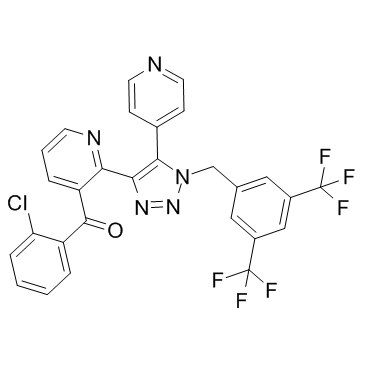
Tradipitant (formerly also known as VLY-686 and LY-686017) is novel, potent and 2nd generation neurokinin-1 (NK-1) receptor antagonist, which showed activity in preclinical anxiety models. LY686017 has the potential for treating alcoholism. LY686017 can be also served as a suitable chemical platform for future imaging ligand development.
On Dec. 30, 2025, Vanda Pharmaceuticals Inc. (Vanda) (Nasdaq: VNDA) announced that the U.S. Food and Drug Administration (FDA) has approved NEREUS™ (tradipitant), an oral neurokinin-1 (NK-1) receptor antagonist, for the prevention of vomiting induced by motion. This approval marks the first new pharmacologic treatment in motion sickness in over four decades, representing a significant advancement in the understanding and management of this debilitating physiologic response that affects a substantial portion of the population and has long been recognized as a factor affecting military operational readiness. "This approval underscores the strong scientific evidence in the antiemetic effects of NEREUS™ in motion sickness," said Mihael H. Polymeropoulos, M.D., President, CEO and Chairman of the Board of Vanda Pharmaceuticals. "For the first time in over 40 years, patients have access to a novel therapy grounded in modern neuropharmacology, offering effective prevention without the limitations of existing options. We are proud of this historic milestone and grateful to the Vanda researchers, patients, investigators, and regulators who contributed to this achievement."Physicochemical Properties
| Molecular Formula | C28H16CLF6N5O |
| Molecular Weight | 587.902965545654 |
| Exact Mass | 587.094 |
| Elemental Analysis | C, 57.20; H, 2.74; Cl, 6.03; F, 19.39; N, 11.91; O, 2.72 |
| CAS # | 622370-35-8 |
| PubChem CID | 9916461 |
| Appearance | Light brown to gray solid powder |
| Density | 1.5±0.1 g/cm3 |
| Boiling Point | 640.9±65.0 °C at 760 mmHg |
| Flash Point | 341.4±34.3 °C |
| Vapour Pressure | 0.0±1.9 mmHg at 25°C |
| Index of Refraction | 1.613 |
| LogP | 4.46 |
| Hydrogen Bond Donor Count | 0 |
| Hydrogen Bond Acceptor Count | 11 |
| Rotatable Bond Count | 6 |
| Heavy Atom Count | 41 |
| Complexity | 865 |
| Defined Atom Stereocenter Count | 0 |
| SMILES | C1=CC=C(C(=C1)C(=O)C2=C(N=CC=C2)C3=C(N(N=N3)CC4=CC(=CC(=C4)C(F)(F)F)C(F)(F)F)C5=CC=NC=C5)Cl |
| InChi Key | CAVRKWRKTNINFF-UHFFFAOYSA-N |
| InChi Code | InChI=1S/C28H16ClF6N5O/c29-22-6-2-1-4-20(22)26(41)21-5-3-9-37-23(21)24-25(17-7-10-36-11-8-17)40(39-38-24)15-16-12-18(27(30,31)32)14-19(13-16)28(33,34)35/h1-14H,15H2 |
| Chemical Name | (2-(1-(3,5-bis(trifluoromethyl)benzyl)-5-(pyridin-4-yl)-1H-1,2,3-triazol-4-yl)pyridin-3-yl)(2-chlorophenyl)methanone |
| Synonyms | LY686017; LY 686017; LY686017; VLY 686; VLY686; VLY686. |
| HS Tariff Code | 2934.99.9001 |
| Storage |
Powder-20°C 3 years 4°C 2 years In solvent -80°C 6 months -20°C 1 month |
| Shipping Condition | Room temperature (This product is stable at ambient temperature for a few days during ordinary shipping and time spent in Customs) |
Biological Activity
| Targets |
NK-1/neurokinin-1 receptor LY686017 is a potent and selective antagonist of the neurokinin-1 (NK-1) receptor. [1] |
| ln Vitro |
The findings demonstrated that Tradipitant ([3H]-LY686017) bound to guinea pig brain slices in a manner resembling the previously documented distribution of NK-1 receptors. The accessory olfactory nucleus, anteroventral thalamic nucleus, paraventricular hypothalamic nucleus, central amygdala (lateral), and medial amygdala (anterodorsal) are the areas with the highest density [1]. Saturation binding experiments using guinea pig caudate nucleus brain sections and [³H]-LY686017 yielded a mean dissociation constant (Kd) of 0.34 ± 0.11 nM and a maximum binding site density (Bmax) of 31.4 ± 2.3 fmol/mg dry tissue (n=5). [1] Displacement experiments with structurally distinct NK-1 antagonists confirmed the specificity of [³H]-LY686017 binding. The affinities (Ki) of other antagonists were: Lanepitant (0.14 ± 0.032 nM), Vofopitant (0.012 ± 0.002 nM), CP-122,721 (0.015 ± 0.005 nM), and Aprepitant (0.89 ± 0.196 nM). [1] In vitro autoradiography showed that specific [³H]-LY686017 binding sites were distributed throughout the guinea pig forebrain, with high densities in regions such as the accessory olfactory nucleus, anteroventral thalamic nucleus, paraventricular hypothalamic nucleus, and central/lateral amygdala, consistent with the known distribution of NK-1 receptors. [1] |
| ln Vivo |
Through the use of agonist or antagonist radioligands, autoradiography experiments revealed that Tradipitant ([3H]-LY686017) administered intravenously localized in the brain of guinea pigs in a manner resembling that of NK-1 receptors [1]. Tradipitant is an orally bioavailable, centrally-acting, selective, neurokinin 1 receptor (NK1-receptor; NK1R; NK-1R) antagonist with potential anti-emetic, anti-pruritic and anti-inflammatory activities. Upon oral administration, tradipitant competitively binds to and blocks the activity of the NK1R in the central nervous system (CNS), thereby inhibiting the binding of the endogenous ligand and neuropeptide, substance P (SP; neurokinin-1; NK1). This inhibits SP/NK1-mediated signal transduction and may prevent both SP-induced emesis and pruritis. In addition, inhibition of SP/NK1R signaling also reduces neurogenic inflammation which is triggered by the release of neuropeptides, such as substance P, from nerve cells. NK1R is a G protein-coupled receptor (GPCR) that preferentially binds to SP, a neuropeptide secreted by neuronal cells and inflammatory cells. Following intravenous administration of [³H]-LY686017 to guinea pigs, radioactivity accumulated in the brain. Time-course studies showed that the ratio of radioactivity in the striatum (high NK-1 density) to the cerebellum (low NK-1 density) was optimal at 2 hours post-injection, with a ratio of approximately 6.5:1. [1] The accumulation of [³H]-LY686017 in the striatum was dose-dependently reduced by pre-treatment with the NK-1 antagonist Aprepitant (administered intraperitoneally 1 hour before the radioligand). Significant inhibition was observed at doses of 0.3, 1, 3, and 10 mg/kg of Aprepitant. A dose of 10 mg/kg Aprepitant produced an approximate 70% reduction in striatal radioactivity. [1] Ex vivo autoradiography after intravenous administration of [³H]-LY686017 showed a distribution of radioactivity in the guinea pig brain virtually identical to the pattern seen in vitro and to the known distribution of NK-1 receptors. High levels were observed in regions such as the central amygdala, paraventricular hypothalamic nucleus, and external plexiform layer of the olfactory bulb. [1] |
| Animal Protocol |
In vitro binding and autoradiography: Male Hartley guinea pig brains were frozen, sectioned at 12 µm thickness, and thaw-mounted onto slides. For saturation and competition binding, sections were preincubated for 30 min in modified Kreb's phosphate buffer, then incubated with various concentrations of [³H]-LY686017 (for saturation) or with 0.3 nM [³H]-LY686017 plus displacing compounds (for competition) for 60 min at room temperature. Sections were then rinsed twice for 10 min each in ice-cold buffer without bacitracin or BSA, dipped in ice-cold distilled water, wiped off, and counted by liquid scintillation. Nonspecific binding was defined using 1 µM LY303870. [1] For in vitro autoradiography, sections were incubated with 0.3 nM [³H]-LY686017, rinsed, dried, and apposed to tritium-sensitive phosphorimaging plates for 92-96 hours. [1] In vivo distribution and occupancy: Male Hartley guinea pigs (550-650 g) were implanted with jugular catheters. [³H]-LY686017 (25 µCi for time-course/displacement studies; 100 µCi for autoradiography) was administered intravenously via the catheter. For displacement studies, animals were pretreated intraperitoneally with vehicle or Aprepitant (0.03 to 10 mg/kg, in 1% CMC with 0.5% SLS) 1 hour before radioligand administration. Animals were euthanized 2 hours post-injection. For tissue counting, the striatum and cerebellum were dissected, weighed, digested, and counted. For ex vivo autoradiography, whole brains were removed, frozen, sectioned at 12 µm, thaw-mounted, and apposed to phosphorimaging plates for 4-9 weeks. [1] |
| References |
[1]. In vitro and ex vivo autoradiography of the NK-1 antagonist [3H]-LY686017 in Guinea pig brain. Neuropeptides. 2011 Apr;45(2):157-64. |
| Additional Infomation |
Tradipitant has been used in trials studying the treatment and prevention of Eczema, Pruritus, Gastroparesis, Chronic Pruritus, and Atopic Dermatitis, among others. Tradipitant is an orally bioavailable, centrally-acting, selective, neurokinin 1 receptor (NK1-receptor; NK1R; NK-1R) antagonist with potential anti-emetic, anti-pruritic and anti-inflammatory activities. Upon oral administration, tradipitant competitively binds to and blocks the activity of the NK1R in the central nervous system (CNS), thereby inhibiting the binding of the endogenous ligand and neuropeptide, substance P (SP; neurokinin-1; NK1). This inhibits SP/NK1-mediated signal transduction and may prevent both SP-induced emesis and pruritis. In addition, inhibition of SP/NK1R signaling also reduces neurogenic inflammation which is triggered by the release of neuropeptides, such as substance P, from nerve cells. NK1R is a G protein-coupled receptor (GPCR) that preferentially binds to SP, a neuropeptide secreted by neuronal cells and inflammatory cells. LY686017 is a centrally active NK-1 receptor antagonist. The study aimed to evaluate its potential as a platform for developing a brain imaging ligand (e.g., for PET) to measure NK-1 receptor occupancy in vivo. [1] NK-1 receptor antagonists have shown clinical efficacy in treating chemotherapy-induced nausea and vomiting (CINV). LY686017 has been evaluated in clinical studies for other indications, including social anxiety disorder, irritable bowel syndrome, and alcoholism. In a study with detoxified alcoholic inpatients, 50 mg/day LY686017 reduced spontaneous alcohol cravings and blunted cue-induced cravings. [1] The distribution of NK-1 receptors labeled by LY686017 in guinea pig brain correlates with regions implicated in stress, emotion, and reward processing. [1] |
Solubility Data
| Solubility (In Vitro) | DMSO : ~100 mg/mL (~170.10 mM) |
| Solubility (In Vivo) |
Solubility in Formulation 1: ≥ 2.5 mg/mL (4.25 mM) (saturation unknown) in 10% DMSO + 90% Corn Oil (add these co-solvents sequentially from left to right, and one by one), clear solution. For example, if 1 mL of working solution is to be prepared, you can add 100 μL of 25.0 mg/mL clear DMSO stock solution to 900 μL of corn oil and mix evenly. (Please use freshly prepared in vivo formulations for optimal results.) |
| Preparing Stock Solutions | 1 mg | 5 mg | 10 mg | |
| 1 mM | 1.7010 mL | 8.5048 mL | 17.0097 mL | |
| 5 mM | 0.3402 mL | 1.7010 mL | 3.4019 mL | |
| 10 mM | 0.1701 mL | 0.8505 mL | 1.7010 mL |