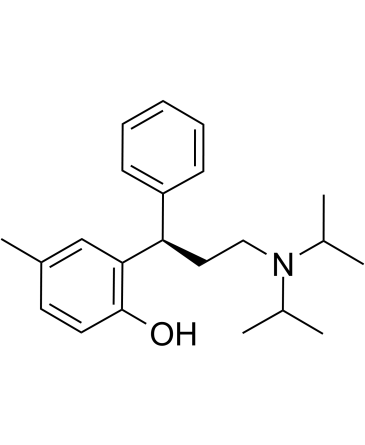
Tolterodine (also known as PNU-200583E) is a tartrate salt of tolterodine that is a potent and competitive muscarinic receptor antagonist. Tolterodines is an antimuscarinic medication used to treat urinary incontinence symptoms. While older antimuscarinic treatments for overactive bladder specifically target M3 receptors, tolterodine acts on both the M2 and M3 subtypes of muscarinic receptors. Tolterodine targets the bladder more than other parts of the body, so even though it acts on all types of receptors, it has fewer side effects than oxybutynin (which is selective for M3 and M1, but more so in the parotid than in the bladder).
Physicochemical Properties
| Molecular Formula | C22H31NO |
| Molecular Weight | 325.48764 |
| Exact Mass | 325.24 |
| Elemental Analysis | C, 81.18; H, 9.60; N, 4.30; O, 4.92 |
| CAS # | 124937-51-5 |
| Related CAS # | Tolterodine tartrate; 124937-52-6; Tolterodine-d14 hydrochloride; 1217645-16-3 |
| PubChem CID | 443879 |
| Appearance | Colorless to light yellow solid powder |
| Density | 1.0±0.1 g/cm3 |
| Boiling Point | 442.2±45.0 °C at 760 mmHg |
| Flash Point | 192.1±27.4 °C |
| Vapour Pressure | 0.0±1.1 mmHg at 25°C |
| Index of Refraction | 1.548 |
| LogP | 5.77 |
| Hydrogen Bond Donor Count | 1 |
| Hydrogen Bond Acceptor Count | 2 |
| Rotatable Bond Count | 7 |
| Heavy Atom Count | 24 |
| Complexity | 340 |
| Defined Atom Stereocenter Count | 1 |
| SMILES | CC(C)N(C(C)C)CC[C@H](C1=CC=CC=C1)C2=C(O)C=CC(C)=C2 |
| InChi Key | OOGJQPCLVADCPB-HXUWFJFHSA-N |
| InChi Code | InChI=1S/C22H31NO/c1-16(2)23(17(3)4)14-13-20(19-9-7-6-8-10-19)21-15-18(5)11-12-22(21)24/h6-12,15-17,20,24H,13-14H2,1-5H3/t20-/m1/s1 |
| Chemical Name | 2-[(1R)-3-[di(propan-2-yl)amino]-1-phenylpropyl]-4-methylphenol |
| Synonyms | Detrusitol; Tolterodine; Detrol; PHA-686464B |
| HS Tariff Code | 2934.99.9001 |
| Storage |
Powder-20°C 3 years 4°C 2 years In solvent -80°C 6 months -20°C 1 month |
| Shipping Condition | Room temperature (This product is stable at ambient temperature for a few days during ordinary shipping and time spent in Customs) |
Biological Activity
| ADME/Pharmacokinetics |
Absorption, Distribution and Excretion Following administration of a 5-mg oral dose of 14C-tolterodine solution to healthy volunteers, 77% of radioactivity was recovered in urine and 17% was recovered in feces in 7 days. 113 ± 26.7 L Metabolism / Metabolites Tolterodine has known human metabolites that include 5-Hydroxymethyl tolterodine and N-Dealkylated tolterodine. Biological Half-Life 1.9-3.7 hours |
| Toxicity/Toxicokinetics |
Hepatotoxicity In multiple randomized controlled trials of tolterodine in patients with overactive bladder syndrome, serum aminotransferase and alkaline phosphatase elevations were not common, arising in less than 1% of treated subjects and in a similar proportion of placebo recipients. In these clinical trials there were no reports of clinically apparent liver injury or jaundice. Since the approval of tolterodine in 1998 and its widescale use (with more than 1 million prescriptions filled yearly in the United States), there has been only one published case report of liver injury with symptoms and jaundice attributed to its use (Case 1). Thus, acute symptomatic liver injury due to tolterodine must be very rare, if it occurs at all. Likelihood score: D (possible, very rare cause of clinically apparent liver injury). Effects During Pregnancy and Lactation ◉ Summary of Use during Lactation No information is available on the use of tolterodine during breastfeeding. Long-term use of tolterodine might reduce milk production or milk letdown. During long-term use, observe for signs of decreased lactation (e.g., insatiety, poor weight gain). ◉ Effects in Breastfed Infants Relevant published information was not found as of the revision date. ◉ Effects on Lactation and Breastmilk Anticholinergics can inhibit lactation in animals, apparently by inhibiting growth hormone and oxytocin secretion. Anticholinergic drugs can also reduce serum prolactin in nonnursing women. The prolactin level in a mother with established lactation may not affect her ability to breastfeed. Protein Binding Approximately 96.3%. |
| References |
[1]. Tolterodine and its active 5-hydroxymethyl metabolite: pure muscarinic receptor antagonists. Pharmacol Toxicol. 2002 May;90(5):260-7. [2]. Biotransformation of tolterodine, a new muscarinic receptor antagonist, in mice, rats, and dogs. Drug Metab Dispos. 1998 Jun;26(6):528-35. [3]. Tolterodine does not affect memory assessed by passive-avoidance response test in mice. Eur J Pharmacol. 2008 Jan 28;579(1-3):225-8. |
| Additional Infomation |
Tolterodine is a tertiary amine. It has a role as a muscarinic antagonist, a muscle relaxant and an antispasmodic drug. It is functionally related to a p-cresol. Tolterodine is an antimuscarinic drug that is used to treat urinary incontinence. Tolterodine acts on M2 and M3 subtypes of muscarinic receptors. Tolterodine is a Cholinergic Muscarinic Antagonist. The mechanism of action of tolterodine is as a Cholinergic Muscarinic Antagonist. Tolterodine is an anticholinergic agent used to treat urinary incontinence and overactive bladder syndrome. Tolterodine therapy has not been associated liver enzyme elevations while only a single case report has been published of clinical apparent acute liver injury attributed to its use. Tolterodine Tartrate is the tartrate salt form of tolterodine, a benzhydryl compound and a muscarinic receptor antagonist possessing both antimuscarinic and antispasmodic properties. Both tolterodine and its active metabolite, 5-hydroxymethyltolterodine, competitively blocks muscarinic receptors, thereby inhibiting acetylcholine receptor binding. This antagonistic action results in an increase in residual urine, reflecting an incomplete emptying of the bladder, and a decrease in detrusor pressure, indicating an antimuscarinic action on the lower urinary tract.. The 5-hydroxymethyl metabolite appears to contribute significantly to the therapeutic effects. Tolterodine is a benzhydryl compound and a muscarinic receptor antagonist possessing both antimuscarinic and antispasmodic properties. Both tolterodine and its active metabolite, 5-hydroxymethyltolterodine, competitively blocks muscarinic receptors, thereby inhibiting acetylcholine binding. This antagonistic action results in an increase in residual urine, reflecting an incomplete emptying of the bladder, and a decrease in detrusor pressure, indicating an antimuscarinic action on the lower urinary tract. The 5-hydroxymethyl metabolite appears to contribute significantly to the therapeutic effects. An ANTIMUSCARINIC AGENT selective for the MUSCARINIC RECEPTORS of the BLADDER that is used in the treatment of URINARY INCONTINENCE and URINARY URGE INCONTINENCE. See also: Tolterodine Tartrate (has salt form). Drug Indication For the treatment of overactive bladder (with symptoms of urinary frequency, urgency, or urge incontinence). FDA Label Mechanism of Action Both tolterodine and its active metabolite, 5-hydroxymethyltolterodine, act as competitive antagonists at muscarinic receptors. This antagonism results in inhibition of bladder contraction, decrease in detrusor pressure, and an incomplete emptying of the bladder. Pharmacodynamics Tolterodine is a competitive muscarinic receptor antagonist. Both urinary bladder contraction and salivation are mediated via cholinergic muscarinic receptors. After oral administration, tolterodine is metabolized in the liver, resulting in the formation of the 5-hydroxymethyl derivative, a major pharmacologically active metabolite. The 5-hydroxymethyl metabolite, which exhibits an antimuscarinic activity similar to that of tolterodine, contributes significantly to the therapeutic effect. Both tolterodine and the 5-hydroxymethyl metabolite exhibit a high specificity for muscarinic receptors, since both show negligible activity or affinity for other neurotransmitter receptors and other potential cellular targets, such as calcium channels. Tolterodine has a pronounced effect on bladder function. The main effects of tolterodine are an increase in residual urine, reflecting an incomplete emptying of the bladder, and a decrease in detrusor pressure, consistent with an antimuscarinic action on the lower urinary tract. |
Solubility Data
| Solubility (In Vitro) |
Ethanol: ~120 mg/mL (~368.7 mM) DMSO: ~100 mg/mL (~307.2 mM) |
| Solubility (In Vivo) |
Solubility in Formulation 1: ≥ 2.08 mg/mL (6.39 mM) (saturation unknown) in 10% DMSO + 40% PEG300 + 5% Tween80 + 45% Saline (add these co-solvents sequentially from left to right, and one by one), clear solution. For example, if 1 mL of working solution is to be prepared, you can add 100 μL of 20.8 mg/mL clear DMSO stock solution to 400 μL PEG300 and mix evenly; then add 50 μL Tween-80 to the above solution and mix evenly; then add 450 μL normal saline to adjust the volume to 1 mL. Preparation of saline: Dissolve 0.9 g of sodium chloride in 100 mL ddH₂ O to obtain a clear solution. Solubility in Formulation 2: ≥ 2.08 mg/mL (6.39 mM) (saturation unknown) in 10% DMSO + 90% (20% SBE-β-CD in Saline) (add these co-solvents sequentially from left to right, and one by one), clear solution. For example, if 1 mL of working solution is to be prepared, you can add 100 μL of 20.8 mg/mL clear DMSO stock solution to 900 μL of 20% SBE-β-CD physiological saline solution and mix evenly. Preparation of 20% SBE-β-CD in Saline (4°C,1 week): Dissolve 2 g SBE-β-CD in 10 mL saline to obtain a clear solution. Solubility in Formulation 3: ≥ 2.08 mg/mL (6.39 mM) (saturation unknown) in 10% DMSO + 90% Corn Oil (add these co-solvents sequentially from left to right, and one by one), clear solution. For example, if 1 mL of working solution is to be prepared, you can add 100 μL of 20.8 mg/mL clear DMSO stock solution to 900 μL of corn oil and mix evenly. (Please use freshly prepared in vivo formulations for optimal results.) |
| Preparing Stock Solutions | 1 mg | 5 mg | 10 mg | |
| 1 mM | 3.0723 mL | 15.3615 mL | 30.7229 mL | |
| 5 mM | 0.6145 mL | 3.0723 mL | 6.1446 mL | |
| 10 mM | 0.3072 mL | 1.5361 mL | 3.0723 mL |