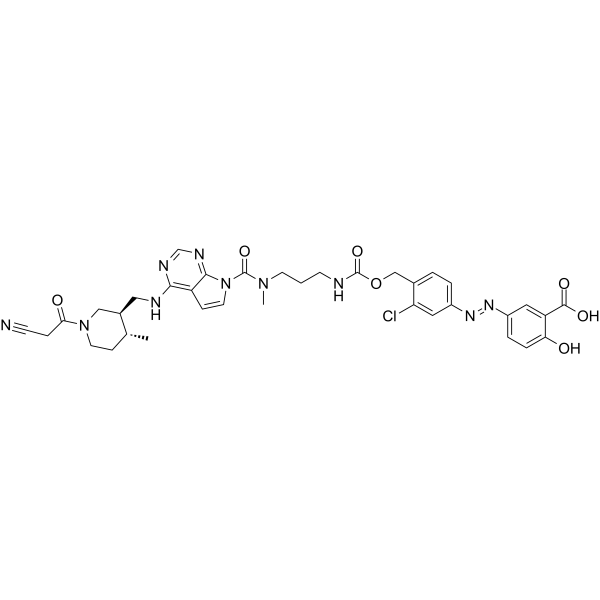
Tofacitinib Prodrug-1 is a novel and orally bioactive colon-targeted Azo prodrug that is designed to mitigate the systemic adverse effects of Tofacitinib. It utilizes 5-ASA-PABA-MAC and 5-ASA-PABA-diamine systems which can effectively attenuate the oxazolone-induced colitis in mice model with low toxicity. Tofacitinib Prodrug-1 has the potential to be used for the treatment of ulcerative colitis.
Physicochemical Properties
| Molecular Formula | C36H39CLN10O7 |
| Molecular Weight | 759.21 |
| Appearance | Typically exists as solid at room temperature |
| HS Tariff Code | 2934.99.9001 |
| Storage |
Powder-20°C 3 years 4°C 2 years In solvent -80°C 6 months -20°C 1 month |
| Shipping Condition | Room temperature (This product is stable at ambient temperature for a few days during ordinary shipping and time spent in Customs) |
Biological Activity
| Targets | JAK | |
| ln Vitro |
|
|
| ln Vivo |
|
|
| Enzyme Assay |
Stability of Prodrugs in Simulated Gastric Fluid and Intestinal Fluid[1] The simulated gastric and intestinal fluids were prepared by adding pepsin into a pH = 1.2 HCl aqueous solution and trypsin into the pH = 6.8 phosphate buffer. The 10 mM stock solutions of compounds 9 and 20a–20g were prepared in DMSO. The reaction was started by adding 10 μL of the stock solutions into the simulated gastric fluid (990 μL) or simulated intestinal fluid (990 μL). Then, the mixtures were incubated at 37 °C. Finally, the reactions were terminated at 0, 2, 5, 8, and 12 h by adding 1 mL of a cooled acetonitrile solution containing the internal standard (IS) sulfasalazine (100 μM). The samples were vortex-mixed and centrifuged for 10 min at 10,000 g at 25 °C to obtain the supernatants, which were directly used for quantitative determination by LC–MS/MS. The mobile phases were consistent with that of the Chemical Stability of the Prodrugs in Aqueous Solutions experimental section. The gradient program setting was as follows: 5% A at 0–10 min, 95% A at 5–10 min, and 5% A at 10–15 min. The flow rate was 0.5 mL/min, and the amount of compound was estimated from the standard curve. Data were presented as means ± SEM. In Vitro Release Studies[1] Male Sprague-Dawley (SD) rats were used. The suspensions of the colon content were prepared by suspending fresh colon contents of male SD rats into a buffer solution containing 0.1 M PBS and 1.5 mg/mL d-glucose (pH 6.8, previously bubbled with nitrogen) to yield 10 wt.% suspension. The 10 mM stock solutions of compounds 9 and 20a–20g and positive control sulfasalazine were prepared in DMSO. The reaction was started by adding the stock solutions of each sample (10 μL) into 0.1 M PBS buffer (990 μL) and 10 wt % suspension of colon content (1 mL). Then, the samples were incubated at 37 °C in a nitrogen atmosphere. Finally, the reactions were terminated at 0, 0.5, 1, 1.5, 2, 3, 4, 5, 6, 7, and 8 h by adding a cooled solution of 6 mL of the IS (sulfasalazine, 100 nM, dissolved in acetonitrile). The samples were vortex-mixed and centrifuged (8000 g, 10 min, 4 °C) and stored frozen (<−15 °C) until analysis to obtain the supernatants, which were directly used for quantitative determination by HPLC. The gradient program setting was consistent with the experimental section of Chemical Stability of the Prodrugs in Aqueous Solutions. The flow rate was 1.0 mL/min. The column temperature was maintained at 25 °C, and the amount of the compound was estimated from the standard curve. The in vitro release AUC(tofacitinib, 0–5h) values and the release rate(tofacitinib, 0–2h) values were calculated by GraphPad software. Data were presented as means ± SEM. |
|
| Animal Protocol |
PK Studies[1] Male SD rats (aged 5–6 weeks, body weight range of 220–250 g, n = 6) were used, and they had free access to food and water and were maintained on a 12-h light/dark cycle in a temperature and humidity-controlled room for 3 days. After fasting for 12 h with free access to water, the rats were randomly divided into two groups. Tofacitinib and compound 20g were suspended in a 0.5% CMC-Na solution, and the rats in both groups were orally administered by gavage with tofacitinib (15 mg/kg) or compound 20g (22.5 mg/kg, equivalent to the dose of tofacitinib), respectively. Food was returned to rats 1 h after the oral administration. Blood samples of the tofacitinib group were collected into heparinized tubes via orbital vein bleeding at 5 min, 15 min, 30 min, 1 h, 2 h, 4 h, 7 h, 10 h, and 12 h postdosing, and blood samples of the compound 20g group were gathered at 1, 2, 4, 6, 8, 12, 14, and 20 h postdosing. Plasma was separated by centrifugation (8000 g, 10 min, 4 °C) and stored frozen (<−15 °C) until analysis. The resulting plasma samples (50 μL) were extracted by adding a cooled solution of 150 μL of acetonitrile containing 10 μL of the IS, and these mixtures were further vortex-mixed and centrifuged at 8000g at 4 °C for 10 min. The resulting supernatants were directly transferred to the autosampler vial for LC–MS/MS analysis. Data were presented as means ± SEM. Intestinal Tissue Distribution Study[1] Male BALB/c mice (aged 5–6 weeks, body weight range: 25–30 g, n = 6) were were kept in a temperature- and humidity-controlled room with a 12-h light/dark cycle and provided free access to food and water for 3 days. After fasting for 12 h with free access to water, the mice were randomly divided into the tofacitinib and compound 20g groups. The tested compounds were dissolved in the 0.5% CMC-Na solution to prepare the suspensions. Then, the mice were orally administered by gavage with tofacitinib (15 mg/kg) or compound 20g (22.5 mg/kg), and food was returned to mice 1 h after the oral administration. The blood samples were collected via orbital vein bleeding at 0.5, 1, 2, 3, 4, 6, 9, and 12 h postdosing, and the intestinal tissues (duodenum, jejunum, ileum, and colon) were collected from the mice after sacrificing them at 0.5, 1, 2, 3, 4, 6, 9, and 12 h postdosing. The collected blood samples were added into heparinized tubes and further centrifuged (8000g, 10 min, 4 °C) to prepare plasma. The collected intestinal tissues from the mice were cut into pieces with scissors. The resultant pieces were weighed, diluted with six times the corresponding blank tissue pieces (weight/weight: w/w), and homogenated using a Benchmark D1000 rotor-stator hand homogenizer (Benchmark Scientific, New Jersey, US) at a speed of 10,000 rpm (2 × 30 s). Then, 50 μL of plasma and tissue homogenate samples was extracted with 150 μL of acetonitrile containing 10 μL of the IS, followed by vortexing and centrifugation (8000 g, 10 min, 4 °C). The resulting supernatants were directly used for LC–MS/MS analysis. Data were presented as means ± SEM. Oxazolone-Induced Colitis Model[1] Male BALB/C mice (aged 5–6 weeks, body weight range: 25–28 g, n = 7–9) had free access to food and water, and they were maintained in a 12 h light/dark cycle in a temperature- and humidity-controlled room for 3 days before the experiment. The mice were randomly divided into the model group, blank group, tofacitinib group (10 mg/kg), and compound 20g group (1.5 mg/kg). Among them, the oral dose of compound 20g (1.5 mg/kg) was equivalent to one-tenth dose of tofacitinib (10 mg/kg). On day 0, an approximately 2 cm × 2 cm field was shaved on the skin of the back of the mice with an electric clipper. Caution was taken to avoid open wounds. Then, the oxazolone, tofacitinib, and 20g groups were presensitized with oxazolone (200 μL, 3%, 4:1 ethanol/olive) by skin painting. Then, on the 5th day, the mice in each group were orally administered twice daily with the 0.5% CMC-Na solution, tofacitinib (10 mg/kg), or compound 20g (1.5 mg/kg) for 4 consecutive days. Subsequently, the mice were intrarectally administered with oxazolone (100 μL, 0.8%) to induce the colitis model on the seventh day. On the eighth day, the body weights of all mice (containing blank group) were examined and recorded twice a day after inducing the colitis model. Moreover, the stool consistency and presence of hematochezia were examined and recorded. All mice were sacrificed on the ninth day, and the colons were collected to examine their lengths and weights. The colons were prepared in a “Swiss roll” configuration, fixed in 4% PFA for 48 h, and further embedded in paraffin. The 5 μm cross-sections were used for histological evaluation. In addition, the spleens were gathered to examine spleen weight and calculate the spleen factor. The DAI was calculated as the sum of three subscores: loss of body weight (0 = none, 1 = 1–5%, 2 ≥5–10%, 3 ≥10–20%, 4 ≥20%), diarrheal score (0 = normal, 2 = loose, 4 = diarrhea), and bloody stool score (0 = normal, 2 = fecal occult blood, 4 = gross bleeding). The colon density was calculated as the colon weight/colon length. The histological scores were determined according to the histological grading criteria (inflammation: 0 none, 1 slight, 2 moderate; edema: 0 none, 1 slight, 2 moderate). The spleen index was calculated according to the following formula: spleen index (mg/g) = spleen weight (mg)/animal body weight (g). GraphPad Prism software was used for the statistical analysis of different groups. Data were presented as means ± SEM. Student’s t-test was used to compare the model and blank groups, and ANOVA followed by Fisher’s least significant difference (LSD) posthoc test was used to compare the model, tofacitinib, and compound 20g groups. Statistical significance between groups was considered at P < 0.05. Systemic Immunosuppression Study[1] Male BALB/c mice were used (aged 5–6 weeks, body weight range: 25–28 g, n = 10). The mice had free access to food and water and were maintained on a 12 h light/dark cycle in a temperature- and humidity-controlled room for 3 days before the experiment. Then, the mice were randomly divided into three groups, namely, tofacitinib, compound 20g, and blank groups. The same oral doses (tofacitinib: 10 mg/kg; compound 20g: 1.5 mg/kg) as the oxazolone-induced colitis model were selected for intragastric administration of mice twice daily for 4 days. Subsequently, the mice were sacrificed via neck dislocation 1 h after the last oral administration. The weights of the body and spleens were examined to calculate the spleen index [spleen index (mg/g) = spleen weight (mg)/animal body weight (g)], and spleens were crushed and diluted with 10 mL of PBS immediately. The resulting spleen cell samples (100 μL) were stained by adding 2 μL of the fluorophore-labeled antibody (APC-CD49b; BioLegend Biosciences) and 2 μL of the fluorophore-labeled antibody (PE-CD3; BioLegend Biosciences). Then, they were incubated at 4 °C for 1 h and diluted with 900 μL of PBS. The lymphocytes were first distinguished from cell debris on the basis of forward and side scatter properties (FSC-A and SSC-A), and CD49+ NK cells were then gated on the CD49+/CD3– quadrant The percentage of CD49+ NK cells in the staining samples was determined by flow cytometry (Becton Dickinson Calibur). The number of spleen cells in a 30 s time period was determined by flow cytometry with a flow rate of 35 μL/min (absolute spleen cell = 10 mL × 2/35 μL × number of spleen cells in 30 s, and absolute number of NK cell = absolute spleen cell × percentage of CD49+ NK cells). Acute Oral Toxicity Study[1] Healthy Kunming mice of both sexes (18–22 g; n = 10) were used. The mice had free access to food and water and were maintained on a 12 h light/dark cycle in a temperature- and humidity-controlled room for 1 week. After fasting for 12 h with free access to water prior to the experiment, four groups of animals (male control group, female control group, male test group, and female test group; n = 8) were used for the acute oral toxicity study. The control groups were treated with the 0.5% CMC-Na, and the test groups were treated with a single dose (2000 mg/kg) of prodrug 20g, which was suspended in the 0.5% CMC-Na solution. All treatments were intragastrically administered immediately after 12 h of fasting. The mice were observed continuously for any signs and symptoms of toxicity, and the body weight of these mice was monitored every day over the 7 day period after treatment. On the seventh day, whole blood samples of all mice were collected via orbital vein bleeding, and the collected blood samples were centrifuged at 3000g at 4 °C for 10 min. The ALT, AST, urea, and creatine levels in serum were determined with the assay kits, in accordance with the manufacturer’s instructions. All mice were sacrificed, and blood vessel catheter bleeding was performed with PBS. Subsequently, the liver, kidney, and spleen were collected and weighed, and the organ index was calculated as follows: organ index = weight of the experimental organ (mg)/weight of the experimental animal (g). |
|
| References |
[1]. Discovery of a Colon-Targeted Azo Prodrug of Tofacitinib through the Establishment of Colon-Specific Delivery Systems Constructed by 5-ASA-PABA-MAC and 5-ASA-PABA-Diamine for the Treatment of Ulcerative Colitis. J Med Chem. 2022;65(6):4926-4948. |
|
| Additional Infomation | To mitigate the systemic adverse effects of tofacitinib, 5-ASA-PABA-MAC and 5-ASA-PABA-diamine colon-specific delivery systems were constructed, and tofacitinib azo prodrugs 9 and 20a-20g were synthesized accordingly. The release studies suggested that these systems could effectively release tofacitinib in vitro, and the 5-ASA-PABA-diamine system could successfully realize the colon targeting of tofacitinib in vivo. Specifically, compound 20g displayed a 3.67-fold decrease of plasma AUC(tofacitinib, 0-∞) and a 9.61-fold increase of colonic AUC(tofacitinib, 0-12h), compared with tofacitinib at a molar equivalent oral dose. Moreover, mouse models suggested that compound 20g (1.5 mg/kg) could achieve roughly the same efficacy against ulcerative colitis compared with tofacitinib (10 mg/kg) and did not impair natural killer cells. These results demonstrated the feasibility of compound 20g as an effective alternative to mitigate the systemic adverse effects of tofacitinib, and 5-ASA-PABA-MAC and 5-ASA-PABA-diamine systems were proven to be effective for colon-specific drug delivery.[1] |
Solubility Data
| Solubility (In Vitro) | May dissolve in DMSO (in most cases), if not, try other solvents such as H2O, Ethanol, or DMF with a minute amount of products to avoid loss of samples |
| Solubility (In Vivo) |
Note: Listed below are some common formulations that may be used to formulate products with low water solubility (e.g. < 1 mg/mL), you may test these formulations using a minute amount of products to avoid loss of samples. Injection Formulations (e.g. IP/IV/IM/SC) Injection Formulation 1: DMSO : Tween 80: Saline = 10 : 5 : 85 (i.e. 100 μL DMSO stock solution → 50 μL Tween 80 → 850 μL Saline) *Preparation of saline: Dissolve 0.9 g of sodium chloride in 100 mL ddH ₂ O to obtain a clear solution. Injection Formulation 2: DMSO : PEG300 :Tween 80 : Saline = 10 : 40 : 5 : 45 (i.e. 100 μL DMSO → 400 μLPEG300 → 50 μL Tween 80 → 450 μL Saline) Injection Formulation 3: DMSO : Corn oil = 10 : 90 (i.e. 100 μL DMSO → 900 μL Corn oil) Example: Take the Injection Formulation 3 (DMSO : Corn oil = 10 : 90) as an example, if 1 mL of 2.5 mg/mL working solution is to be prepared, you can take 100 μL 25 mg/mL DMSO stock solution and add to 900 μL corn oil, mix well to obtain a clear or suspension solution (2.5 mg/mL, ready for use in animals). Injection Formulation 4: DMSO : 20% SBE-β-CD in saline = 10 : 90 [i.e. 100 μL DMSO → 900 μL (20% SBE-β-CD in saline)] *Preparation of 20% SBE-β-CD in Saline (4°C,1 week): Dissolve 2 g SBE-β-CD in 10 mL saline to obtain a clear solution. Injection Formulation 5: 2-Hydroxypropyl-β-cyclodextrin : Saline = 50 : 50 (i.e. 500 μL 2-Hydroxypropyl-β-cyclodextrin → 500 μL Saline) Injection Formulation 6: DMSO : PEG300 : castor oil : Saline = 5 : 10 : 20 : 65 (i.e. 50 μL DMSO → 100 μLPEG300 → 200 μL castor oil → 650 μL Saline) Injection Formulation 7: Ethanol : Cremophor : Saline = 10: 10 : 80 (i.e. 100 μL Ethanol → 100 μL Cremophor → 800 μL Saline) Injection Formulation 8: Dissolve in Cremophor/Ethanol (50 : 50), then diluted by Saline Injection Formulation 9: EtOH : Corn oil = 10 : 90 (i.e. 100 μL EtOH → 900 μL Corn oil) Injection Formulation 10: EtOH : PEG300:Tween 80 : Saline = 10 : 40 : 5 : 45 (i.e. 100 μL EtOH → 400 μLPEG300 → 50 μL Tween 80 → 450 μL Saline) Oral Formulations Oral Formulation 1: Suspend in 0.5% CMC Na (carboxymethylcellulose sodium) Oral Formulation 2: Suspend in 0.5% Carboxymethyl cellulose Example: Take the Oral Formulation 1 (Suspend in 0.5% CMC Na) as an example, if 100 mL of 2.5 mg/mL working solution is to be prepared, you can first prepare 0.5% CMC Na solution by measuring 0.5 g CMC Na and dissolve it in 100 mL ddH2O to obtain a clear solution; then add 250 mg of the product to 100 mL 0.5% CMC Na solution, to make the suspension solution (2.5 mg/mL, ready for use in animals). Oral Formulation 3: Dissolved in PEG400 Oral Formulation 4: Suspend in 0.2% Carboxymethyl cellulose Oral Formulation 5: Dissolve in 0.25% Tween 80 and 0.5% Carboxymethyl cellulose Oral Formulation 6: Mixing with food powders Note: Please be aware that the above formulations are for reference only. InvivoChem strongly recommends customers to read literature methods/protocols carefully before determining which formulation you should use for in vivo studies, as different compounds have different solubility properties and have to be formulated differently. (Please use freshly prepared in vivo formulations for optimal results.) |
| Preparing Stock Solutions | 1 mg | 5 mg | 10 mg | |
| 1 mM | 1.3172 mL | 6.5858 mL | 13.1716 mL | |
| 5 mM | 0.2634 mL | 1.3172 mL | 2.6343 mL | |
| 10 mM | 0.1317 mL | 0.6586 mL | 1.3172 mL |