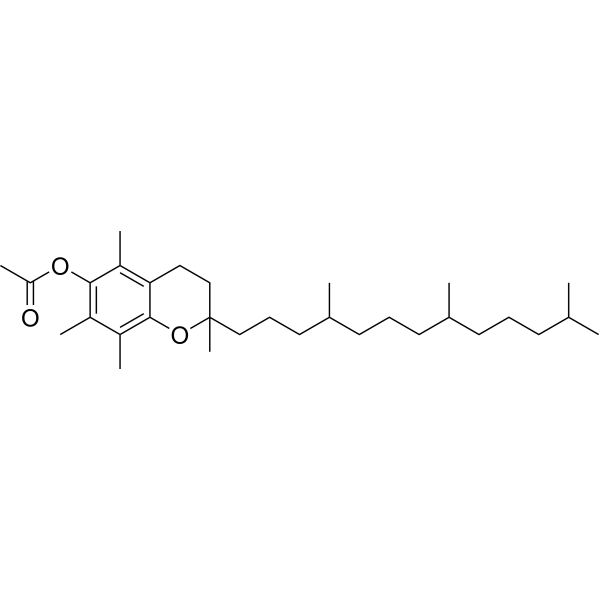
Physicochemical Properties
| Molecular Formula | C31H52O3 |
| Molecular Weight | 472.7428 |
| Exact Mass | 472.391 |
| CAS # | 7695-91-2 |
| Related CAS # | D-α-Tocopherol acetate;58-95-7;DL-α-Tocopherol acetate;52225-20-4 |
| PubChem CID | 2117 |
| Appearance | Colorless to light yellow viscous liquid |
| Density | 0.9±0.1 g/cm3 |
| Boiling Point | 485.3±0.0 °C at 760 mmHg |
| Melting Point | -28ºC |
| Flash Point | 235.6±24.7 °C |
| Vapour Pressure | 0.0±1.2 mmHg at 25°C |
| Index of Refraction | 1.488 |
| LogP | 12.07 |
| Hydrogen Bond Donor Count | 0 |
| Hydrogen Bond Acceptor Count | 3 |
| Rotatable Bond Count | 14 |
| Heavy Atom Count | 34 |
| Complexity | 602 |
| Defined Atom Stereocenter Count | 0 |
| SMILES | 0 |
| InChi Key | ZAKOWWREFLAJOT-UHFFFAOYSA-N |
| InChi Code | InChI=1S/C31H52O3/c1-21(2)13-10-14-22(3)15-11-16-23(4)17-12-19-31(9)20-18-28-26(7)29(33-27(8)32)24(5)25(6)30(28)34-31/h21-23H,10-20H2,1-9H3 |
| Chemical Name | [2,5,7,8-tetramethyl-2-(4,8,12-trimethyltridecyl)-3,4-dihydrochromen-6-yl] acetate |
| HS Tariff Code | 2934.99.9001 |
| Storage |
Powder-20°C 3 years 4°C 2 years In solvent -80°C 6 months -20°C 1 month |
| Shipping Condition | Room temperature (This product is stable at ambient temperature for a few days during ordinary shipping and time spent in Customs) |
Biological Activity
| ln Vivo | (±)-alpha-tocopheryl acetate ((±)-vitamin E acetate) (oral; 600 mg/kg, 1200 mg/kg, 1800 mg/kg; 15, 30, and 45 days) demonstrated considerable High complement activity[1]. (±)-α-Tocopherol acetate (orally; 600 mg/kg, 1200 mg/kg, 1800 mg/kg; 15, 30, and 45 days) promotes nonspecific immunity in sea bream after 30 days of in vivo fish delivery system. Diet (1200 mg/kg) [1]. |
| Animal Protocol |
Animal/Disease Models: Gilthead seabream (Sparus aurata L.) [1] Doses: 600 mg/kg, 1200 mg/kg, 1800 mg/kg Route of Administration: oral; 600 mg/kg, 1200 mg/kg, 1800 mg/kg kg; 15-day, 30-day and 45-day Experimental Results: positively correlated with serum α-tocopherol levels, and the increase is related to dose and time of use. They did not show an enhancement in any immune parameter, while the specific growth rate of fish fed the diet supplemented with 1200 mg/kg was slightly higher (but not statistically significant) than that of fish fed the other diets. After 30 and 45 days, dietary intake of 1200 mg/kg enhanced serum hemolytic activity and phagocytosis of head kidney leukocytes, but leukocyte migration and respiratory burst activity were not affected. Does not cause immune stimulation at 1800 mg/kg. |
| References |
[1]. High dietary intake of alpha-tocopherol acetate enhances the non-specific immune response of gilthead seabream (Sparus aurata L.). Fish Shellfish Immunol. 2000 May;10(4):293-307. |
| Additional Infomation |
DL-alpha-Tocopherol acetate is a tocol. DL-alpha-Tocopherol acetate has been reported in Senegalia catechu with data available. Vitamin E Acetate is the acetate ester of a fat-soluble vitamin with potent antioxidant properties. Considered essential for the stabilization of biological membranes (especially those with high amounts of polyunsaturated fatty acid), vitamin E is a generic name for a group of compounds known as tocopherols and tocotrienols (tocols). This agent is a potent peroxyl radical scavenger and inhibits noncompetitively cyclooxygenase activity in many tissues, resulting in a decrease in prostaglandin production. Vitamin E also inhibits angiogenesis and tumor dormancy through suppressing vascular endothelial growth factor (VEGF) gene transcription. (NCI04) A natural tocopherol and one of the most potent antioxidant tocopherols. It exhibits antioxidant activity by virtue of the phenolic hydrogen on the 2H-1-benzopyran-6-ol nucleus. It has four methyl groups on the 6-chromanol nucleus. The natural d form of alpha-tocopherol is more active than its synthetic dl-alpha-tocopherol racemic mixture. See also: Alpha-Tocopherol Acetate (annotation moved to). |
Solubility Data
| Solubility (In Vitro) | DMSO : ~100 mg/mL (~211.53 mM) |
| Solubility (In Vivo) |
Solubility in Formulation 1: 2.5 mg/mL (5.29 mM) in 10% DMSO + 40% PEG300 + 5% Tween80 + 45% Saline (add these co-solvents sequentially from left to right, and one by one), suspension solution; with sonication. For example, if 1 mL of working solution is to be prepared, you can add 100 μL of 25.0 mg/mL clear DMSO stock solution to 400 μL PEG300 and mix evenly; then add 50 μL Tween-80 to the above solution and mix evenly; then add 450 μL normal saline to adjust the volume to 1 mL. Preparation of saline: Dissolve 0.9 g of sodium chloride in 100 mL ddH₂ O to obtain a clear solution. Solubility in Formulation 2: 2.5 mg/mL (5.29 mM) in 10% DMSO + 90% (20% SBE-β-CD in Saline) (add these co-solvents sequentially from left to right, and one by one), suspension solution; with ultrasonication. For example, if 1 mL of working solution is to be prepared, you can add 100 μL of 25.0 mg/mL clear DMSO stock solution to 900 μL of 20% SBE-β-CD physiological saline solution and mix evenly. Preparation of 20% SBE-β-CD in Saline (4°C,1 week): Dissolve 2 g SBE-β-CD in 10 mL saline to obtain a clear solution. Solubility in Formulation 3: ≥ 2.5 mg/mL (5.29 mM) (saturation unknown) in 10% DMSO + 90% Corn Oil (add these co-solvents sequentially from left to right, and one by one), clear solution. For example, if 1 mL of working solution is to be prepared, you can add 100 μL of 25.0 mg/mL clear DMSO stock solution to 900 μL of corn oil and mix evenly. (Please use freshly prepared in vivo formulations for optimal results.) |
| Preparing Stock Solutions | 1 mg | 5 mg | 10 mg | |
| 1 mM | 2.1153 mL | 10.5766 mL | 21.1533 mL | |
| 5 mM | 0.4231 mL | 2.1153 mL | 4.2307 mL | |
| 10 mM | 0.2115 mL | 1.0577 mL | 2.1153 mL |