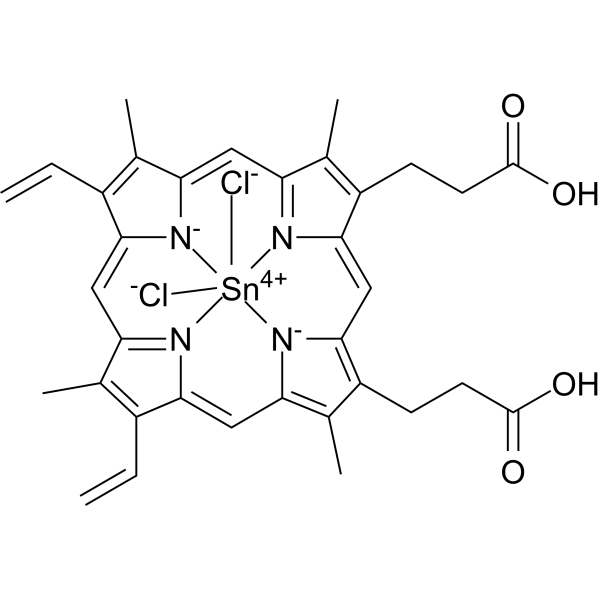
Tin-protoporphyrin IX (SnPPIX) is a novel and potent Heme oxygenase-1 (HO-1) inhibitor that can sensitize pancreatic ductal adenocarcinoma (PDAC) tumors to chemotherapy in mice model.
Physicochemical Properties
| Molecular Formula | C₃₄H₃₂CL₂N₄O₄SN |
| Molecular Weight | 750.26 |
| Exact Mass | 754.113 |
| Elemental Analysis | C, 54.43; H, 4.30; Cl, 9.45; N, 7.47; O, 8.53; Sn, 15.82 |
| CAS # | 14325-05-4 |
| PubChem CID | 73755113 |
| Appearance | Brown to reddish brown solid powder |
| Boiling Point | 849.3±75.0 °C at 760 mmHg |
| Flash Point | 467.5±37.1 °C |
| Vapour Pressure | 0.0±3.3 mmHg at 25°C |
| LogP | 4.753 |
| Hydrogen Bond Donor Count | 2 |
| Hydrogen Bond Acceptor Count | 8 |
| Rotatable Bond Count | 8 |
| Heavy Atom Count | 43 |
| Complexity | 1380 |
| Defined Atom Stereocenter Count | 3 |
| SMILES | CC\1=C(C2=CC3=C(C(=C([N-]3)/C=C\4/C(=C(/C(=C/C5=C(C(=C([N-]5)/C=C1\[N-]2)C=C)C)/[N-]4)C=C)C)C)CCC(=O)O)CCC(=O)O.[Sn+4] |
| InChi Key | VWEYNEFKXXWVHZ-IBPJAKCHSA-N |
| InChi Code | InChI=1S/C34H32N4O4.Sn/c1-7-21-17(3)25-13-26-19(5)23(9-11-33(39)40)31(37-26)16-32-24(10-12-34(41)42)20(6)28(38-32)15-30-22(8-2)18(4)27(36-30)14-29(21)35-25;/h7-8,13-16H,1-2,9-12H2,3-6H3,(H,39,40)(H,41,42);/q-4;+4/b25-13-,26-13?,27-14?,28-15-,29-14-,30-15?,31-16?,32-16?; |
| Chemical Name | 3-[(4Z,10Z,14Z)-18-(2-carboxyethyl)-7,12-bis(ethenyl)-3,8,13,17-tetramethylporphyrin-21,22,23,24-tetraid-2-yl]propanoic acid;tin(4+) |
| Synonyms | Tinprotoporphyrin IX; Tin protoporphyrin IX; Sn-heme; Sn Protoporphyrin; tin(4+) ion 10,14-bis(2-carboxyethyl)-4,19-diethenyl-5,9,15,20-tetramethyl-21,22,23,24-tetraazapentacyclo[16.2.1.1^{3,6}.1^{8,11}.1^{13,16}]tetracosa-1(20),2,4,6,8,10,12,14,16,18-decaene-21,22,23,24-tetraide; Tin-protoporphyrin; tin(4+) ion 10,14-bis(2-carboxyethyl)-4,19-diethenyl-5,9,15,20-tetramethyl-21,22,23,24-tetraazapentacyclo(16.2.1.1^(3,6).1^(8,11).1^(13,16))tetracosa-1(20),2,4,6,8,10,12,14,16,18-decaene-21,22,23,24-tetraide; SnPP IX; ...; 14325-05-4;Tin protoporphyrin IX |
| HS Tariff Code | 2934.99.9001 |
| Storage |
Powder-20°C 3 years 4°C 2 years In solvent -80°C 6 months -20°C 1 month Note: Please store this product in a sealed and protected environment, avoid exposure to moisture. |
| Shipping Condition | Room temperature (This product is stable at ambient temperature for a few days during ordinary shipping and time spent in Customs) |
Biological Activity
| Targets | Metalloporphyrin |
| ln Vitro | The proliferation of Capan-1 and CD18/HPAF cells was dramatically suppressed by tin protoporphyrin IX (20 μM, 50 μM; 24 hours). On the other hand, except for at 50 μM concentration, tin protoporphyrin IX dichloride did not significantly affect PDAC cell growth under any exposure circumstances [1]. |
| ln Vivo | Gemcitabine, either alone or in combination, significantly decreased pancreatic tumor weight (P < 0.05), decreased metastasis, and enhanced the effectiveness of gemcitabine treatment when tin protoporphyrin IX (ip; 5 mg/kg; days 0, 7, 15, and 20) was administered [1]. |
| Cell Assay |
Cell Viability Assay[1] Cell Types: Capan-1, CD18/HPAF, PDAC Cell Tested Concentrations: 20 μM, 50 μM Incubation Duration: 24 or 72 hrs (hours) Experimental Results: Inhibited Capan-1 and CD18/HPAF cell proliferation and inhibited PDAC cell growth 50μM. |
| Animal Protocol |
Animal/Disease Models: Male and female athymic nude mice, PDAC cell-derived xenograft tumors [1] Doses: 5 mg/kg Route of Administration: intraperitoneal (ip) injection; intraperitoneal (ip) injection. Results on days 1, 4, 6, 8, 11, 13, 15, 18 and 20: Inhibited tumor growth and sensitized tumors to chemotherapy (gemcitabine). In vivo mice model studies: Male and female 6–8 week old athymic nude mice were maintained in pathogen-free conditions in the institutional animal facility (n = 6 for each group). PDAC cell-derived xenograft tumors were established by orthotopic implantation of 0.5 × 10⁶ luciferase tagged, CD18/HPAF cells suspended in 50 µl PBS into the mouse pancreas. Ten days post implantation, animals were randomized into 4 groups with 6 animals in each group based on luciferase imaging by in vivo imaging system (IVIS) spectrum after intraperitoneal injection of D-luciferin. Group 1 was comprised of control mice given PBS as vehicle control. Group 2 was given gemcitabine alone (50 mg/kg) at days 1, 8, and 15. Group 3 was treated with Tin protoporphyrin IXSnPP alone (5 mg/kg) at days 1, 4, 6, 8, 11, 13, 15, 18, and 20. Group 4 received gemcitabine and Tin protoporphyrin IX/SnPP combination therapy. During treatment period, mice were imaged weekly by IVIS after intraperitoneal injection of D-luciferin to monitor the tumor growth and metastasis (0, 7, 15, and 20 days of treatment). The emitted photons were calculated using Living Image software version 4.4. After 4 weeks of treatment, all the animals were sacrificed by asphyxiation with CO2 followed by cervical dislocation. Tumors were removed and weighed. Distant organs were carefully screened for metastatic sites. The primary tumors and metastatic lesions were collected for RNA isolation, immunohistochemistry (IHC), and protein analysis.[1] |
| References |
[1]. Enhancing responsiveness of pancreatic cancer cells to gemcitabine treatment under hypoxia by heme oxygenase-1 inhibition.Transl Res. 2019 May;207:56-69. |
| Additional Infomation | Pancreatic ductal adenocarcinoma (PDAC) is one of the most aggressive malignancies and has one of the worst prognoses leading to a meager 5-year survival rate of ∼8%. Chemotherapy has had limited success in extending the life span of patients with advanced PDAC due to poor tumor perfusion and hypoxia-induced resistance. Hypoxia reprograms the gene expression profile and upregulates the expression of multiple genes including heme oxygenase-1 (HO-1), which provide survival advantage to PDAC cells. However, the relationships between HO-1, hypoxia, and response to chemotherapy is unclear. Our results showed that hypoxia upregulates the expression of HO-1 in PDAC cells, and HO-1 inhibition using the HO-1 inhibitors zinc protoporphyrin, tin protoporphyrin IX (SnPP), and HO-1 knockout using CRISPR/Cas9 suppresses the proliferation of PDAC cells under hypoxia and sensitize them to gemcitabine under in vitro conditions. Treating orthotopic tumors with SnPP, or SnPP in combination with gemcitabine, significantly reduced the weight of pancreatic tumors (P < 0.05), decreased metastasis and improved the efficacy of gemcitabine treatment (P < 0.05). Mechanistically, inhibition of HO-1 increased the production of reactive oxygen species as demonstrated by increased dihydroethidium, and Mitosox, disrupted glutathione cycle, and enhanced apoptosis. There was significant increase in cleaved caspase-3 staining in tumors after combined treatment with SnPP and gemcitabine comparing to control or gemcitabine alone. In addition, inhibiting HO-1 reduced expression of stemness markers (CD133, and CD44) as compared to control or gemcitabine. Overall, our study may present a novel therapeutic regimen that might be adopted for the treatment of PDAC patients.[1] |
Solubility Data
| Solubility (In Vitro) |
0.1 M NaOH : ~14.29 mg/mL (~19.05 mM) 1M NaOH : 5 mg/mL (~6.66 mM) DMF : 1 mg/mL (~1.33 mM) DMSO : ~0.5 mg/mL (~0.67 mM) |
| Solubility (In Vivo) |
Note: Listed below are some common formulations that may be used to formulate products with low water solubility (e.g. < 1 mg/mL), you may test these formulations using a minute amount of products to avoid loss of samples. Injection Formulations (e.g. IP/IV/IM/SC) Injection Formulation 1: DMSO : Tween 80: Saline = 10 : 5 : 85 (i.e. 100 μL DMSO stock solution → 50 μL Tween 80 → 850 μL Saline) *Preparation of saline: Dissolve 0.9 g of sodium chloride in 100 mL ddH ₂ O to obtain a clear solution. Injection Formulation 2: DMSO : PEG300 :Tween 80 : Saline = 10 : 40 : 5 : 45 (i.e. 100 μL DMSO → 400 μLPEG300 → 50 μL Tween 80 → 450 μL Saline) Injection Formulation 3: DMSO : Corn oil = 10 : 90 (i.e. 100 μL DMSO → 900 μL Corn oil) Example: Take the Injection Formulation 3 (DMSO : Corn oil = 10 : 90) as an example, if 1 mL of 2.5 mg/mL working solution is to be prepared, you can take 100 μL 25 mg/mL DMSO stock solution and add to 900 μL corn oil, mix well to obtain a clear or suspension solution (2.5 mg/mL, ready for use in animals). Injection Formulation 4: DMSO : 20% SBE-β-CD in saline = 10 : 90 [i.e. 100 μL DMSO → 900 μL (20% SBE-β-CD in saline)] *Preparation of 20% SBE-β-CD in Saline (4°C,1 week): Dissolve 2 g SBE-β-CD in 10 mL saline to obtain a clear solution. Injection Formulation 5: 2-Hydroxypropyl-β-cyclodextrin : Saline = 50 : 50 (i.e. 500 μL 2-Hydroxypropyl-β-cyclodextrin → 500 μL Saline) Injection Formulation 6: DMSO : PEG300 : castor oil : Saline = 5 : 10 : 20 : 65 (i.e. 50 μL DMSO → 100 μLPEG300 → 200 μL castor oil → 650 μL Saline) Injection Formulation 7: Ethanol : Cremophor : Saline = 10: 10 : 80 (i.e. 100 μL Ethanol → 100 μL Cremophor → 800 μL Saline) Injection Formulation 8: Dissolve in Cremophor/Ethanol (50 : 50), then diluted by Saline Injection Formulation 9: EtOH : Corn oil = 10 : 90 (i.e. 100 μL EtOH → 900 μL Corn oil) Injection Formulation 10: EtOH : PEG300:Tween 80 : Saline = 10 : 40 : 5 : 45 (i.e. 100 μL EtOH → 400 μLPEG300 → 50 μL Tween 80 → 450 μL Saline) Oral Formulations Oral Formulation 1: Suspend in 0.5% CMC Na (carboxymethylcellulose sodium) Oral Formulation 2: Suspend in 0.5% Carboxymethyl cellulose Example: Take the Oral Formulation 1 (Suspend in 0.5% CMC Na) as an example, if 100 mL of 2.5 mg/mL working solution is to be prepared, you can first prepare 0.5% CMC Na solution by measuring 0.5 g CMC Na and dissolve it in 100 mL ddH2O to obtain a clear solution; then add 250 mg of the product to 100 mL 0.5% CMC Na solution, to make the suspension solution (2.5 mg/mL, ready for use in animals). Oral Formulation 3: Dissolved in PEG400 Oral Formulation 4: Suspend in 0.2% Carboxymethyl cellulose Oral Formulation 5: Dissolve in 0.25% Tween 80 and 0.5% Carboxymethyl cellulose Oral Formulation 6: Mixing with food powders Note: Please be aware that the above formulations are for reference only. InvivoChem strongly recommends customers to read literature methods/protocols carefully before determining which formulation you should use for in vivo studies, as different compounds have different solubility properties and have to be formulated differently. (Please use freshly prepared in vivo formulations for optimal results.) |
| Preparing Stock Solutions | 1 mg | 5 mg | 10 mg | |
| 1 mM | 1.3329 mL | 6.6644 mL | 13.3287 mL | |
| 5 mM | 0.2666 mL | 1.3329 mL | 2.6657 mL | |
| 10 mM | 0.1333 mL | 0.6664 mL | 1.3329 mL |